
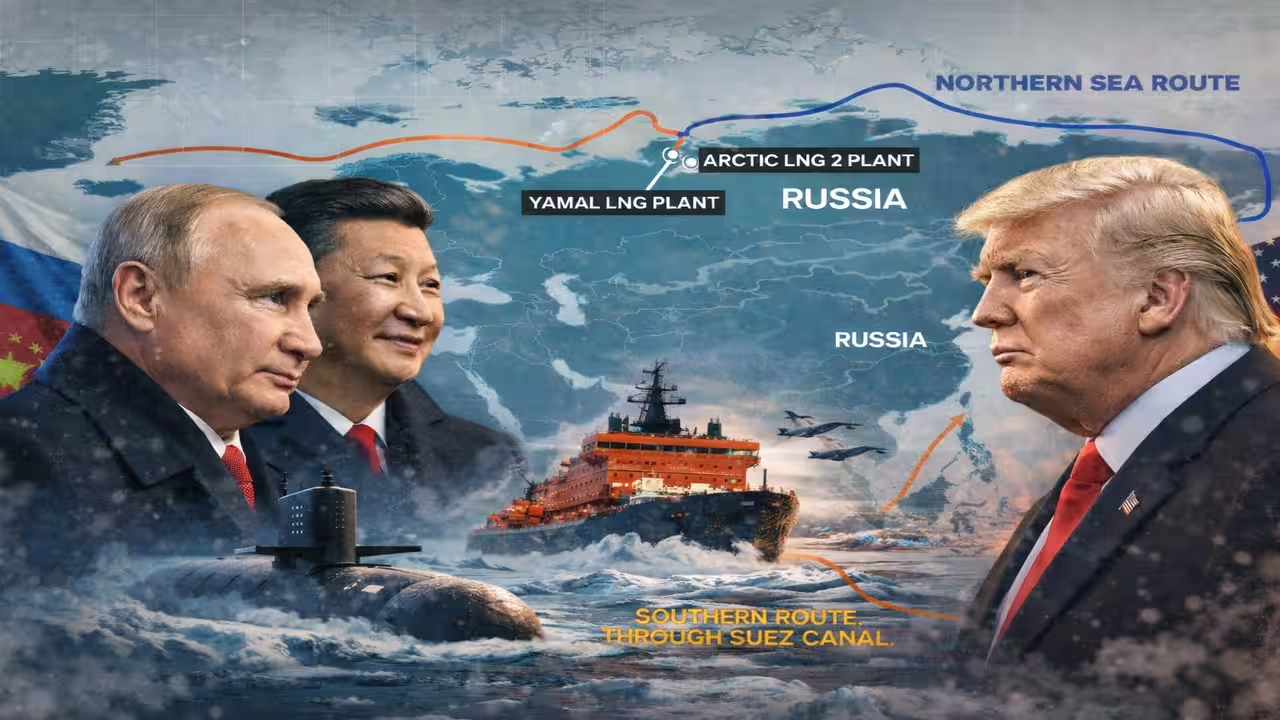
Russia is betting tens of billions of dollars on the Northern Sea Route (NSR) as a strategic alternative to global trade chokepoints like the Suez Canal, but Western sanctions and infrastructure gaps are constraining its ambitions. The Arctic shipping lane stretches some 5,600 kilometers, crossing five Arctic seas and potentially shortening voyages between Europe and Asia by seven to ten days . For Moscow, the route offers more than commercial advantage: it is a tool to bypass sanctions, redirect energy exports to Asia, and assert sovereignty over a region increasingly contested by global powers.
President Vladimir Putin has declared that Russia aims to make navigation along the Northern Sea Route year-round, a goal that would transform the seasonal Arctic passage into a reliable international corridor . Speaking at the Eastern Economic Forum in Vladivostok in September 2026, Putin framed the Trans-Arctic Transport Corridor—running from St. Petersburg and Murmansk through the NSR to Vladivostok and onward to Asia-Pacific nations—as a guarantee of “flexibility and security of international supplies” amid global shipping risks . He projected that cargo traffic along the corridor would at least double by 2030 to 70 million tons annually .
To achieve this, Russia is expanding its icebreaker fleet, satellite constellation, and port infrastructure. Presidential adviser Anton Kobyakov noted that Russia already operates 42 ice-class vessels, including eight nuclear-powered icebreakers, and plans to build another 14 by 2030 . The latest Project 22220 icebreakers can escort vessels of up to 100,000 tons through thick Arctic ice, while the upcoming Rossiya-class super-icebreaker, with 120 megawatts of power, is expected to launch in 2028 . Russia is also investing in ARC7 ice-class dry cargo vessels and dredging fleets to support year-round operations .
However, the reality on the water tells a more complicated story. Cargo volumes along the NSR declined for the second consecutive year in 2025, falling 2.3 percent to 37.02 million tons, far below the 80 million tons originally targeted for 2024 . Hydrocarbons dominate the route—LNG, oil, and gas condensate account for 83 percent of all cargo, with the vast majority originating from the Yamal LNG and Arctic LNG 2 projects in the Ob Bay region . The port of Sabetta alone handles more than 90 percent of NSR port turnover, concentrating the route’s fortunes in a single node .
Sanctions have sliced into Russia’s Arctic energy logistics. LNG shipments fell 2.7 percent in 2025, partly due to scheduled maintenance at Yamal LNG and the loss of the Arc7 carrier Christophe de Margerie after US sanctions in December 2024 . The flagship Arctic LNG 2 project, which began routine exports in August 2025 and has since ramped up production to record levels, remains only about 50 percent complete, and plans for successor projects—Arctic LNG 1 and 3, and Ob LNG—have been postponed indefinitely . The EU’s planned ban on Russian LNG imports in 2027 threatens to further squeeze the route’s core cargo base, potentially forcing Novatek to acquire 32 to 40 additional tankers to reroute exports to Asia, a difficult proposition under sanctions .
Russia is responding with a “shadow fleet” strategy. Bloomberg reported that Arctic LNG 2 now has access to at least 20 vessels, most part of a shadow fleet, up from just 11 at the end of 2025 . A 19-year-old tanker, the Arctic Express, recently loaded sanctioned fuel from the Saam floating storage unit in Murmansk, the latest sign of Moscow’s efforts to keep exports flowing despite restrictions . Ukrainian Navy spokesman Dmytro Pletenchuk noted that Russia is also using warships to escort merchant vessels in the Arctic, protecting economic interests by military means .
Not all segments are contracting. Oil product shipments surged 43 percent to 1.27 million tons in 2025, gas condensate rose 17 percent, and ore concentrate flows jumped more than 13-fold, driven by a single 330,000-ton iron ore shipment from Murmansk to China . Container shipping also expanded modestly, with 17 vessels carrying 321,000 tons between August and October, including the first-ever container ship arrival from China to Murmansk in August 2026 . Russian Foreign Minister Sergey Lavrov highlighted this milestone as evidence that international cooperation on the NSR is bearing fruit .
Analysts remain skeptical about the route’s near-term trajectory. Mikhail Grigoryev, head of the consultancy Gecon, said cargo volumes are unlikely to exceed 2025 levels this year due to a lack of growth drivers, and that Russia needs deeper cooperation with other countries to fully utilize the route . The EU is already examining whether European shipyards servicing Arc7 LNG icebreakers undermine its sanctions policy, with a European Parliament question demanding the removal of transition periods for such services .
For Putin, the NSR remains a long-term strategic bet. His instructions to the government call for a comprehensive development plan through 2050, the establishment of international consortiums with “friendly states,” and a financial model for the Trans-Arctic corridor . The vision is grand: an Arctic shipping artery that could one day rival Suez, insulated from the chokepoints and geopolitical risks that plague traditional routes. But with sanctions biting, cargo volumes shrinking, and the route still dependent on a narrow band of hydrocarbon exports, Russia’s Arctic gamble faces its hardest test yet.