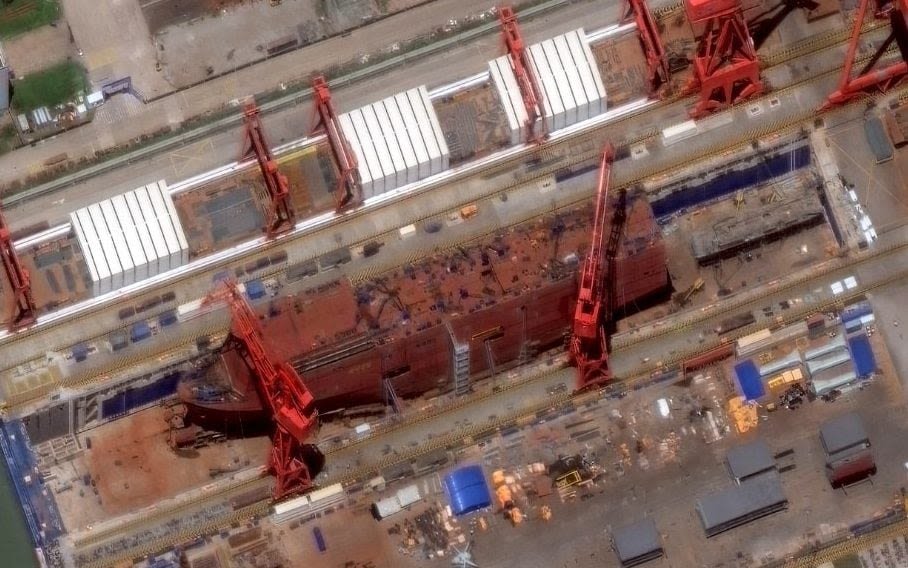
China is reportedly building the world’s first mothership specifically designed to launch and recover large submarine drones, a development that could significantly extend the operational reach of its growing fleet of uncrewed underwater vehicles. Satellite images analyzed by defense analysts indicate that a roughly 200-meter (656-foot) vessel is under construction at the Hudong-Zhonghua shipyard in Shanghai, a facility previously used to build large amphibious assault ships. According to assessments published by Naval News and corroborated by independent imagery analysts, the ship features an unusual configuration with a large internal hangar and a stern opening that appears designed to launch, recover, and maintain extra-extra-large uncrewed underwater vehicles (XXLUUVs).
The vessel is believed to be capable of carrying at least four of China’s massive autonomous submarines, which are the largest of their kind known to exist. These uncrewed underwater drones, first revealed in January 2025, measure between 35 and 45 meters (115 to 148 feet) in length, making them six to eight times larger than the U.S. Navy’s Boeing Orca XLUUV, which measures approximately 16 meters (51 feet). The sheer scale of these Chinese vehicles has prompted analysts to coin the term “extra-extra-large uncrewed undersea vehicle” (XXLUUV) to distinguish them from Western designs. Two distinct models have been observed during testing in the South China Sea near Hainan Island, according to reports.
The mothership’s design includes a wet well-deck at the stern with 12 vertical jack-up mechanisms and a large transport cradle that can be lowered below the vessel’s hull to deploy or retrieve the underwater drones. A substantial internal hangar forward of the well-deck is likely intended to store the vehicles when not in use, keeping them protected and out of the water. Independent defense analyst H.I. Sutton, who specializes in underwater warfare, described the vessel as “a special drone submarine mothership,” noting that the size and configuration make a civilian or research explanation unconvincing. The ship also appears to have a separate hangar near its bow that could accommodate a helicopter.
The strategic implications of such a platform are substantial. By serving as a mobile floating base, the mothership could transport XXLUUVs thousands of miles from Chinese shores, allowing the drones to conserve their own range for missions rather than traveling long distances from port. Naval News assessed that these uncrewed submarines appear capable of carrying out missions over long distances, potentially including deployment off the U.S. West Coast. The drones are believed to be designed for long-range covert operations, and their much larger size compared to Western counterparts suggests they could carry significantly heavier payloads, potentially including heavyweight torpedoes and other weapons. Beyond combat roles, such vehicles could conduct intelligence, surveillance, and reconnaissance missions, remaining submerged for extended periods to monitor maritime traffic or collect acoustic intelligence.
China has not publicly acknowledged the vessel’s existence or its purpose. The development comes amid a broader naval expansion in which China now operates approximately 405 warships compared to the U.S. Navy’s 295, according to estimates cited in multiple reports. China is also the world’s largest producer of warships, with shipbuilding capacity estimated to be vastly greater than that of the United States. The construction of a dedicated submarine drone mothership suggests that China’s XXLUUV program is shifting from experimental testing toward operational deployment, potentially giving Beijing a capability no other navy currently possesses. Analysts note that while the vessels’ combat effectiveness will ultimately depend on autonomy and sensor integration, the platform’s existence signals a significant investment in undersea warfare capabilities that could affect strategic calculations in the Pacific and beyond.