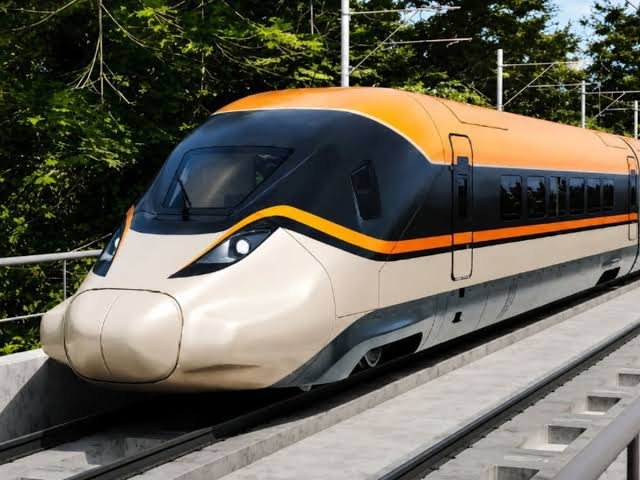
India’s high-speed rail vision has reached a historic turning point with the development of the nation’s first indigenous bullet train set (B28), manufactured in Bengaluru at Bharat Earth Movers Limited (BEML) for the iconic Mumbai-Ahmedabad High-Speed Rail corridor. Combining high-end Japanese Shinkansen-derived engineering standards tailored specifically to Indian conditions, this indigenous high-speed train delivers rapid transit capability paired with world-class interior comfort, inclusive passenger facilities, and cutting-edge railway technology.
High-Speed Performance and Aerodynamic Engineering
At the core of the bullet train’s capabilities is its extraordinary operational efficiency. The train is engineered for a maximum testing speed of 280 kmph, while operating at a sustained operating speed of 249 kmph. Measuring roughly 202 metres in total length, the initial configuration features an 8-coach composition consisting of 4 powered motor cars and 4 trailer cars, accommodating 557 passengers. To handle extreme high-speed travel, the train utilizes an aerodynamic nose and body design optimized using Computational Fluid Dynamics (CFD). This design minimizes atmospheric drag, prevents turbulence, and effectively mitigates intense air pressure waves when entering tunnels. Furthermore, the train features modular trainset coupling capability, allowing two 8-car configurations to join together into a unified 16-car formation during peak travel demands.
Ergonomic Interiors and Passenger Facilities
Stepping inside the cabin reveals an environment meticulously tailored around Indian anthropometric standards for maximum ergonomics and travel luxury. The interior is divided into 7 standard-class coaches with 3×2 seating and 1 executive-class coach with 2×2 seating, each featuring generous legroom and ergonomically designed seats. Passengers can enjoy continuous scenic views through wide panoramic windows at every seat row, illuminated by warm, glare-free ambient LED interior lighting. To satisfy heavy luggage requirements, coaches come equipped with spacious overhead baggage racks alongside dedicated floor-mounted luggage stands for oversized suitcases. Passengers remain connected through individual at-seat electrical charging sockets for laptops and mobile devices, complemented by a preloaded Wi-Fi infotainment system streaming media straight to passenger devices. Travel sanitation is raised to world standards with eco-friendly modern bio-digester toilets engineered for minimal effluent discharge, while smooth transitions between cars are guaranteed by sealed, single-piece gangways.
Universal Accessibility (Divyangjan-Friendly Facilities)
Inclusive design forms a core principle of India’s high-speed train network. To allow seamless boarding, the coaches feature platform-level floor alignment paired with automated retractable footsteps integrated into doors, eliminating dangerous gaps between the train car and station platform. For passengers with reduced mobility (PRM) and Divyangjan travelers, coaches offer wide wheelchair-accessible doors and dedicated seating areas. These are paired with specialized wheelchair-friendly accessible toilets and Braille-enabled information signage installed throughout the interior panels to aid visually impaired commuters.
Advanced Propulsion, HVAC, and Acoustic Technology
The operational technology beneath the car body ensures passenger safety, ride stability, and overall energy management. Propulsion is supplied via a 25 kV, 50 Hz single-phase AC traction system backed by a heavy compound catenary network. Environmental sustainability is maximized through a regenerative braking system, which captures kinetic energy during deceleration and feeds electricity back into the grid. Climate control is managed by dual high-capacity HVAC units per car, engineered to maintain precise temperature and humidity levels inside the sealed cabin regardless of outside heat. Cabin noise and vibration are drastically reduced using advanced soundproofing insulation, acoustic floor coatings, and protective aerodynamic bogie skirts. Finally, driver safety is managed via intelligent onboard control systems in dual end-cabs connected to a multilingual LCD passenger information system, public address audio announcements, and emergency crew talkback units placed in all vestibules.