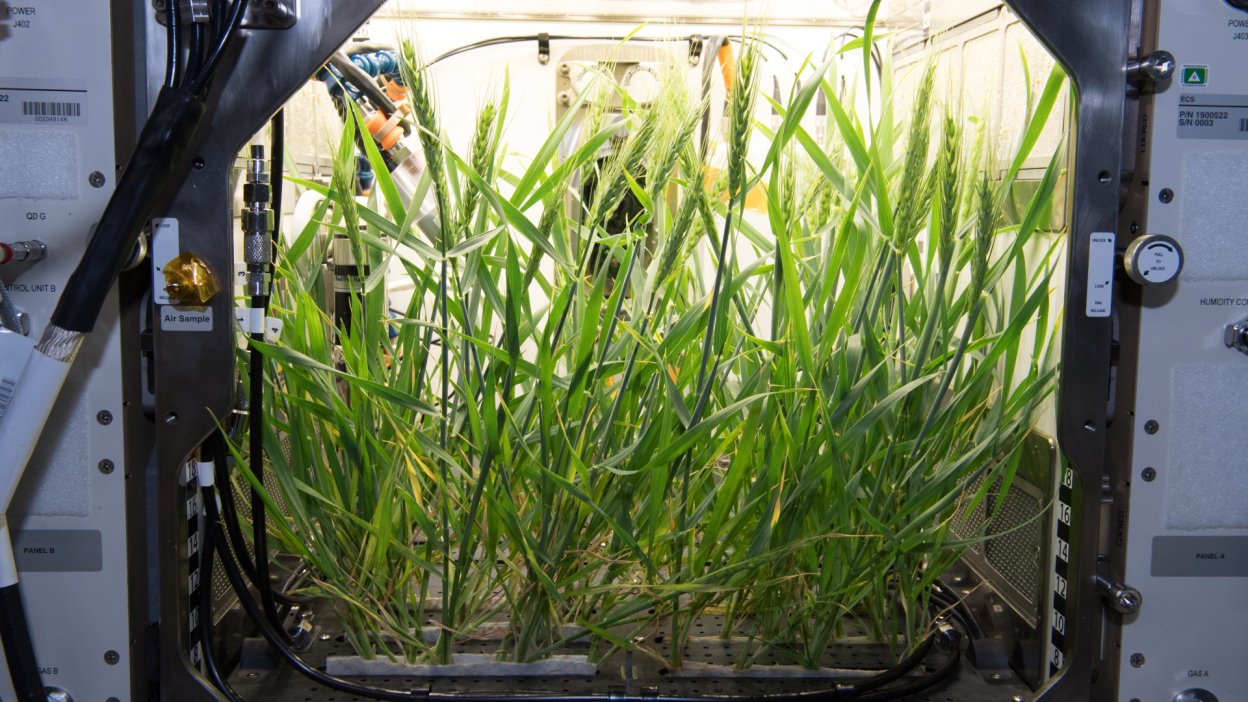
The PESTO (Photosynthesis Experiment and System Testing and Operations) experiment represents a landmark investigation conducted by NASA aboard the International Space Station (ISS). Designed to explore how crops behave in microgravity, the project focused on evaluating plant growth, photosynthetic performance, cellular changes, and life-support viability using USU Apogee dwarf wheat (Triticum aestivum). As humanity looks toward extended spaceflight, understanding how plants adapt to orbital environments is essential for constructing sustainable, self-contained Controlled Ecological Life Support Systems (CELSS).
The primary objective of PESTO was to address a fundamental question in space biology: can crops effectively photosynthesize, grow, and regenerate atmospheric oxygen and food in microgravity without compromising their biochemical efficiency? To test this, NASA scientists utilized the Biomass Production System (BPS), a specialized hardware habitat featuring automated environmental controls, precise fluid distribution mechanisms, LED lighting, and active gas-exchange sensors. Over multiple growth cycles, researchers continuously measured net carbon exchange, photosynthetic electron transport rates, and canopy-level gas exchange to monitor real-time plant metabolism in spaceflight conditions.
One of the most striking outcomes of the PESTO experiment was the physical response of the crop. Researchers discovered that wheat plants grown in microgravity were approximately 10% taller than their ground-based Earth controls. On Earth, gravity exerts a constant mechanical stress that stimulates the production of rigid cell walls through structural polymers like lignin. In the microgravity environment of the ISS, the absence of downward gravitational force altered cell wall extensibility and structural tension. This reduction in gravitational loading allowed plant cells to elongate more freely, resulting in noticeably taller stalks and altered leaf morphology.
Beyond physical height, PESTO provided critical scientific insights into plant cellular structure and chloroplast organization. Microgravity led to subtle adaptations inside the leaf tissue, including modifications in chloroplast layout and thylakoid membrane arrangement. Laboratory analyses revealed modest reductions in specific photosynthetic sub-processes under saturating light and elevated carbon dioxide conditions, such as a 13% reduction in Photosystem II (PSII) activity and a 16% reduction in Photosystem I (PSI) activity. However, despite these microscopic subcellular variations, whole-canopy photosynthetic rates, overall carbon fixation, and gas exchange remained healthy and fully functional, proving that plants can effectively sustain primary metabolic processes in microgravity.
In addition to plant biology, the experiment served as a vital proving ground for advanced spaceflight agricultural hardware. Operating a garden in space presents severe fluid dynamics challenges, as liquids do not flow or drain naturally without gravity. The BPS successfully overcame fluid distribution barriers, delivering water and nutrient solution directly to the root modules using capillary action and controlled porous media. This verified that automated moisture and nutrient management systems could maintain proper root-zone aeration and prevent root hypoxia in microgravity.
The implications of the PESTO experiment extend far beyond orbital science. The successful growth and adaptation of dwarf wheat demonstrated that crop cultivation can serve as a dependable backbone for deep-space missions to the Moon and Mars. Space-grown crops do not merely provide fresh, high-density nutrition for astronauts; they act as living bio-reactors that absorb exhaled carbon dioxide, release breathable oxygen, and assist in water recycling systems. By confirming that microgravity does not impede macro-level plant development or crop viability, PESTO established fundamental engineering and biological protocols that continue to inform modern space farming facilities like NASA’s Veggie and the Advanced Plant Habitat (APH).