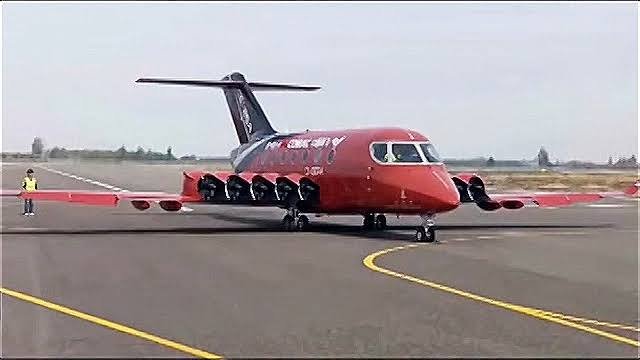
In a historic milestone for sustainable aviation, China has successfully completed the world’s first crewed flight of a 10-tonne electric commercial aircraft, the CE-25A. Taking place on November 14, 2026, in Binzhou, located in eastern China’s Shandong Province, this maiden piloted voyage signals a major breakthrough in transitioning battery-powered flight from lightweight experimental prototypes to viable, multi-passenger regional airliners. The test flight carried two pilots and one flight-test engineer on board, marking the first time human crew members operated the heavy electric airframe under real-world conditions. According to official statements, the entire test session spanned 57 minutes and 46 seconds from start to finish, with the aircraft spending 16 minutes and 38 seconds airborne and covering a total distance of 60.4 kilometers. Throughout the flight, the aircraft operated smoothly, and all flight-control, propulsion, and onboard telemetry indicators met or exceeded engineering expectations.
The CE-25A is the product of an ambitious multi-sector consortium spearheaded by the Commercial Aircraft Corporation of China (COMAC), the state-owned aerospace giant behind the C919 narrow-body jet. To solve the immense weight-to-power challenges that have historically grounded large electric airplanes, COMAC partnered with Contemporary Amperex Technology Co., Limited (CATL)—the world’s largest manufacturer of electric vehicle and aviation batteries—alongside Shanghai Jiao Tong University and several specialized aerospace research institutions. By uniting premier airframe manufacturing, high-density battery cell chemistry, and cutting-edge academic aerodynamics, the consortium engineered an aircraft capable of lifting a maximum takeoff weight of 10 tonnes (approximately 22,046 pounds). Prior to putting humans in the cockpit, the development team followed a rigorous, safety-first validation protocol. The CE-25A completed its very first unmanned autonomous flight on February 2, 2026, and subsequently logged 19 successful unmanned autonomous flight validations to verify its flight-control software, structural integrity, and battery discharge behavior before clearing the aircraft for crewed operations.
Engineered specifically for short-haul intercity commuting and regional feeder routes, the CE-25A boasts performance metrics tailored to compete with regional turboprops and high-speed ground transit. The cabin is configured to accommodate up to 19 passengers, placing it squarely in the commuter airliner category. In terms of flight performance, the aircraft achieves a cruising speed of 300 kilometers per hour (186 mph), operates at a standard cruising altitude of 2,400 meters (roughly 7,874 feet), and delivers a maximum operational range of 400 kilometers (249 miles) on a single charge. Powered by electric propulsion systems utilizing electric ducted fans, the aircraft eliminates direct carbon dioxide and nitrogen oxide emissions during flight while drastically reducing acoustic noise signatures compared to conventional aviation turbine fuel engines. For point-to-point regional trips—such as island hopping, crossing mountainous terrain, or connecting secondary cities—a 400-kilometer range allows airlines to operate clean, low-maintenance shuttles without relying on expensive jet fuel.
From a regulatory standpoint, the CE-25A has already entered the formal certification pipeline, bringing commercial service closer to reality. The aircraft is being developed and tested in strict accordance with China’s CCAR-25 transport-category airworthiness regulations, which govern large commercial passenger airplanes. Even before the November piloted flight, the Civil Aviation Administration of China (CAAC) officially accepted COMAC’s application for a type certificate. While type-certificate acceptance represents a crucial institutional milestone, aviation regulators emphasize that it marks the beginning rather than the end of scrutiny. Before the CE-25A can carry fare-paying passengers, engineers and CAAC inspectors must conduct exhaustive, item-by-item reviews covering high-voltage battery fire safety, thermal runaway containment, propulsion redundancy, and extreme-weather reliability. Additionally, COMAC has yet to publicly disclose granular technical figures regarding the pack’s exact kilowatt-hour capacity, energy density, and charging turnaround times, which will ultimately dictate airline operating economics.
Globally, China’s achievement puts intense competitive pressure on Western aerospace pioneers racing to electrify regional aviation. Across the United States and Europe, several startups and established manufacturers have pursued electric and hybrid-electric commuter planes, yet most have either stalled at smaller weight classes or pivoted toward hybrid architectures due to battery weight constraints. For example, Israel’s nine-passenger Eviation Alice prototype demonstrated early promise but faced prolonged development pauses, while American firm Heart Aerospace redesigned its 36-seat ES-36 around a hybrid-electric powertrain to overcome pure-battery range limits. By successfully flying a pure-electric, 10-tonne, 19-seat airframe with a crew aboard, China has demonstrated an unmatched ability to translate its domestic dominance in lithium-ion battery supply chains directly into heavy aerospace engineering.
Looking ahead, the successful maiden piloted flight of the CE-25A represents a foundational step toward decarbonizing short-haul air travel and shaping the emerging low-altitude economy. Aviation accounts for a stubborn share of global greenhouse gas emissions, and short regional flights are widely considered the most practical proving ground for zero-emission propulsion before battery energy densities evolve enough for larger narrow-body jets. As the CE-25A progresses through further piloted test campaigns to verify its full 400-kilometer range and payload efficiency, it sets a new international benchmark for commercial electric flight, proving that battery-powered passenger airliners are no longer a distant concept, but an airborne reality.