China is accelerating its push to commercialize nuclear fusion energy, positioning itself as a leading contender in the global race to build an “artificial sun.” The country’s fusion program has moved beyond purely scientific research into large-scale engineering, with a clear focus on demonstrating net energy gain and eventually generating electricity. According to the Chinese Academy of Sciences, scientists at the Experimental Advanced Superconducting Tokamak (EAST) facility in Hefei, Anhui Province, set a new world record by generating and maintaining plasma at temperatures ten times hotter than the sun’s core. This breakthrough builds on previous milestones, including sustaining plasma at 100 million degrees Celsius for 1,066 seconds, a critical step toward achieving stable, long-pulse operation required for a practical reactor.
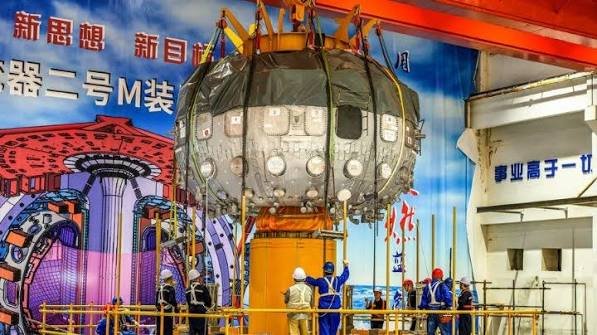
The centerpiece of China’s near-term strategy is the Burning Plasma Experimental Superconducting Tokamak (BEST), a next-generation device currently under construction in Hefei. Unlike EAST, which studies plasma physics without significant fusion reactions, BEST is designed to demonstrate actual “burning” of deuterium-tritium plasma and achieve net fusion power gain. The project aims to demonstrate fusion-based electricity generation by around 2030, a milestone often described as lighting humanity’s “first nuclear-fusion-powered lamp”. Engineering progress is already substantial: the main ring installation began in June 2026, with the vacuum vessel modules being hoisted into place, and completion of the main ring is expected by early 2027. The BEST project is targeting a fusion power output of 20 to 200 megawatts. The industrial supply chain is also mobilizing, with nearly 400 supplier units participating and initial contracts worth over 200 million yuan already fulfilled for core components like the vacuum vessel sectors.
Beyond BEST, China’s longer-term roadmap includes the China Fusion Engineering Demonstration Reactor (CFEDR), which is expected to begin construction around 2030 and be completed by approximately 2035, with demonstration power generation targeted for around 2040. This stepwise approach—from EAST to BEST to CFEDR—reflects a deliberate strategy to bridge the gap between experimental physics and commercial deployment. The state-led “national team,” represented by institutions like the Chinese Academy of Sciences and China National Nuclear Corporation, is pursuing a relatively conservative path based on low-temperature superconducting tokamaks, prioritizing engineering reliability and large-scale performance. The government’s commitment is evident in funding: between 2022 and 2025, China’s public investment in fusion reached approximately 5.45 billion euros, the highest among major economies, though its private sector investment lags significantly behind the United States.
A parallel and increasingly dynamic force is China’s private fusion sector, which is pursuing a more aggressive timeline. Companies like Star Torus Energy (星环聚能), Energy Singularity, and Nova Fusion are developing compact tokamaks using high-temperature superconducting magnets, aiming to reduce cost and accelerate commercialization. Star Torus Energy has outlined an ambitious schedule: begin construction of its NTST device in 2026, complete engineering validation by 2028, and build a commercial demonstration reactor by 2033—twelve years ahead of the national team’s commercial timeline. These startups are targeting a specific market: providing zero-carbon baseload power to artificial intelligence data centers, which require enormous and reliable electricity supplies. Nova Fusion, founded in 2025, has set a goal of achieving Q>1 (energy gain) by 2027 using a magneto-inertial fusion approach, while other private ventures are exploring alternative fuels like deuterium-helium-3 and hydrogen-boron to avoid the challenges of tritium handling and neutron activation.
China’s fusion ambitions also extend to international collaboration. In the ITER project in France, the world’s largest tokamak, Chinese engineering teams are playing a central role in assembly. In July 2026, the sixth vacuum vessel sector module was successfully installed, bringing the overall assembly progress to more than two-thirds complete. The 30-hour precision operation was led by a Chinese consortium, demonstrating the country’s growing capabilities in managing complex international megaprojects. China’s contributions include the fabrication of nine key components, and its own EAST facility serves as the first ITER satellite device for supporting physics and technology research.
Despite the rapid progress, significant technical hurdles remain before fusion can become a commercial reality. Experts identify three core challenges: achieving long-duration, stable operation of burning plasma, developing materials capable of withstanding intense neutron radiation for the first wall, and closing the tritium fuel cycle to ensure self-sufficiency. The shift from experimental plasmas to actual burning plasmas introduces extreme conditions that have not yet been fully validated. Furthermore, while China holds a commanding lead in fusion-related patents—holding 1.5 times more valid patent families than the other four major economies combined—these are predominantly filed domestically, reflecting a focus on internal industrial development rather than global market positioning. The industry consensus is that 2027 will serve as a critical first test, when both the national team and private companies must demonstrate tangible engineering results to validate their respective technical and commercial approaches. For now, China’s dual-track strategy—balancing state-led engineering with private-sector innovation—has positioned it at the forefront of the effort to harness the power of the stars.