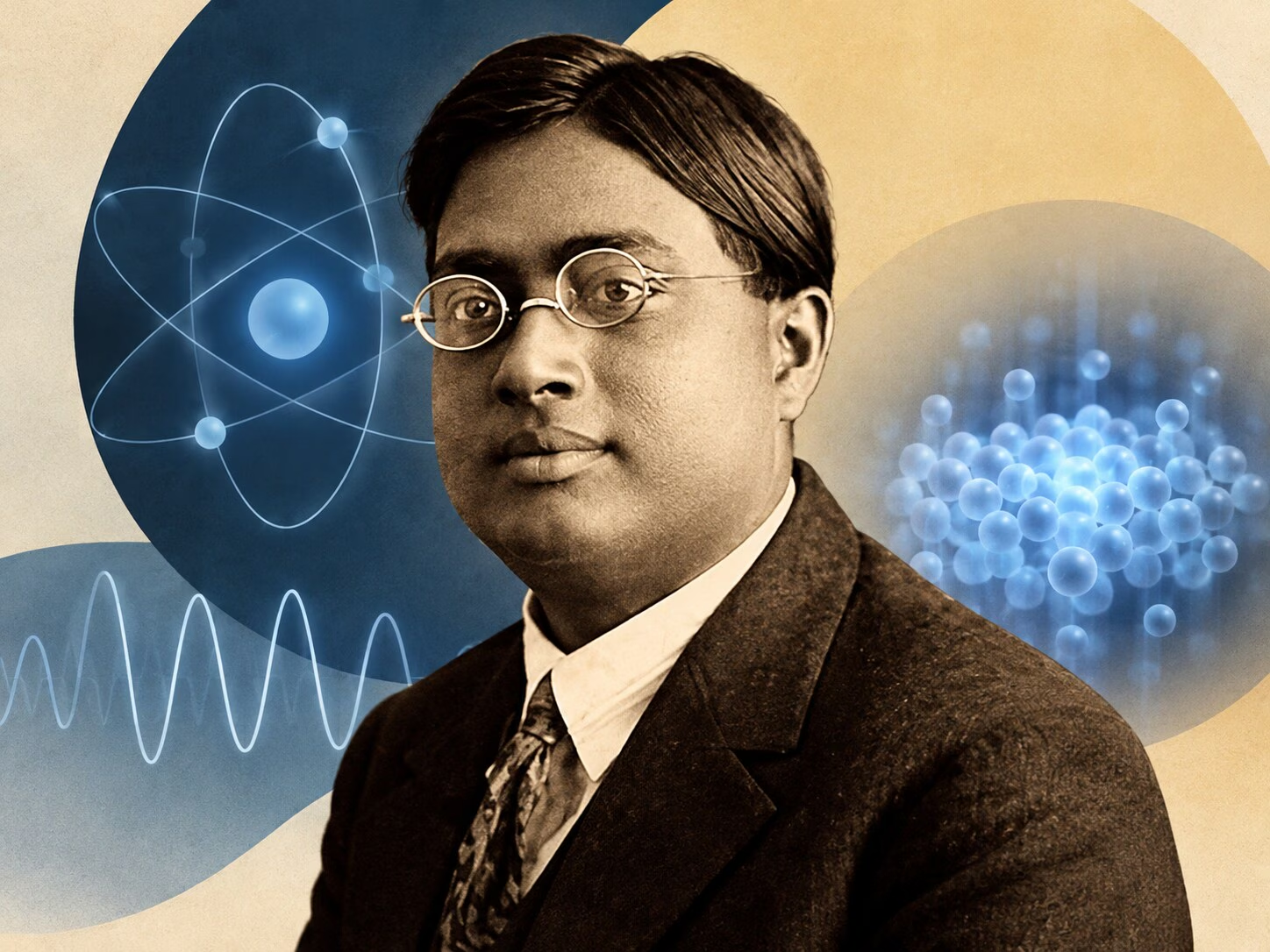
Satyendra Nath Bose stands as one of the most influential theoretical physicists of the twentieth century, a self-taught pioneer in quantum mechanics whose mathematical breakthroughs forever changed how humanity understands the fundamental building blocks of the universe. Born on January 1, 1894, in Calcutta (now Kolkata), India, Bose grew up during a period of intense intellectual and cultural awakening in Bengal. From early childhood, he exhibited an extraordinary aptitude for mathematics and the physical sciences, famously scoring 110 out of 100 on a school mathematics examination because he solved multiple complex problems using alternative methods. He attended the prestigious Hindu School and later enrolled at Presidency College, Calcutta, where he studied alongside future luminaries such as Meghnad Saha and was mentored by legendary Indian scientists Jagadish Chandra Bose and Prafulla Chandra Ray. Completing both his Bachelor of Science in 1913 and his Master of Science in Mixed Mathematics in 1915 at the University of Calcutta, Bose achieved record-breaking academic marks that remain legendary in Indian academic history.
As a young lecturer at the newly established University College of Science (Rajabazar Science College) in Calcutta, Bose faced a formidable challenge: modern European physics—particularly Max Planck’s quantum hypothesis and Albert Einstein’s theory of relativity—was advancing rapidly, yet English textbooks on these subjects were virtually nonexistent in India. Determined to master and teach these revolutionary ideas, Bose taught himself German and French so he could read original papers by Planck, Einstein, and Henri Poincaré. In 1920, Bose and Meghnad Saha published the world’s first English-language translation of Albert Einstein’s papers on Special and General Relativity, making Einstein’s groundbreaking work accessible to English-speaking physicists across the globe for the very first time. This intellectual independence prepared Bose for the defining breakthrough of his career after he moved in 1921 to become a Reader in Physics at the newly founded University of Dacca (now Dhaka, Bangladesh).
In 1924, while preparing a lecture at the University of Dacca on the photoelectric effect and the ultraviolet catastrophe, Bose attempted to demonstrate to his students why classical physics failed to explain the radiation emitted by a heated body. Instead of merely presenting Max Planck’s 1900 derivation of the black-body radiation law—which still relied awkwardly on classical electrodynamics—Bose deliberately made a radical statistical assumption. He treated light quanta (photons) not as classical, distinguishable particles, but as strictly identical, indistinguishable packets of energy that could occupy the same quantum state without restriction. By counting the possible states of these indistinguishable photons using a completely new statistical method, Bose derived Planck’s radiation formula purely from quantum principles, without invoking any classical physics whatsoever.
Bose wrote a concise, four-page paper titled “Planck’s Law and the Hypothesis of Light Quanta” and submitted it to the prestigious British journal Philosophical Magazine, which promptly rejected the manuscript, failing to recognize its revolutionary significance. Undeterred, Bose made a bold decision on June 4, 1924: he mailed the rejected paper directly to Albert Einstein in Berlin, accompanied by a humble letter asking Einstein to evaluate its merit and, if he found it worthy, arrange for its publication in the German journal Zeitschrift für Physik. Einstein immediately recognized the profound importance of Bose’s insight. He personally translated Bose’s paper into German, arranged for its publication in Zeitschrift für Physik in August 1924, and appended an enthusiastic note declaring Bose’s derivation an “important step forward.”
Einstein did not stop at translating the paper; he immediately extended Bose’s statistical method from massless photons to massive gas atoms. Through this collaboration—conducted initially via letters and later in person—the two scientists formulated Bose–Einstein statistics, one of the two foundational pillars of quantum statistics (alongside Fermi–Dirac statistics). Applying these rules to an ideal gas at ultra-low temperatures, Einstein predicted in 1925 that a large fraction of atoms would collapse into the lowest possible quantum state, merging into a single, macroscopic quantum entity. This exotic fifth state of matter, known today as a Bose–Einstein Condensate (BEC), remained a theoretical prediction for seven decades until Eric Cornell, Carl Wieman, and Wolfgang Ketterle experimentally created it in 1995, earning the 2001 Nobel Prize in Physics.
Following Einstein’s endorsement, Bose was granted a two-year study leave in 1924 to travel to Europe, where he worked alongside the foremost architects of modern physics. In Paris, he conducted X-ray crystallography and radioactivity research in the laboratories of Marie Curie and Maurice de Broglie. In 1925, Bose traveled to Berlin and met Albert Einstein in person, engaging in deep discussions on quantum theory and unified field theory at a pivotal moment when Werner Heisenberg and Erwin Schrödinger were formulating modern quantum mechanics. Rather than staying in Europe to build an international career, Bose returned to the University of Dacca in 1926, driven by a deep commitment to nurturing scientific research and higher education in his homeland.
Back in India, Bose dedicated decades to teaching, mentoring young researchers, and expanding experimental capabilities in X-ray spectroscopy, thermoluminescence, and organic chemistry, while also serving as President of the Indian Science Congress in 1944 and later returning to the University of Calcutta as Khaira Professor of Physics. Beyond the laboratory, he was a passionate polymath and champion of science communication in native languages. Fluent in Bengali, English, French, German, and Sanskrit, he founded the Bangiya Bijnan Parishad (Science Association of Bengal) in 1948 and edited the Bengali science journal Jnan O Bijnan, insisting that complex scientific concepts could and should be taught in Indian mother tongues so science would never remain the exclusive privilege of an English-speaking elite. He was also an accomplished musician who played the esraj, a traditional Indian bowed string instrument.
Bose’s enduring immortality in physics was cemented by British Nobel laureate Paul Dirac, who coined the term “boson” in honor of Satyendra Nath Bose to describe the entire class of fundamental particles that obey Bose–Einstein statistics. Today, every elementary particle in the universe is classified into one of two families: fermions (which make up matter and obey the Pauli exclusion principle) and bosons (which carry fundamental forces and have integer spin). Famous bosons—including photons (carriers of electromagnetism), gluons (carriers of the strong nuclear force), W and Z bosons (carriers of the weak nuclear force), and the Higgs boson (discovered at CERN in 2012, which gives elementary particles their mass)—all bear Bose’s name.
Although Satyendra Nath Bose was nominated multiple times for the Nobel Prize in Physics—by luminaries such as Kedar Nath Banerjee, Daulat Singh Kothari, and Shibapratim Bagchi—the Nobel Committee never awarded him the prize, a decision widely regarded by historians of science as one of the most notable oversights in Nobel history, especially given that numerous Nobel Prizes were later awarded for discoveries built directly upon Bose–Einstein statistics and Bose–Einstein condensates. Nevertheless, India honored him with the Padma Vibhushan in 1954, appointed him National Professor in 1959, and saw him elected a Fellow of the Royal Society (FRS) in 1958. When Satyendra Nath Bose passed away on February 4, 1974, in Calcutta, he left behind a legacy woven into the very language of modern physics—ensuring that every time scientists speak of photons, lasers, superfluids, or the Higgs boson, they speak his name.