December 4, 2025, 14:37 Beijing Time
In a dramatic and bittersweet milestone for China’s commercial space sector, the country’s first fully reusable rocket successfully reached orbit but met a catastrophic end moments after touchdown, exploding in a massive fireball on its landing pad. The debut flight of the “Jianghu-1” (Gallaxy-1) rocket, developed by the private aerospace firm Galactic Energy, marks a significant technological leap forward for China, even as its fiery conclusion underscores the immense difficulty of mastering fully reusable launch systems.
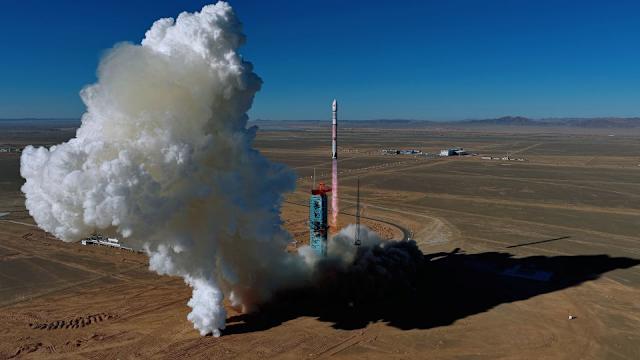
The mission launched without issue at 14:00 local time from the Jiuquan Satellite Launch Center in the Gobi Desert. The 45-meter-tall rocket, powered by a methane-liquid oxygen (methalox) engine named “Ceres,” roared skyward, carrying a dummy payload into a low Earth orbit approximately 300 kilometers above the planet. This achievement alone solidified Galactic Energy’s position at the forefront of China’s rapidly evolving private space industry, making the Jianghu-1 the first Chinese reusable rocket to successfully achieve orbit on its maiden flight. For nearly an hour, mission control celebrated as the rocket’s first stage separated, performed a boost-back burn, and began its controlled, atmospheric re-entry, mirroring maneuvers pioneered by competitors like SpaceX.
The critical and final phase—the vertical landing—initially appeared flawless. Live footage showed the sooty, finned first-stage descending under the power of its relit Ceres engines toward a dedicated landing zone at Jiuquan. However, as the rocket slowed to what should have been a gentle hover, a sudden and violent catastrophic rupture occurred at the base of the vehicle. In an instant, the landing sequence transformed into a towering fireball and a rolling shockwave that swept across the landing complex. The rocket’s remains toppled and were consumed by secondary explosions and intense fire. Mission control audio fell momentarily silent before emergency protocols were activated.
Despite the destructive finale, Galactic Energy and Chinese space authorities were quick to frame the mission as a net success. In a press conference three hours after the event, Galactic Energy’s Chief Engineer, Dr. Wei Zhang, stated, “Today, we unequivocally demonstrated that our core architecture works—orbit was achieved, the thermal protection system endured re-entry, and the guidance navigation system executed a precision return to the landing site. The final moment, while visually stark, is a data point we are designed to learn from. We have retrieved the flight recorder and initial telemetry already points to a specific propulsion system anomaly during the landing burn.” This sentiment was echoed by the China Aerospace Science and Technology Corporation (CASC), the state-run giant, which released a statement congratulating Galactic Energy on its “historic orbital achievement” and emphasizing the “collective progress of the national aerospace ecosystem.”
The incident highlights the intense global race to develop affordable, rapid-turnaround reusable rockets, a market currently dominated by SpaceX’s Falcon 9 and Starship vehicles. The Jianghu-1’s explosion is a stark reminder that landing a rocket remains an exceptionally complex high-stakes ballet of physics and engineering. Key points of focus for the investigation will include the performance of the methalox engine during its final deep-throttle maneuver, potential structural fatigue from re-entry heating, and the stability of the landing leg deployment system. Professor Li Chen, a propulsion specialist at Beihang University, noted, “Methane fuel offers performance and cleanliness advantages, but its combustion stability in dynamic throttle scenarios, especially after the thermal and mechanical stresses of launch and re-entry, presents unique challenges. This is likely the heart of the forensic investigation.”
The financial and programmatic repercussions are significant but not necessarily fatal. Galactic Energy, backed by significant private and local government investment, had staked its future on the Jianghu-1 platform. The explosion represents a major setback for China’s private space sector, which aims to capture a share of the global commercial launch market. Competitors like LandSpace and iSpace will be analyzing the failure closely as they prepare their own reusable vehicle tests. However, the proven ability to reach orbit will likely reassure investors of the fundamental soundness of the technology. “They have crossed the hardest threshold, which is getting to space reliably. They now have to solve the last-mile problem, literally the last meter,” said an analyst from the Euroconsult space consultancy.
From a strategic standpoint, the mission’s partial success delivers valuable data to China’s broader space ambitions. Reusable technology is critical to China’s plans for a permanent lunar station, large-scale satellite megaconstellations, and low-cost access to space. The lessons learned from Jianghu-1’s flight, including its failure, will directly inform the development of CASC’s own reusable rockets and the national manned space program.
As of late evening on December 4, emergency crews had secured the landing site. The investigation board, comprised of Galactic Energy engineers and officials from the China National Space Administration, has begun its work. The world now waits to see how quickly China’s space entrepreneurs can diagnose the fault, iterate their design, and return to the launch pad. The journey to a truly operational reusable Chinese rocket faced a fiery setback today, but its first flight proved the concept was within reach.