
April 1st, 2026
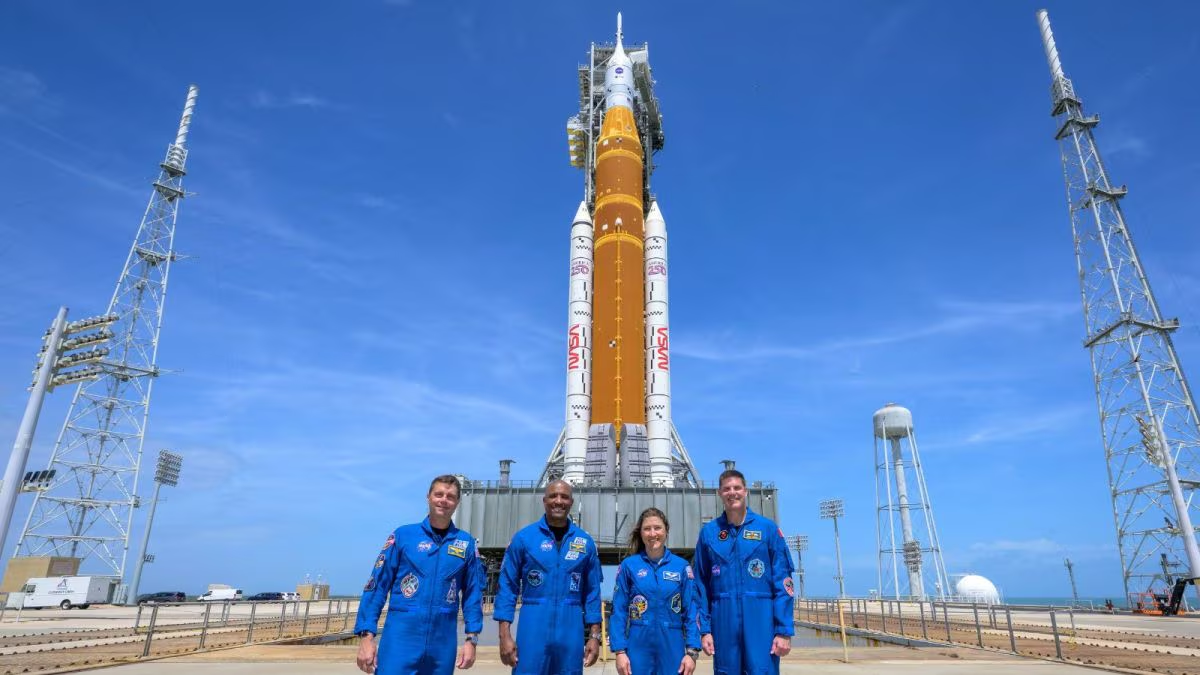
In a convergence of cosmic ambition and calendar irony that has captured the world’s imagination, NASA is set to launch the historic Artemis II mission at 8:42 AM EDT on April 1st, 2026, sending four astronauts on a lunar flyby aboard the Orion spacecraft—a journey that marks humanity’s first return to the vicinity of the Moon in over half a century, with the chosen date carrying a weight of both levity and profound symbolic resonance. As the Space Launch System (SLS) rocket stands poised at Kennedy Space Center’s Launch Complex 39B, the agency has leaned into the April Fools’ Day timing with characteristic scientific earnestness, emphasizing that while the date invites playful headlines, the mission itself represents the most rigorously tested and critical crewed test flight since Apollo 8, designed to validate life support systems, high-speed reentry protocols, and human endurance in deep space before Artemis III attempts a lunar landing.
The crew—Commander Reid Wiseman, Pilot Victor Glover, Mission Specialist Christina Koch, and Canadian Space Agency astronaut Jeremy Hansen—will become the first humans to venture beyond low-Earth orbit since 1972, their four-day journey culminating in a 6,000-mile loop around the far side of the Moon that will push Orion to its operational limits. Addressing the unusual launch date during a pre-mission briefing, Artemis II Commander Reid Wiseman stated with a grin, “Look, we’ve trained for every contingency imaginable—solar flares, system failures, you name it—but if the universe decides to play a joke on us on April 1st, we’re confident we’ve got the punchline ready. More seriously, this date is a reminder that spaceflight requires both discipline and the ability to embrace the unexpected. We’re honored to carry that spirit with us.” The decision to launch on April Fools’ Day was not a deliberate gambit for publicity but rather the result of complex orbital mechanics and the opening of a narrow “lunar mission window” that optimizes trajectory, lighting conditions for launch abort scenarios, and communication line-of-sight with the Deep Space Network, according to NASA’s Launch Services Program, which confirmed the date months ago following a meticulous review of weather patterns, booster readiness, and the critical alignment required for a free-return trajectory around the Moon.
This trajectory acts as a built-in safety mechanism; if Orion’s main engine were to fail after leaving Earth’s orbit, the spacecraft would naturally swing around the Moon and be flung back toward Earth without requiring a critical burn, a design philosophy that echoes the Apollo-era commitment to crew safety while incorporating five decades of technological advancement. Inside the Neil Armstrong Operations and Checkout Building, where the Orion capsule was fueled and sealed earlier this week, NASA Administrator Bill Nelson addressed the significance of the mission, emphasizing that Artemis II is the “bridge” between uncrewed testing and sustainable lunar exploration. “When these four astronauts look out that window and see Earth shrinking behind them, they will be carrying the hopes of a generation,” Nelson said. “The date is coincidental, but the message is clear: America’s return to the Moon is no joke. It is the most serious endeavor in human exploration, and we are doing it with the most advanced spacecraft ever built.” The astronauts themselves have spent the past 18 months in intensive training that included simulations of emergency egress, partial gravity operations, and what NASA engineers call “nominal and off-nominal” mission scenarios—a clinical way of saying they have rehearsed everything from a flawless flight to a harrowing abort during the most violent phases of ascent.
Christina Koch, who will become the first woman to venture to the Moon, reflected on the deep-time responsibility of the mission in a recent interview: “When I look at the Artemis II patch, I see the Earth, the Moon, and a trail that connects them. It’s a trail that many have worked to build, and we’re the first to walk it. The fact that our launch falls on a day associated with surprise feels fitting because spaceflight always surprises you. But we are ready for whatever surprises come our way.” The SLS rocket, towering 322 feet tall and generating 8.8 million pounds of thrust at liftoff, has been the subject of intense scrutiny following years of delays and cost overruns, yet its core stage performed flawlessly during the uncrewed Artemis I mission in 2022, and engineers have since implemented upgrades to the launch abort system’s pyrotechnic initiators and the Orion heat shield—the latter of which will face its greatest test during reentry when the spacecraft hits the atmosphere at 24,500 miles per hour, generating temperatures half as hot as the surface of the Sun. For the Canadian Space Agency, the mission carries particular national pride as Jeremy Hansen becomes the first non-American astronaut to travel beyond Earth orbit, a milestone cemented by Canada’s contribution of the Canadarm3 for the future Lunar Gateway space station. In a statement released from the Canadian Embassy in Washington, Hansen reflected on the universal nature of the mission: “This is not a mission of one nation, but of our planet. On April 1st, when we look back from the far side of the Moon, all of humanity will share that perspective. There’s no punchline more profound than that.”
As the final hours of the countdown tick forward at the Kennedy Space Center, anticipation has reached a fever pitch among the estimated 200,000 to 300,000 spectators expected to line Florida’s Space Coast, a crowd size rivaling the Apollo 11 launch, with local authorities implementing the largest security and traffic management operation since the final Space Shuttle mission. Meteorologists with the 45th Weather Squadron are tracking a 70% chance of favorable conditions at the scheduled launch time, citing concerns over cumulus clouds and the possibility of a marginal weather violation that could trigger a 24-hour scrub, though the window extends for two hours with diminishing probabilities. Should the launch proceed as planned, the four astronauts will spend their first day in orbit performing a series of critical checkouts of Orion’s environmental control and life support systems—which must sustain them during the 10-day mission—before the Interim Cryogenic Propulsion Stage executes the Trans-Lunar Injection burn approximately 90 minutes after liftoff, accelerating the spacecraft to 24,000 miles per hour and setting it on a precise collision course with the Moon’s gravity well. For NASA, which has framed Artemis II as the definitive proof that humanity is ready to establish a sustained presence on the lunar surface and use the Moon as a proving ground for Mars, the April 1st launch represents not a day for tricks, but for a transcendent truth: that after decades of low-Earth orbit confinement, human beings are once again reaching for the stars, and the universe, it seems, has granted them an appointment with destiny on a morning that the world will remember as anything but foolish.