
May 30, 2026
Beijing Daxing International Airport (PKX) stands not merely as a transportation hub but as the undisputed crown jewel of China’s modern architectural and engineering ambition. Seven years after its spectacular debut, the starfish-shaped giant continues to shatter expectations, evolving from a futuristic vision into the world’s most efficient and operationally superior aviation powerhouse. While the initial fanfare of its 2019 opening focused on the breathtaking Zaha Hadid-designed terminal, the reality of 2026 is that PKX has successfully proven that its groundbreaking design translates directly into world-class performance metrics.
Recent operational data confirms a significant milestone: the airport is now firing on all cylinders, blending aesthetic wonder with logistical perfection to redefine what a 21st-century megahub can be. As of spring 2026, the airport is witnessing a major strategic evolution in its carrier lineup, welcoming a wave of international flag carriers that solidify its role not just as a reliever for Beijing Capital International (PEK), but as a primary point of entry for global commerce.
Recent statistics paint a picture of stunning operational maturity. In January 2026, PKX recorded 14,491 departing flights, representing a stable year-over-year increase of +0.11% . However, the most jaw-dropping figure lies in the airport’s punctuality. The airport achieved an extraordinary on-time departure rate of 95.45% in January 2026, a massive improvement of +3.47% compared to the same month in 2025 . For context, maintaining a punctuality rate above 90% is a challenge for even the most disciplined medium-sized airports; sustaining 95.45% while managing the complex logistics of a megahub is an industry rarity.
This performance is complemented by a dramatic reduction in disruptions, as flight cancellations dropped by -7.85% compared to January 2025, proving that the airport’s sophisticated ground handling and proactive contingency planning are effectively immunizing it against the weather and technical delays that plague other global hubs . This level of efficiency is a direct result of the terminal’s radial design, which minimizes taxiing distances and gate congestion, allowing for rapid aircraft turnaround.
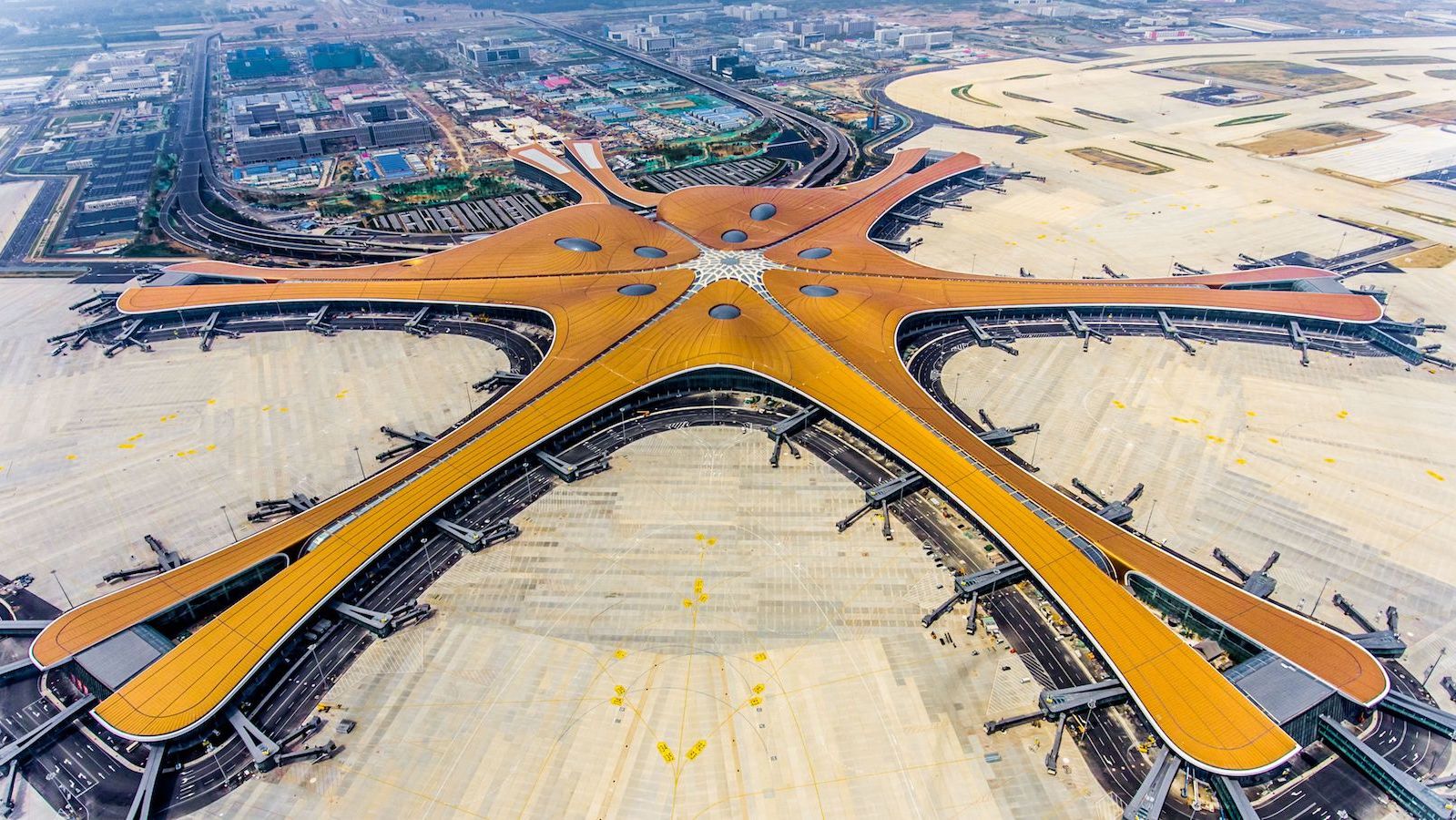
The architectural narrative of PKX remains one of the most compelling stories in global construction. Conceived to alleviate the saturation of Beijing Capital International Airport—which was handling nearly 90 million passengers annually by the early 2010s— the RMB 450 billion project was a gamble on scale . The centerpiece is the 700,000-square-meter terminal, recognized as the world’s largest single-building airport terminal . Yet, the genius of the design, led by the late Zaha Hadid and her firm, lies not just in size but in the eradication of the “walking fatigue” associated with megastructures.
The distinctive phoenix-like shape, with five radiating piers extending from a central hub, ensures that passengers never walk more than 600 meters to their gate . Unlike traditional linear terminals that require shuttle trains or exhausting hikes, PKX compresses the journey from curb to gate. The engineering behind this feat required 170,000 structural steel members supporting a hyperboloid grid roof that allows natural daylight to pour through eight massive vaulted skylights, effectively guiding passengers intuitively through the space while reducing energy costs .
As of May 2026, the airport is experiencing a significant shift in its geopolitical and commercial standing. Initially dominated by SkyTeam members like China Southern and China Eastern, PKX is now aggressively capturing long-haul premium traffic from traditional strongholds. In a landmark move, Air China began its first long-haul routes from Daxing this spring . Launching on April 28, 2026, the carrier deployed the Boeing 777-300ER on a daily service to Frankfurt, strategically scheduling the arrival to catch morning connecting waves across Asia. This was followed by the initiation of an Airbus A330-300 service to Milan Malpensa on June 13, 2026 .
This is more than a route launch; it is a strategic pivot. By splitting operations between its primary hub at PEK and the ultra-efficient PKX, Air China is effectively doubling its capacity to Europe, specifically targeting high-yield business travelers who value the punctuality and seamless connectivity that Daxing offers. Complementing this, Uzbekistan Airways officially migrated its Beijing operations to PKX on March 30, 2026, highlighting the airport’s growing appeal to Central Asian carriers looking for premium facilities and reduced congestion .
Beyond the runways and check-in counters, PKX is quietly revolutionizing the passenger experience through invisible data systems and high-touch service standards. The airport has recently been recognized by the International Organization for Standardization (ISO) for its “Xingxiang Shicheng” service brand, marking the only airport passenger service case published on the ISO/TC 312 official website . This system treats service like a manufacturing product, implementing a “Four Commitments” philosophy that moves through 12 key stages of product management. In practical terms, this means the airport monitors everything from restroom cleanliness to security wait times in real-time, using predictive analytics to deploy staff before bottlenecks form.
This dedication to “soft” infrastructure is matched by “hard” luxury amenities. Global Lounge Network celebrated the grand opening of “The Lounge” at PKX on April 22, 2026 . Located in one of Asia’s busiest gateways, this new addition raises the bar for pre-flight comfort, offering international-standard seating, high-speed connectivity, and premium dining, ensuring that the passenger experience matches the architectural splendor of the terminal. As 2026 progresses, Beijing Daxing is no longer just China’s most celebrated architectural achievement; it is the global benchmark for how airports should operate—beautifully, efficiently, and relentlessly passenger-first.