
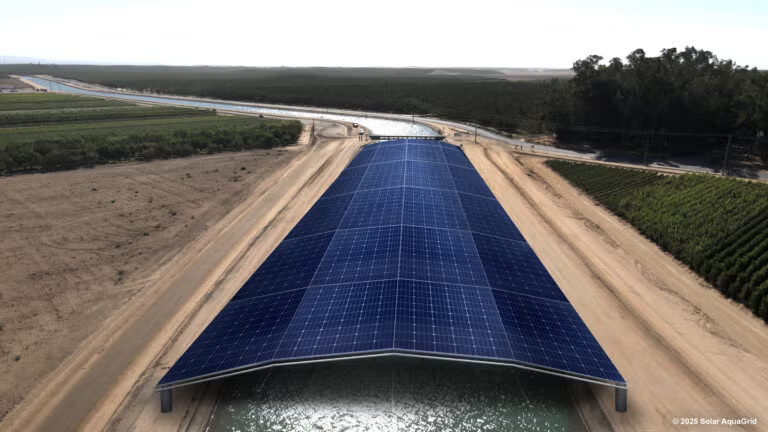
The ambitious vision of turning California’s vast canal network into a dual-purpose water and energy infrastructure has taken a monumental step from theory to reality with the completion of Project Nexus, a first-of-its-kind 1.6-megawatt pilot project in the Central Valley . This innovative project, which was officially launched in April 2026, is the culmination of years of research, planning, and a $20 million investment from the state of California, and it represents a significant test of a groundbreaking concept to address two of the state’s most pressing challenges: water scarcity and the need for renewable energy . The pilot’s origins can be traced back to a landmark 2021 study published in Nature Sustainability by researchers at the University of California, Merced, which explored the potential of covering California’s approximately 4,000 miles of open canals with solar panels .
The study’s modeling suggested that such an ambitious undertaking could generate a staggering 13 gigawatts of solar power and save up to an estimated 63 billion gallons of water annually by preventing evaporation—enough to meet the residential needs of over 2 million people . While the initial study captured global attention, Project Nexus was designed to provide empirical, real-world data to validate these projections and assess the practical feasibility of solar-over-canal technology across California’s diverse water infrastructure .
Project Nexus is a powerful demonstration of collaboration, bringing together a unique public-private-academic partnership between the California Department of Water Resources, the Turlock Irrigation District (TID), the solar development firm Solar AquaGrid, and UC Merced . The Turlock Irrigation District proved to be an ideal host, providing 250 miles of canals with varying widths and orientations that serve as a representative cross-section of California’s extensive canal network . This diversity allowed the project to serve as a testbed for multiple design configurations, including large-span structures over wide canals, smaller systems on narrow channels, vertical installations along canal banks, and even a prototype retractable rail system designed to allow for maintenance access . The project sites, which together cover an area roughly the size of one-and-a-half football fields, have been equipped with advanced sensors to continuously monitor a comprehensive set of metrics, including electricity generation, water evaporation rates, water quality, aquatic weed growth, and overall canal maintenance requirements .
After gathering data over a full irrigation season, the initial results from the pilot have been nothing short of encouraging, with early data significantly exceeding expectations . One of the most promising findings is the dramatic reduction in water evaporation, with preliminary readings from sensors indicating that the shade from the solar panels has reduced water loss by an impressive 50 to 70 percent . This is a critical benefit for a state that has experienced severe droughts and is increasingly grappling with a hotter, drier future . Furthermore, the shading effect has also shown a substantial benefit for canal maintenance by significantly limiting aquatic plant and algae growth, which is a constant and costly challenge for canal operators. The pilot observed an 85 percent decrease in algae growth, a result that could lead to millions of dollars in annual savings for entities like TID and improve the overall flow of water and water quality . As Jordan Harris, CEO and co-founder of Solar AquaGrid, noted, the project has delivered both expected and unexpected benefits, proving the concept’s viability in a real-world setting .
The promise of Project Nexus extends far beyond water conservation. By generating a combined 1.6 megawatts of clean, renewable energy, the pilot is demonstrating how existing infrastructure can be leveraged to help California achieve its ambitious climate goals, which include generating 60 percent of its electricity from renewable sources by 2030 and achieving 100 percent carbon-free energy by 2045 . The solar canopies also provide a critical land-use advantage, as they are built over already developed canal corridors, thereby avoiding the need to convert agricultural land or natural habitats for solar farms . This dual-purpose approach aligns perfectly with the state’s goals of conserving 30 percent of its open land for biodiversity while expanding its clean energy capacity . The project also includes a 75 kW iron-flow battery storage system at one of its narrow canal sites, which serves as another innovation to test the integration of long-duration energy storage with this novel infrastructure .
The successful completion of Project Nexus and its promising early data have provided a powerful proof of concept that has energized plans for scaling up the technology. The partners have established the California Solar Canal Initiative (CSCI), a research collaboration with the University of Southern California and seven other universities, to analyze policies, conduct a full cost-benefit analysis, and create a GIS mapping dashboard to identify the most promising “tier-one” opportunities across California’s 4,000 miles of canals . As Governor Gavin Newsom stated, the project exemplifies California’s spirit of innovation and its commitment to investing in cutting-edge technologies to address climate challenges, showing the world what’s possible when innovation meets action . While covering every mile of the canal network remains a future challenge, Project Nexus has successfully laid the groundwork, providing crucial data and demonstrating that these solar canopies can generate clean energy, conserve precious water, and reduce maintenance costs, marking a significant step toward a more resilient and sustainable water-energy future for California .