
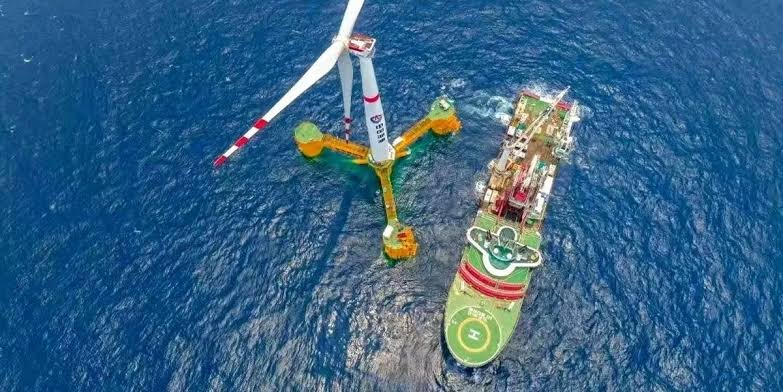
China is making significant strides toward establishing a permanent presence in the deep sea with a bold vision that includes floating cities, energy platforms, and research facilities. One of the most remarkable projects is the “Haiyou Guanlan” or “Haiyu Anlan,” the world’s first 16-megawatt tension-leg floating wind power platform, which has been successfully connected to the grid in the South China Sea . This engineering marvel, standing as tall as a 110-story building, is located over 136 kilometers from shore in waters 136 meters deep . Its primary purpose is to supply green energy to offshore oil fields, with an annual production capacity of approximately 54 million kilowatt-hours of electricity. This is expected to save about 15,000 cubic meters of fuel oil and reduce carbon dioxide emissions by 35,000 tons each year . The platform incorporates a lightweight design and an advanced tension-leg mooring system, which significantly reduces steel usage by around 40% compared to conventional semi-submersible platforms, and it possesses the strength to withstand a Category 5 typhoon . The successful deployment of the “Haiyou Guanlan” represents a major breakthrough in China’s deep-sea floating wind technology, proving that it can operate in extreme and challenging ocean environments .
Beyond energy, China is constructing a massive, movable research facility known as the “Open-Sea Floating Island” . This national key infrastructure project, led by Shanghai Jiao Tong University, is a 30-story-tall floating artificial island designed for all-weather deep-sea scientific research . The platform, which boasts a displacement comparable to a medium-sized aircraft carrier, features an innovative semi-submersible twin-hull design and can withstand waves and winds of up to 250 km/h, equivalent to a Category 5 super typhoon . Its true purpose lies in its scientific capabilities; it is equipped with a massive “moon pool” that allows researchers to deploy heavy equipment up to 300 tonnes to depths of 6,000 to 10,000 meters . This facility, scheduled for completion by 2030, will serve as a critical testing ground for deep-sea mining systems, marine equipment, and oil and gas facilities, and is expected to accelerate marine resource commercialization and improve our understanding of marine ecosystems . It is often described as a “space station at sea” for its potential to revolutionize ocean science .
The concept of floating infrastructure is also being explored in other creative and commercial domains. The project demonstrates a modular approach, utilizing discrete algorithms to reconfigure floating modules for various spatial needs and incorporating semi-submersible bases with buoyancy adjustment systems to maintain stability . Another ambitious venture is the construction of a floating, nuclear-powered shipping port of the future, designed to decarbonize and reinvent global logistics by being self-fueling and modular . Furthermore, a project in Zhuhai called the “Multifunctional Mobile Floating Island” aims to create a movable “maritime space station” that can support marine ranching, energy storage, and emergency rescue missions . Even in the tourism sector, the concept is making waves with a “Floating Garden Resort Hotel” being built in the Maldives, showcasing Chinese design and craftsmanship in creating a unique, immersive maritime experience . Together, these ambitious endeavors highlight a clear and determined push by China to not only explore the oceans but to inhabit them, transforming the deep sea into a new frontier for energy, science, and human habitation.