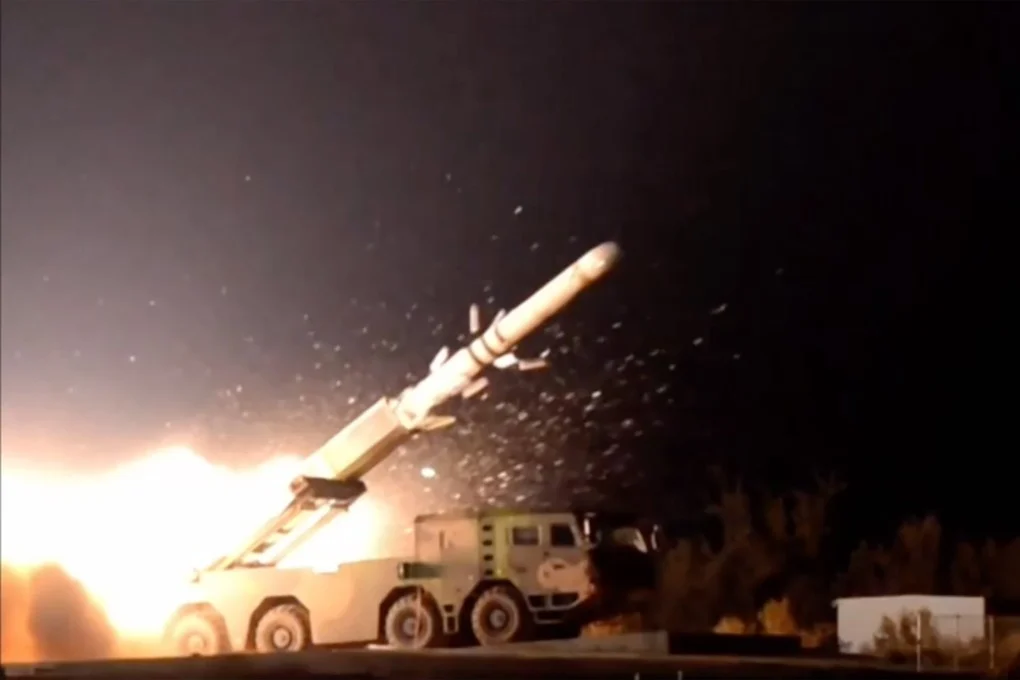
Recent reports, citing sources such as Bloomberg, indicate China has achieved a significant technological breakthrough by successfully testing a novel weapon system: a hypersonic glide vehicle capable of launching an air-to-air missile from thousands of kilometers away. This development marks a paradigm shift in aerial warfare, effectively transforming the traditional dynamics of air-to-air combat by extending its reach from the tactical to the strategic level.
Traditional air-to-air missiles, like the Falcon-15 or the PL-17, are limited to a range of a few hundred kilometers and must be launched by fighter jets that first need to be within that proximity of their targets. The newly tested system upends this concept by using a rocket booster to propel a hypersonic glide vehicle to the edge of the atmosphere. This vehicle then “skips” across the upper atmosphere at speeds exceeding Mach 5 for distances up to two thousand kilometers. Upon reaching its target area, the platform releases a smaller air-to-air missile to strike its objective. The primary targets identified for this revolutionary weapon are high-value, low-maneuverability aerial assets that are crucial to modern air warfare, such as airborne command posts, early warning and control aircraft (AWACS), and aerial refueling tankers. These “force multipliers” are the backbone of a modern air campaign, and they have traditionally been considered safe when operating deep behind the front lines. By extending the engagement range to thousands of kilometers, this new Chinese system directly threatens these vital nodes.
The strategic implications of this capability are profound, particularly in the context of the Indo-Pacific region. The United States’ operational strategy in the Western Pacific relies heavily on a network of support aircraft to project power. For instance, an F-22 fighter jet has a relatively limited operational radius of around 1,100 kilometers and depends on aerial refueling from KC-135 tankers to conduct extended missions. These support aircraft, however, are large, slow, and have virtually no defensive countermeasures against such a long-range, high-speed threat. Analysts suggest that the range of this new glide vehicle, potentially paired with existing systems, could cover distances of approximately 2,400 kilometers with a platform like the DF-17, reaching as far as Guam, while a more powerful system like the DF-27 could extend the threat to 8,000 kilometers, encompassing targets near Hawaii. This development is seen as a direct challenge to the aerial “systems of systems” that underpin US military dominance in the region.
While the specific designation and official details remain unconfirmed by Chinese authorities, the reported test demonstrates a capability that no other nation is known to have deployed: the combination of a long-range hypersonic glide vehicle with an air-to-air missile. This is not an isolated incident but part of a broader pattern of Chinese advancements in hypersonic technology. Concurrent reports highlight other related developments, such as the “Jing Lei-1” (Thunder-1), a long-range air-launched nuclear-capable missile with a range between 5,000 and 8,000 kilometers, which, combined with the range of a H-6K/N bomber, could project power at intercontinental distances. Other reports also mention the successful testing of a separate hypersonic air-to-air missile designed to withstand extreme temperatures and potentially threaten advanced US stealth bombers like the B-21 Raider. These advancements collectively signal a significant acceleration in China’s quest to challenge and potentially disrupt the established power balance in aerial and space warfare. The ability to strike at the heart of an adversary’s air operations from thousands of kilometers away represents a “game-changer” that forces a reevaluation of current tactical doctrines and strategic planning.