
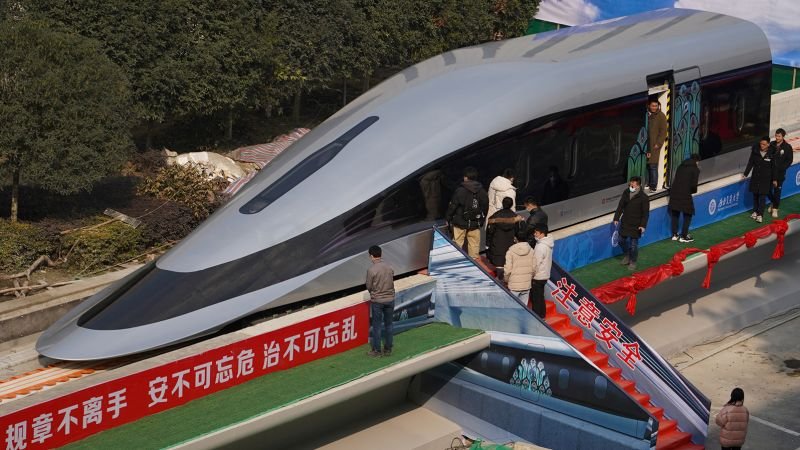
China’s experimental maglev train has shattered its own short-distance acceleration record, reaching an astonishing 800 kilometers per hour from a standstill in just 5.3 seconds . This remarkable feat, achieved on a one-kilometer test track at the Donghu Laboratory in Hubei province, marks the third time in six months that the same 1.1-tonne vehicle has surpassed its previous benchmark, demonstrating the rapid pace of technological progress in the field of magnetic levitation . The ultra-high-speed maglev vehicle, which leverages the fundamental principle of magnetic levitation to eliminate friction with the track, is propelled forward by a powerful electromagnetic field generated by coils along the guideway . According to reports citing China’s state-owned media, the precision required for such a system is extreme, with track alignment maintained to a tolerance of within 0.5 millimeters to ensure safe operation at these incredible velocities .
The test was not merely about achieving raw speed; it was a comprehensive evaluation of systems critical for future ultra-fast transport . Following the rapid acceleration, researchers successfully demonstrated the vehicle’s advanced braking capabilities, bringing it to a complete, controlled stop over a distance of nearly 200 meters . This successful deceleration is as crucial as the acceleration itself for any practical application. The trial pushed several key technologies to their limits, including high-power energy delivery, high-speed levitation control, electromagnetic propulsion, and emergency braking systems . This progressive record-breaking run began in June 2025 when the system first reached 650 kmph in seven seconds, followed by successive improvements to 700 kmph and then 798 kmph, with each test allowing engineers to gather vital data and refine the complex interplay of systems required for such extreme performance .
Despite the sensational numbers, it is important to note that this experimental vehicle is not designed for passenger service . For context, China’s fastest commercial high-speed rail services currently operate at around 350 kmph, a fraction of the speed achieved in this experiment . The primary goal of this research is to explore the underlying principles of this powerful electromagnetic technology for applications beyond commercial rail . Researchers are investigating whether such a system could be adapted for ground-based launch systems for rockets, spacecraft, and military aircraft . By providing a substantial initial boost, the technology could reduce the amount of fuel these vehicles need to carry for takeoff .
Looking ahead, Chinese scientists are also exploring next-generation maglev concepts that could operate inside tubes with extremely low air pressure or near-vacuum conditions . This design would drastically reduce air resistance, potentially allowing for even greater speeds and laying the groundwork for a future of ultra-fast terrestrial travel . However, significant challenges remain, including the enormous infrastructure costs, ensuring passenger safety at such velocities, and the construction of precisely aligned tracks over long distances . For now, the Donghu Laboratory’s test vehicle remains an experimental platform, but its repeated success marks a significant step forward in high-speed propulsion technology, demonstrating China’s substantial investment in maglev research and its broader implications for the future of transport and aerospace .