Saturday, February 7, 2026
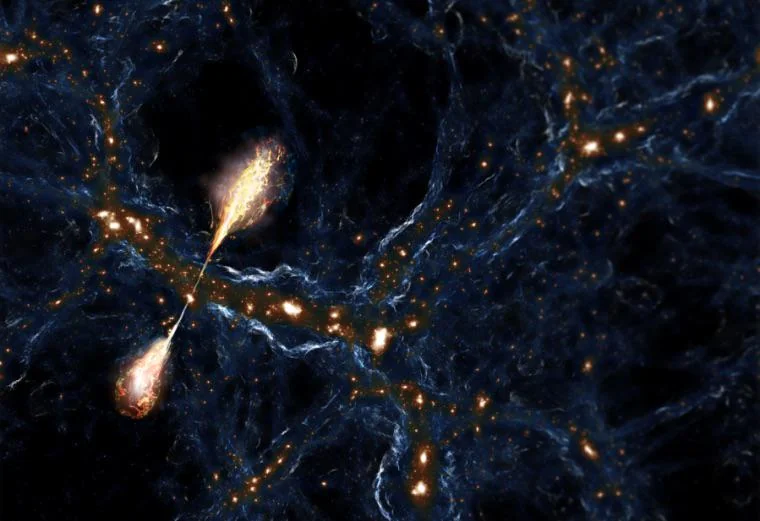
Astronomers have confirmed the existence of a supermassive black hole jet so colossally powerful that it dwarfs the destructive energy of the Death Star from Star Wars by a factor of trillions. Located approximately 665 million light-years from Earth, the phenomenon is the result of a Tidal Disruption Event (TDE)—the violent shredding of a star that strayed too close to the black hole’s gravitational maw. While the event, officially designated AT2018hyz, was first spotted years ago, new data released this week in the Astrophysical Journal reveals that the jet is not only active but is increasing in power exponentially, defying previous models of how black holes “digest” their meals.
The research, led by Yvette Cendes of the University of Oregon, identifies the jet—nicknamed “Jetty McJetface”—as one of the most luminous and energetic events ever recorded in the history of astronomy. Unlike most black holes that emit a burst of energy immediately after consuming a star, AT2018hyz remained curiously “quiet” for years before suddenly erupting into a radio-frequency powerhouse. Scientists estimate that the current energy outflow is between 1 trillion and 100 trillion times more powerful than the estimated peak output of the fictional Death Star’s laser. This massive energy release is equivalent to the power of 400 billion suns, and because the jet is traveling at relativistic speeds (nearly the speed of light), it carries enough kinetic energy to reshape entire regions of its host galaxy.
Expert Analysis and Predictions
The sudden “burp” of energy has left the scientific community both baffled and exhilarated. “This is really unusual,” said Yvette Cendes, the lead astrophysicist on the study. “I’d be hard-pressed to think of anything rising like this over such a long period of time.” Cendes noted that while spaghettification—the process where a star is stretched into long, thin strands by gravity—is well-documented, the delayed launch of such a high-powered jet is unprecedented. “But a black hole emitting this much energy so many years after chewing up a star is unprecedented,” she added, highlighting that the system is currently 50 times brighter than when it was first detected in 2019.
Theoretical models now suggest that the energy from Jetty McJetface has not yet reached its zenith. Astronomers predict the radio emissions will continue to climb throughout 2026, reaching a projected peak in early 2027. The delayed brightening suggests that either the jet was originally pointed away from Earth and has since shifted, or that the black hole took several years to form the accretion disk necessary to launch such a concentrated beam of matter. “I am hesitant to give a final energy estimate—there are too many things that it will depend on that will become clear once we actually see the peak,” Cendes remarked, emphasizing the need for continued monitoring using the Very Large Array (VLA) in New Mexico and the MeerKAT telescope in South Africa.
Key Highlights of the Discovery
-
Unmatched Power: The jet emits up to 100 trillion times the energy of the fictional Death Star, making it a contender for the most energetic single-source event in the universe.
-
Late Bloomer: The black hole remained dormant for nearly three years after the initial star-shredding event before launching the jet, a delay that challenges current astrophysical timelines.
-
Relativistic Speeds: Matter in the jet is being ejected at nearly the speed of light, creating a shockwave as it plows into the surrounding interstellar medium.
-
Radio Dominance: The event is primarily visible in radio waves, with the brightness increasing by 5000% since its 2019 discovery.
-
Scientific Significance: Studying Jetty McJetface helps researchers understand how supermassive black holes influence galaxy evolution and the distribution of magnetism across the cosmic web.
This discovery serves as a stark reminder of the terrifying scale of the cosmos. While science fiction gives us weapons capable of destroying planets, the natural universe produces “cannibal” black holes that can influence the destiny of entire star systems millions of light-years away. As the jet continues to brighten toward its 2027 peak, it remains the primary target for every major radio telescope on the planet.