30 May 2026.
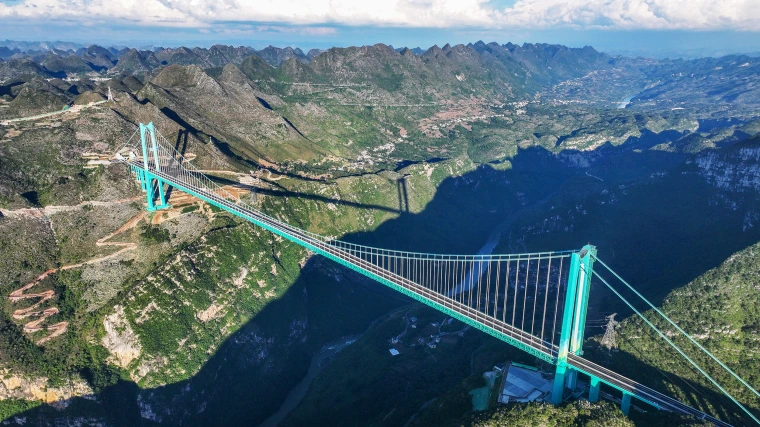
Of all the marvels engineered by human hands, few inspire the same awe as a bridge that dares to leap across a void. The Huajiang Canyon Bridge in China’s Guizhou province stands not merely as a connection between two points on a map but as a stunning testament to what happens when human ambition refuses to be stopped by gravity. Officially recognized by Guinness World Records on April 29, 2026, this steel-truss suspension bridge has been certified as the world’s highest bridge, soaring 626.01 meters (approximately 2,054 feet) above the churning waters of the Beipan River .
Located on the S57 Liuzhi-Anlong Expressway, the bridge is the centerpiece of a region often described as an “earth crack,” a landscape of such dramatic verticality that it was once considered an insurmountable barrier . The statistics alone are staggering: the structure stretches 2,890 meters (nearly 9,480 feet) in total length, featuring a main single span of 1,420 meters (4,660 feet)—a record for mountain bridges—supported by towers that rise 262 meters and 205 meters respectively from their foundations .
To grasp the sheer scale, the bridge deck is so high that it could easily swallow the Eiffel Tower and still have hundreds of feet of empty air below it, smashing the previous height record held by China’s own Beipanjiang Bridge (565 meters) by a significant margin . However, to reduce this titan to just its length and height is to miss the point entirely; the Huajiang Canyon Bridge is not just a crossing, but a living laboratory of materials science, a pioneer in smart infrastructure, and an unexpected economic engine that is rewriting the rules of rural development.
The physical construction of the bridge required solving problems that would have broken lesser engineering teams. The primary challenge was the geology of the canyon itself, which is composed of porous, unstable rock that threatens the integrity of traditional foundations . To solve this, engineers did not simply build on the surface; they drilled deep pile foundations and dug massive tunnel anchors—chambers burrowed 94 meters (310 feet) into the rock—to secure the suspension system, effectively tying the bridge to the bones of the earth . Yet, the true genius of the Huajiang Canyon Bridge lies hidden in plain sight within its two main cables.
These cables are the “spine” of the structure, and each one is a masterpiece of metallurgy composed of nearly 40,000 individual steel wires, each a mere 5.7 millimeters in diameter—roughly the thickness of a pencil lead . If one were to lay every wire from both cables end to end, the combined length would circle the Earth’s equator not once, but twice . To withstand the unpredictable, violent wind gusts and drastic humidity shifts of the canyon, these steel wires were pushed to an unprecedented tensile strength of 2,000 megapascals (MPa) . To put that in perspective, this means that every square millimeter of the wire’s cross-section (about the size of a pinhead) can bear the load of roughly 0.2 metric tons, exceeding prevailing international standards by a remarkable 7.5 percent .
Achieving this strength was a chemical balancing act; as a general rule, the stronger steel is, the more brittle it becomes. Researchers from Guizhou Steel Rope, Guizhou University, and Central South University spent years refining the “alloy prescription,” testing different combinations of metals until they found the perfect balance between raw power and flexibility . Because the canyon is perpetually humid, the team also developed a revolutionary zinc-aluminum-magnesium alloy coating with a post-plating cooling process, making the cables 2.5 times more resistant to corrosion than standard materials and securing nearly ten invention patents .
Going beyond the physical, the Huajiang Canyon Bridge represents a fundamental shift in how we monitor and maintain critical infrastructure—it has been given a nervous system. Engineers, in collaboration with Beijing Jiaotong University, pioneered a method of installing fiber grating sensors deep inside the main cables during construction . These sensors act as “smart nerves,” transmitting real-time data on stress, temperature, humidity, and strain to an Intelligent Control Center .
Far from relying on manual, experience-based visual checks, technicians can now sit dozens of kilometers away and watch a digital dashboard where the “health” of the bridge is displayed in precise metrics. If a cable experiences an unexpected load or the internal humidity rises to a dangerous level, the system knows instantly . Furthermore, during the construction phase, the team utilized Doppler Lidar scanning to monitor wind speeds and turbulence in real-time, ensuring that the delicate process of lifting and welding the 93 reinforced steel components of the deck (totaling 22,000 tons) was not compromised by the canyon’s volatile weather . The use of the BeiDou Navigation Satellite System for real-time positioning allowed crews to align massive structural modules with millimeter precision, turning the chaotic environment of the “earth crack” into a controlled, data-driven construction zone .
While the engineering data is impressive, the human and economic impact of the bridge since its opening on September 28, 2025, is perhaps the most transformative aspect of the project . Before the bridge existed, traveling between the Liuzhi Special District and Anlong County required navigating treacherous, winding mountain roads that took nearly two hours.
The Huajiang Canyon Bridge has reduced that journey to a breathtaking two minutes . Yet, it is what has grown around the bridge that is rewriting the narrative of infrastructure. Integrated with tourism from its very design phase, the bridge is the world’s premier example of “bridge-tourism” 3.0. By 30 May 2026, the statistics were clear: the bridge is a tourism powerhouse. During the nine days of the 2026 Spring Festival holiday alone, the bridge attracted over 300,000 visitors, generating massive economic activity . The dedicated Yundu Service Area is no longer a simple pitstop; it is a destination.
Visitors can experience a 625-meter VR bungee jump that simulates the freefall perfectly, walk on a glass skywalk, watch a massive water curtain light show projected onto the side of the gorge, or sip a drink at the “625 Coffee” shop . The cultural integration runs deep, with tourists participating in traditional folk activities like Miao and Bouyei weaving and customary festivals, creating an immersive experience that goes beyond just looking at a view .
Most importantly, the bridge has become a catalyst for rural revitalization, reversing decades of population drain. Down below the bridge in the village of Huajiang, the landscape of life has fundamentally changed. Prior to the bridge, the village was a quiet, aging community; young people left en masse to find factory work in coastal cities, leaving behind a “hollow village” of empty houses and older residents. As of May 2026, that story has flipped entirely. The bridge has created nearly 1,000 direct and indirect jobs in the area .
Seeing the influx of tourists, over 40 young people have returned home to start businesses. Where there was once silence, there are now six finished民宿 (homestays), 13 under construction, seven农家乐 (farmers’ restaurants), and over 50 snack stalls . Foreign investment has followed, with seven outside entrepreneurs setting up shops. The idle farmhouses that once symbolized a lack of opportunity have been renovated into boutique hostels, and traditional home-cooked dishes are now monetized as authentic “earthy” cuisine. The result is a surge in per capita annual income, which has risen by more than 48,000 yuan (approximately $6,900) during the bridge’s initial operational phase .
The Huajiang Canyon Bridge proves that a megastructure can be more than just concrete and steel; it can be a social lifeline, lifting an entire community out of isolation and poverty by literally connecting them to the wider world. On 30 May 2026, as traffic hums along the S57 expressway and tourists peer down from the world’s highest deck, the bridge stands as a bold, indelible symbol of China’s ability to not only conquer its geography but to humanize it, turning impossible voids into vibrant new hubs of human connection.