December 12, 2025
As the year draws to a close, the night sky is preparing to offer a celestial farewell gift in the form of a rare and mysterious visitor. Comet 3I/ATLAS, only the third confirmed interstellar object ever detected in our solar system, is approaching its closest point to Earth, offering a fleeting opportunity for scientific discovery and, for some, a chance of a subtle naked-eye sight. Discovered in late 2024 by the Asteroid Terrestrial-impact Last Alert System (ATLAS) survey in South Africa, this vagabond from deep space has captivated astronomers worldwide, not merely for its upcoming proximity, but for its profound origins. Unlike the countless comets that orbit our Sun, this traveler is just passing through, a nomad on a million-year journey between stars, making its week-long flyby a truly historic and unrepeatable event.
The “I” in its designation is the key to its intrigue, standing for “interstellar.” It follows in the historic footsteps of `Oumuamua in 2017 and Comet 2I/Borisov in 2019, but with a significant difference: we have had far more time to prepare for its arrival. This marks the first time humanity has known of an interstellar visitor well in advance of its closest approach, allowing for an unprecedented global campaign of observation. Dr. Karen Meech, an astronomer at the University of Hawaiʻi Institute for Astronomy who led the characterization efforts for both previous interstellar objects, expressed the scientific community’s enthusiasm: *”With 3I/ATLAS, we are no longer catching a fleeting glimpse of a departing guest. For the first time, we can roll out the full red carpet of our terrestrial and orbital observatories to study an object from another star system as it approaches. The data we gather could revolutionize our understanding of the composition of planetary systems beyond our own.”*
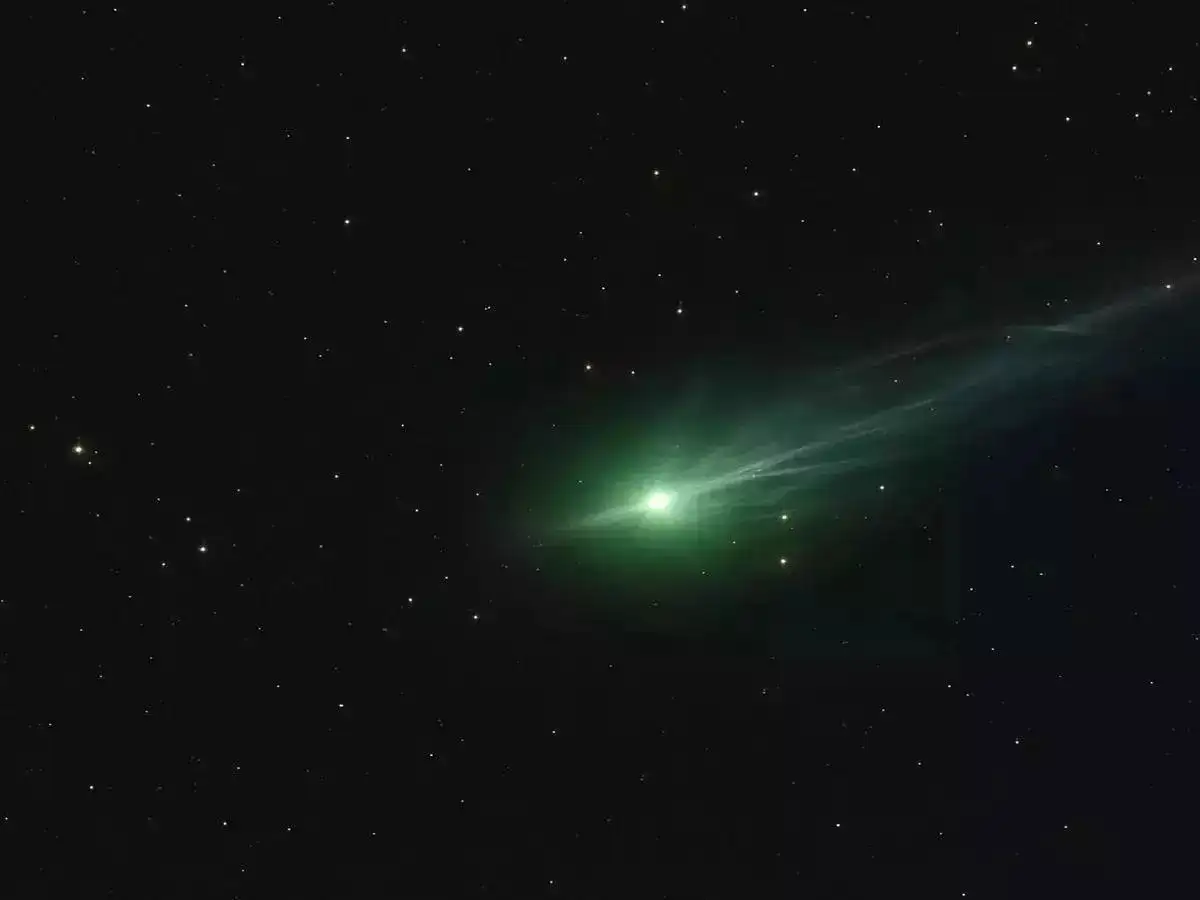
So, what do we know about this visitor? Based on spectroscopic analysis, 3I/ATLAS appears to be a relatively pristine, dynamically new comet, rich in volatile ices like carbon monoxide and diatomic carbon. This suggests it was flung from the outer reaches of a distant planetary system, having spent most of its existence in the deep freeze of interstellar space, shielded from the warming influence of any star. Its nucleus is estimated to be roughly 1.2 kilometers in diameter—larger than 2I/Borisov but smaller than `Oumuamua. As it has ventured inward toward the warmth of our Sun, these ices have begun to sublime, creating a diffuse coma, or atmosphere, of gas and dust. However, observers should not expect a dazzling display akin to the great comets of history; 3I/ATLAS has thus far been a modest performer in terms of brightness and tail development.
The crucial celestial mechanics are as follows: Comet 3I/ATLAS will make its closest approach to the Sun (perihelion) on December 17, 2025, at a distance of approximately 145 million kilometers. Following that, it will speed toward its closest approach to Earth on Friday, December 19, 2025, at approximately 22:17 Universal Time (5:17 PM EST). At that moment, it will be about 44 million kilometers from our planet—a perfectly safe distance, roughly 115 times the span between Earth and the Moon. It will be traveling at a breathtaking speed of over 50 kilometers per second relative to the Sun, a velocity so high it confirms its interstellar pedigree; it is moving too fast to be bound by the Sun’s gravity.
For amateur astronomers and skywatchers hoping to catch a glimpse, the window of opportunity is narrow and the challenge significant. The comet will be best placed for observation in the days immediately following its Earth approach, as it moves swiftly from the evening into the morning sky. Its predicted peak brightness is around magnitude 5.5 to 6.0. This is theoretically at the threshold of naked-eye visibility under perfectly dark, pristine skies, but in practice, binoculars or a small telescope will be essential for almost everyone. “Managing expectations is crucial,” says Dr. Dave Farnocchia, a navigation engineer at JPL-Caltech who has been calculating the comet’s precise trajectory. “This isn’t Hale-Bopp. The scientific value is immense, but the public spectacle will be subtle. It will appear as a small, fuzzy patch of light. The profound truth that you are looking at a piece of another solar system—that is the real magic here.”
How to Spot It: In the nights around December 19-22, look towards the constellation of Monoceros, the Unicorn, which lies between the more prominent constellations of Orion and Canis Minor. On the evening of the 19th, the comet will be relatively low in the eastern sky after dusk. As the week progresses, it will climb higher into the pre-dawn sky. The presence of a waxing crescent Moon will provide some interference in the evening sky, but by the 22nd, the Moon will have shifted to the morning sky, leaving darker evening windows. Your absolute best tools are a pair of 7×50 or 10×50 binoculars and a detailed star chart or astronomy app to pinpoint its exact location, which will change noticeably from night to night.
The scientific harvest from this event will be rich and long-lasting. Every major telescope on Earth and in space, from the James Webb Space Telescope (JWST) to the Very Large Telescope (VLT) in Chile, has scheduled time to stare at 3I/ATLAS. Key goals include analyzing the comet’s chemical fingerprint in extreme detail to search for exotic isotopic ratios or molecular compounds not commonly found in our solar system. This is akin to performing a spectroscopic autopsy on a building block from another cosmic neighborhood. Furthermore, studying how its outgassing affects its trajectory will provide clues about its makeup and the conditions of its formation. Dr. Michele Bannister, a planetary astronomer at the University of Canterbury, notes, *”Each interstellar object is a messenger. 3I/ATLAS’s composition might tell us if the recipe for building comets—and by extension, planets—is universal, or if other stellar systems cook with entirely different ingredients. This is comparative planetology on a galactic scale.”*
As 3I/ATLAS makes its swift pass and begins its eternal journey back into the void, it leaves behind a transformed perspective. Its detection by ATLAS proves our capability to find these objects is improving, suggesting they may be more common than once thought. Future surveys, like the Vera C. Rubin Observatory coming online next year, are expected to find dozens more. This flyby is not an ending, but a beginning—a rehearsal for the next, potentially brighter or closer, interstellar visitor. It underscores that our solar system is not an isolated island, but part of a dynamic galactic ecosystem where material is exchanged between stars.
On a clear December night, if you train your binoculars on that faint, fuzzy smudge traveling between the stars, consider its journey. For a brief moment, this ancient traveler from an unfathomable distance shares our sky, a silent ambassador from a sun we will never know. Its passage is a powerful reminder of our place in a connected cosmos, where the boundaries between star systems are more permeable than we ever imagined, and where every new point of light can rewrite our understanding of home.