
11 December 2025
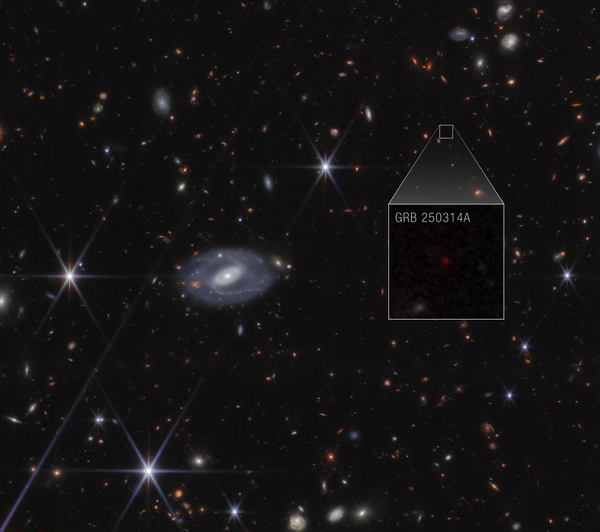
In a discovery that pierces the veil of the universe’s earliest epochs, scientists operating the James Webb Space Telescope (JWST) have confirmed the detection of the oldest and most distant supernovae ever observed, a collection of stellar explosions that occurred when the cosmos was less than 2 billion years old. This groundbreaking find, part of the JWST Advanced Deep Extragalactic Survey (JADES) program, pushes our observational frontier back to a formative era known as “cosmic dawn,” offering an unprecedented direct view of the explosive deaths of the universe’s first generations of stars. The data, which includes a staggering ten supernovae from a period when the universe was in its relative infancy, fundamentally alters our understanding of early stellar life cycles, heavy element production, and the dynamic conditions of the primordial cosmos.
The discovery was made not by looking for brilliant, fleeting points of light, as is common with nearby supernovae, but through a meticulous “deep field” time analysis. The JADES team repeatedly observed the same patch of sky in the near-infrared spectrum—the only wavelength band where light stretched by the universe’s expansion over eons can reach us. By comparing images taken in 2022, 2023, and 2025, astronomers pinpointed objects that appeared or disappeared over time. This “before and after” methodology, uniquely powerful for JWST’s unparalleled infrared sensitivity and stability, allowed them to spot the sudden brightening and subsequent fading of ancient, distant galaxies—the telltale signature of supernovae occurring within them. Dr. Christina Eilers of MIT, a co-investigator on the program, stated, “We are essentially watching the cosmic fireworks display from its very first innings. These aren’t just distant objects; they are messages in a bottle from a time when the universe’s chemical recipe was being written.”
The crown jewels of this discovery are two specific supernovae, designated SN-Encino and SN-Modena, with spectroscopically confirmed redshifts of 14.1 and 13.8, respectively. This places their explosive deaths a mere 300 to 400 million years after the Big Bang. To put this in perspective, the previous record-holder for the oldest supernova, a redshift 12.2 event confirmed by Hubble, existed when the universe was roughly 500 million years older. The light from SN-Encino has traveled for over 13.5 billion years to reach JWST’s mirrors, capturing a moment when the first galaxies were just assembling. Dr. Eiichi Egami of the University of Arizona, a JADES spectroscopist, explained the significance, “Securing a spectrum is the gold standard. It not only confirms the distance unequivocally but also allows us to dissect the light and determine what type of star exploded and what elements it forged and scattered. At these redshifts, we are looking at the potential remnants of Population III stars—the mythical, purely hydrogen-and-helium first stars.”
Crucially, the survey revealed a surprising abundance of these early cataclysms. The ten supernovae identified span a range of redshifts, offering a statistical sample rather than a single anomaly. This suggests that stellar death by supernova was a far more common and influential process in the early universe than most models predicted. The high rate implies that the earliest galaxies were turbulent, rapidly evolving environments, with massive stars living fast and dying young, thereby repeatedly seeding their surroundings with newly synthesized heavy elements like carbon, oxygen, and iron. This “chemical enrichment” from the very first stellar generations is the process that ultimately made rocky planets and life possible. “This changes our narrative of early galaxy evolution,” said Dr. Pierre-Louis Simoni of the Space Telescope Science Institute. “We used to think of these nascent galaxies as relatively serene, slowly building up their mass. Now, JWST shows us they were rocked by frequent, colossal explosions, which would have dramatically affected their gas dynamics, triggered new star formation, and possibly even propelled the earliest outflows that shaped galactic evolution.”
The nature of these supernovae is of intense interest. The data suggests a mix of Type II supernovae, from the core-collapse of massive, short-lived stars, and several potential candidates for Pair-Instability Supernovae (PISNe). A Pair-Instability Supernova is a theoretical titanic explosion predicted for the universe’s very first stars, which could be hundreds of times more massive than our Sun. Such an event would completely obliterate the star, leaving no black hole or neutron star behind, and would forge and disperse enormous quantities of heavier elements. Finding even one confirmed PISN would be a holy grail of astrophysics, as it would provide direct evidence for the existence and properties of Population III stars. “The light curves and spectra of two of our candidates have signatures that are tantalizingly consistent with Pair-Instability models,” noted Dr. Andy Green of the University of Melbourne, a supernova theorist on the team. “If confirmed with further spectral monitoring, it would be the first direct observational evidence for these monstrous, purely primordial stars. It would validate a key pillar of our theory of cosmic chemical origins.”
Beyond rewriting stellar history, this discovery showcases JWST’s revolutionary capability as a time machine for transient phenomena. Prior telescopes like Hubble could glimpse early galaxies, but they lacked the infrared sensitivity to reliably detect the brief, faint flares of their dying stars. JWST has opened an entirely new window onto the dynamics of the young universe—not just its static structures. This proves that JWST can conduct “time-domain astronomy” at the edge of the observable universe, monitoring changes over cosmic time from the deepest past. Dr. Jane Rigby, JWST Operations Project Scientist at NASA Goddard, emphasized this point: “This is more than a record-breaking discovery; it’s a demonstration of a new observational regime. We are now watching the early universe in motion. This capability will let us study the real-time growth of black holes, the merger histories of galaxies, and the life cycles of stars from the dawn of time itself.”
The implications ripple across cosmology. The frequency and brightness of these ancient supernovae may provide a new, independent way to measure the expansion rate of the early universe and constrain the properties of dark energy. Furthermore, understanding the yield of heavy elements from these first explosions is crucial for interpreting the chemical signatures found in the oldest stars of our own Milky Way. In essence, JWST is allowing us to witness the foundational events that set the stage for everything that followed, including our own existence.
Looking ahead, the JADES team plans continued monitoring of these ancient supernovae to refine their light curves and secure more detailed spectra. They will also expand their time-domain survey to other deep fields. The announcement, made on 11 December 2025, marks a definitive turning point in cosmic archaeology. We are no longer merely inferring the properties of the first stars from fossil evidence in later-generation stars; we are now watching them die in real-time, their final acts illuminating the infant cosmos. As Dr. Egami summarized, “With JWST, we have finally opened the chapter of the universe’s first stories. They are written in fire, and they are more dramatic than we ever imagined.”