In January 2026, the Russian Federation, particularly its Far Eastern regions, became the epicenter of a historic meteorological event that local residents and international observers have aptly dubbed the “Snow Apocalypse.” While Russia is a nation synonymous with winter resilience, the sheer volume of precipitation recorded in the early weeks of 2026 has shattered records that have stood for over a century. From the Kamchatka Peninsula to the streets of Moscow, the country has been blanketed in a white shroud of such density and height that entire apartment blocks have been partially swallowed, and the machinery of modern civilization has ground to a stuttering halt. This is not merely a heavy winter; it is a profound display of atmospheric power that has challenged the infrastructure of one of the world’s hardiest nations.
The Present Status of the Crisis
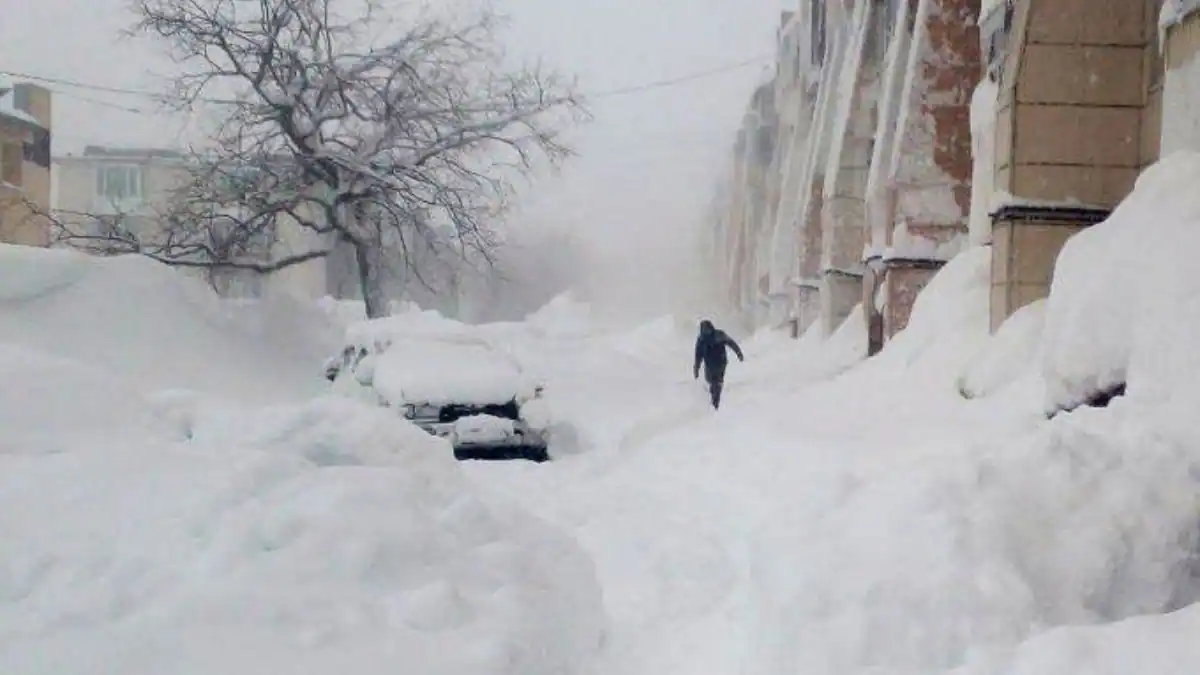
The primary theater of this environmental drama has been the Kamchatka Peninsula. By mid-January 2026, the regional capital of Petropavlovsk-Kamchatsky reported snow depths exceeding 2.5 meters (over 8 feet) in central areas, with wind-driven drifts reaching as high as 12 meters (nearly 40 feet). These massive accumulations have buried low-rise buildings up to their fourth-floor windows, forcing residents to tunnel out of their own homes or exit through upper-story balconies. The statistical weight of the event is staggering; in December 2025 alone, the region received over 370 millimeters of precipitation—more than triple the monthly average—followed by a relentless series of cyclones in January that dumped another 163 millimeters in just two weeks.
The human cost of the record snowfall has been somber. Authorities in Kamchatka declared a citywide state of emergency following several fatalities caused by “rooftop avalanches”—massive slabs of compacted snow and ice sliding off buildings and burying pedestrians below. Mayor Yevgeny Belyayev of Petropavlovsk-Kamchatsky took the drastic step of mobilizing all available resources, including military personnel and heavy industrial machinery, to clear vital supply routes. Despite these efforts, local stores have faced severe shortages of essentials like bread and milk, as the “frozen canyons” that were once city streets remained impassable for delivery trucks for days on end.
Elaborate Reasons Behind the Record Snowfall
Meteorologists and climatologists point to a perfect storm of three primary factors that converged to create this historic deluge:
1. The “Sea of Okhotsk” Cyclone Engine The immediate cause of the relentless snow in the Far East was a series of back-to-back, high-energy low-pressure systems forming over the Sea of Okhotsk. These cyclones acted like a conveyor belt, drawing in vast amounts of moisture from the relatively warm Pacific waters and slamming them into the frigid Siberian air masses sitting over the peninsula. The complex geography of Kamchatka, with its towering volcanic ranges, forced this moist air upward, leading to “orographic enhancement”—a process where mountains wring out moisture from the clouds, resulting in intensified and prolonged snowfall.
2. Sudden Stratospheric Warming (SSW) On a broader scale, the upper atmosphere played a decisive role. In late December 2025, a major Sudden Stratospheric Warming event occurred high above the North Pole. This phenomenon involves a rapid spike in temperatures in the stratosphere, which disrupts the Polar Vortex—the ring of high-speed winds that usually keeps cold Arctic air bottled up at the top of the world. When the vortex weakened and “deformed,” it allowed frigid, Arctic air to spill southward across the Eurasian landmass, creating a “deep freeze” that turned every bit of Pacific moisture into heavy, crystalline snow.
3. Arctic Amplification and Jet Stream Waviness Climate change is the silent architect of this extremity. As the Arctic warms at a rate four times faster than the rest of the planet—a process known as Arctic Amplification—the temperature gradient between the pole and the equator decreases. This weakens the Jet Stream, making it “wavy” and sluggish. Instead of weather systems moving briskly across the continent, these waves become “blocked,” causing storms to stall over a single region for days or weeks, dumping record-breaking amounts of snow in a single location rather than spreading it out across the season.
Statements from the Scientific Community
Experts have been vocal about the unprecedented nature of this winter, highlighting the link between atmospheric instability and the current crisis. “You have these two simultaneous bursts of cool air coming down from the Arctic due to a profound waviness in the jet stream,” explained Theodore Keeping, a climate scientist and extreme weather researcher. “The Arctic polar vortex, which is the massive cold air that circulates the North Pole, is relatively weak right now. What that means is it drives the jet stream less intensely, leading to these prolonged waves of frigid air that lock regions into a cycle of extreme precipitation.”
In the Far East, the perspective is focused on the rarity of the volume. An official from the Kamchatka Krai Hydro-Meteorological Department noted that the intensity is a generational event: “The extreme snowstorms that occurred on the Kamchatka Peninsula during this period are extremely rare. Our records indicate that the last similar event of this magnitude occurred in the early 1970s. We are witnessing a total redistribution of moisture that is shattering 146-year-old precipitation records.”
Reflecting on the broader implications, researchers from the World Meteorological Organization (WMO) shared a cautionary view: “The meteorological landscape for January 2026 is defined by a state of profound atmospheric instability. This is the culmination of several large-scale climatic drivers, including a structurally fragile stratospheric polar vortex and the accelerating effects of Arctic amplification. What we are seeing in Russia is a stress test for national resilience in an era of climate-driven volatility.”