24th November 2025 Geneva, Switzerland
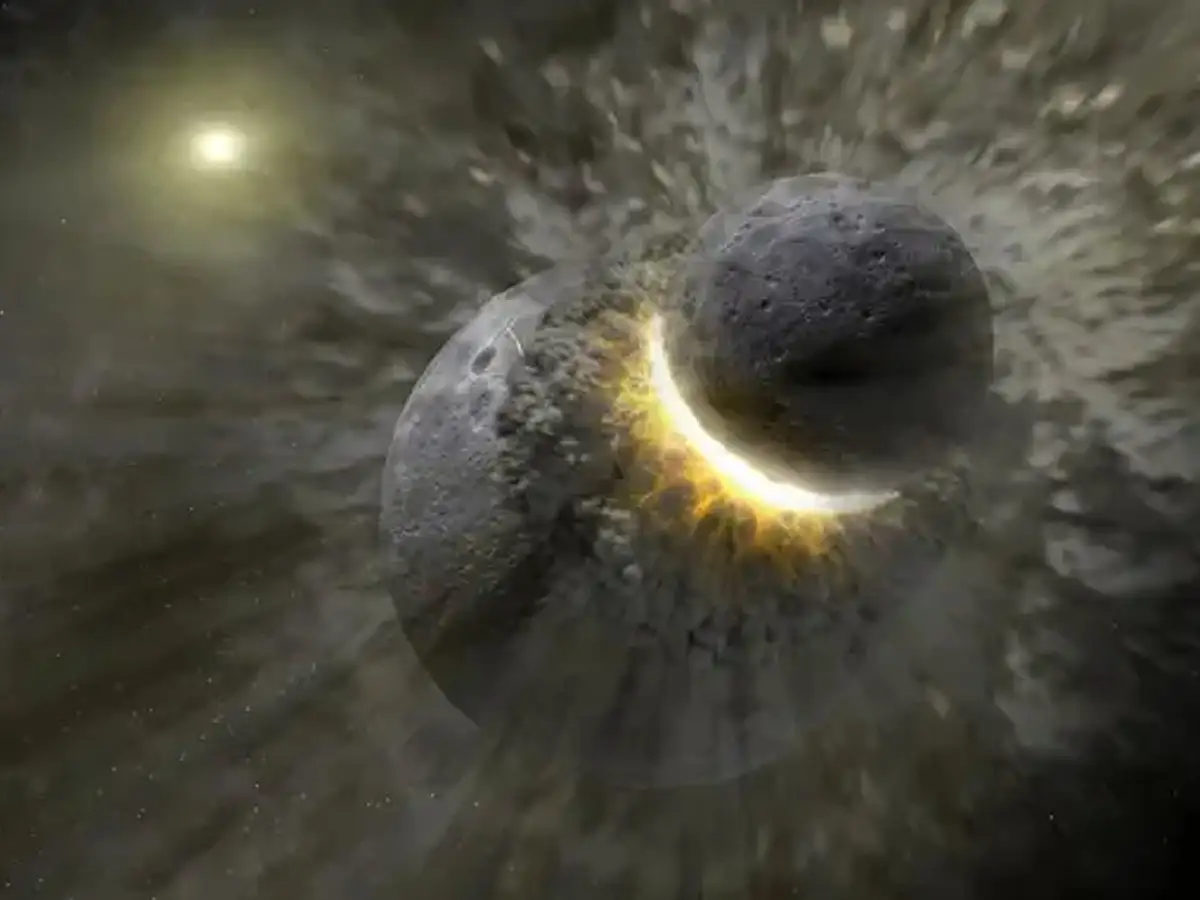
In a development that could resolve one of the solar system’s most enduring mysteries, a consortium of astrophysicists and planetary scientists today announced compelling new evidence for the existence of Theia, the ancient, Mars-sized planet whose cataclysmic collision with a young Earth is theorized to have created the Moon. The findings, which are the result of sophisticated new planetary formation models cross-referenced with deep-mantle seismology, suggest that Theia was not merely destroyed or ejected into deep space, as previously considered possible, but that significant remnants of the lost world have been residing deep within Earth’s mantle for the last 4.5 billion years. Dr. Christian Smithen of the European Planetary Science Institute, the lead author of the study published in Nature, stated, “For decades, the Giant Impact Hypothesis has been the most elegant explanation for the Moon’s existence, but it lacked a smoking gun. We believed a planet named Theia was involved, but we had no physical proof of it. Our models and the corresponding geological data are the closest we have ever come to identifying the culprit and locating its final resting place.”
The research pivots on a long-standing puzzle in planetary science: the surprising similarity in isotopic composition between Earth and the Moon. Samples returned by the Apollo missions revealed that the Moon and Earth’s mantle are twins in terms of their oxygen, tungsten, and other isotopic signatures. According to classic impact models, Theia, having formed in a different part of the solar system, should have had a distinct isotopic fingerprint. The Moon, which standard theory holds was formed primarily from Theia’s debris, should therefore look different from Earth. This contradiction has been a major thorn in the side of the Giant Impact Hypothesis. The new research provides a potential solution. The key breakthrough came from high-resolution simulations that model the planetary collision with unprecedented detail. These models suggest that Theia was not a dry, rocky body like Mercury, but a world rich in water and primordial gases, with a dense, iron-rich core and a substantial silicate mantle. The simulation shows that the impact was not a straightforward merging but a complex, high-energy event where Theia’s core rapidly sank and fused with Earth’s core, while a large portion of its mantle was shredded and mixed with Earth’s, before a fraction of that mixed material was ejected to form the Moon.
This extensive mixing in the immediate aftermath of the impact, the researchers argue, is why the Earth and Moon share such similar isotopes. Dr. Eleanor Vance, a co-author from the University of Oxford, explained, “The models show that the mantle materials of Theia and the proto-Earth would have been churned together violently and thoroughly in the hours following the impact. This homogenization process, occurring in a super-heated, vaporized disk of rock orbiting our planet, effectively erased Theia’s original isotopic identity, creating a common geochemical reservoir from which both the modern Earth’s mantle and the Moon were derived.”
The most startling claim, however, concerns the present-day location of Theia’s remains. For years, seismologists have been puzzled by two massive, distinct blobs of material buried deep within Earth’s mantle, sitting on the core-mantle boundary. Known as Large Low-Shear-Velocity Provinces (LLSVPs), these regions, one under the African continent and one under the Pacific Ocean, are thousands of kilometers across and have a different chemical composition from the surrounding mantle, making them hotter and denser. The new study posits that these are not just random accumulations but the largely intact remains of Theia’s mantle. According to the team’s models, after Theia’s core merged with Earth’s, between two to four percent of its mantle—a colossal amount of material—sank through Earth’s mantle and pooled atop the core, where it has remained relatively undisturbed for eons. The identification of the LLSVPs as the “ghost” of Theia is the study’s most dramatic conclusion, linking a deep-Earth geological mystery directly to a lunar-forming event.
Professor Kenji Tanaka of the Japan Agency for Marine-Earth Science and Technology, who was not involved in the study, commented cautiously, “This is a profoundly elegant hypothesis. Connecting the LLSVPs to the Theia impact is a bold and imaginative leap. It elegantly solves the isotopic similarity problem by suggesting the Moon was forged from a well-mixed blend of both worlds, while also providing a tangible, present-day relic of the impactor itself. However, the geodynamic community will need to rigorously test this. We must determine if the predicted mineralogy and density of these blobs match what our seismic models tell us about the LLSVPs.”
The implications of this discovery are far-reaching. If confirmed, it means that Earth is not a single planet but a hybrid, a planetary chimera that incorporated a primordial sibling. Furthermore, the Theian material in the mantle may play a crucial and previously unappreciated role in driving Earth’s geology. These dense, heat-producing blobs are thought to be the source of deep-seated mantle plumes that fuel the world’s most powerful volcanic events, such as those that created the Deccan Traps or the Hawaiian island chain. In a very real sense, the remains of the planet that gave us our Moon may still be shaping the continents and climate of our world today.
The next steps for the research team involve seeking more direct evidence. Plans are underway to analyze helium and other noble gas isotopes from deep-mantle plumes that reach the surface at hotspots like Iceland and Samoa. If these gases show a primordial signature distinct from the rest of the mantle, it would be a powerful, independent line of evidence supporting the Theia origin of the LLSVPs. While the case is not yet fully closed, the scientific community is abuzz with the possibility that a 4.5-billion-year-old planetary mystery has finally been solved, revealing that the missing piece of the puzzle has been hiding in plain sight, buried deep beneath our feet all along.