
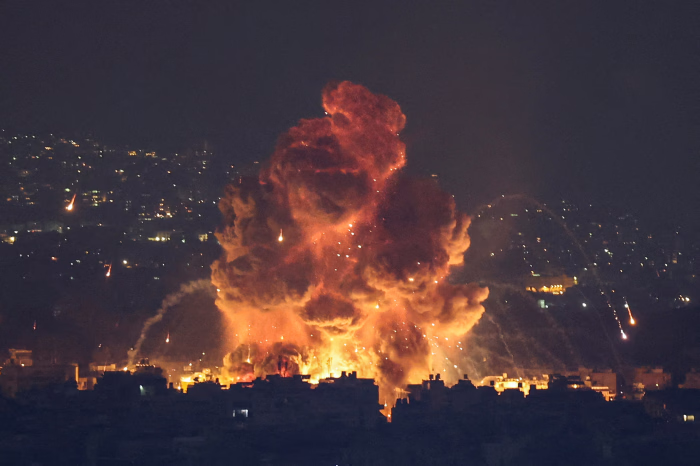
The environmental fallout of a full-scale conflict between Iran, Israel, and the United States in 2026 represents an ecological tipping point for the Middle East, transitioning from a regional crisis to a global climate event. The sheer volume of petrochemical fires ignited by targeted strikes on refineries in the Persian Gulf has released a concentrated “black carbon” plume that scientists estimate has the warming potential of several small nations’ annual emissions. Beyond the immediate heat, these particles settle on the surrounding peaks of the Alborz and Zagros mountains, darkening snowpacks and accelerating glacial melt, which threatens the long-term water security of millions who rely on seasonal runoff.
“The scale of atmospheric loading we are witnessing is unprecedented in the 21st century,” says Dr. Aris Voulgarakis, a leading climate scientist specializing in forest fires and industrial emissions. “When you have millions of barrels of crude oil burning in open-air pits, you aren’t just releasing $CO_2$; you are injecting primary particulate matter directly into the troposphere. This ‘black rain’ doesn’t just stain buildings; it alters the albedo of the entire region, creating a feedback loop of localized heating that could make parts of the Iranian plateau virtually uninhabitable during the summer months.”
The destruction of desalination infrastructure along the Gulf coast has introduced a secondary, more insidious crisis: the “salinity spike.” As power grids fail and plants are targeted, the cessation of controlled brine discharge, coupled with chemical leaks from damaged facilities, has created hypoxic “dead zones” in the water. The Persian Gulf, already a shallow and stressed body of water, is struggling to dilute the influx of heavy metals and unrefined petroleum. This has led to mass die-offs of dugongs and sea turtles, and the collapse of artisanal fisheries that have sustained coastal communities for centuries.
“We are observing a systemic failure of the marine trophic web,” notes Dr. Elena Rossi of the Mediterranean Institute of Oceanography. “The synergy of thermal pollution from fires and chemical toxicity from sunken naval assets creates a ‘toxic soup.’ We aren’t just losing individuals; we are losing the genetic diversity of coral reefs that took millennia to adapt to the Gulf’s high temperatures. Once these thermal refugia are gone, they do not come back in a human lifetime. The war is effectively erasing the biological memory of the ocean.”
Furthermore, the widespread use of heavy munitions and bunker-busters has led to deep-crust soil contamination. In the “Fertile Crescent,” the impact of depleted uranium and perchlorates from missile propellants has rendered vast swaths of agricultural land hazardous. As these toxins leach into the Tigris and Euphrates river systems, the agricultural heartland of the region faces a future of “chemical drought,” where water may be physically present but biologically and chemically unfit for irrigation or human consumption.
“The tragedy of modern kinetic warfare is its persistence,” explains Dr. Michael Mason, an environmental geographer. “The landscape itself becomes a weapon against the survivors. We see the migration of ‘forever chemicals’ from military strike zones into the groundwater tables that feed orchards in Isfahan and Galilee alike. This is a form of ‘slow violence’—the environmental effects of these three weeks of high-intensity combat will manifest as spikes in congenital birth defects and chronic illnesses for the next three decades. The ecology does not recognize national borders or political grievances; it simply absorbs the trauma and passes it back to the population through the food chain.”
Projected Migration of the “Black Rain” Plume: A Regional Atmospheric Event
The defining environmental characteristic of this conflict is the massive atmospheric injection of black carbon and toxic aerosols arising from the persistent burning of oil facilities, particularly around Tehran, Abadan, and the Haifa industrial zone. Unlike a simple smoke cloud, this “toxic plume” is a complex, chemically reactive body that is interacting dynamically with the unique meteorology of the Middle East. Meteorological simulations now project the plume’s trajectory based on the predominant westerly and northwesterly winds known as the Shamal, creating a footprint that extends thousands of kilometers from the source points.
The immediate concern is the deposition zone. The plume is projected to move eastward across northern Iran, Afghanistan, and into the Indus River Valley of Pakistan, potentially impacting major population centers like Lahore and New Delhi by the end of March. When this aerosol mass interacts with cold, moist air over the Zagros and Alborz mountain ranges, it creates the phenomenon termed “Black Rain.” These mountains act as environmental barriers, forcing the deposition of heavy, toxic particulate matter directly onto high-altitude snowpacks and glaciers. This “darkening” of the snow drastically reduces its albedo (reflectivity), causing the snow to absorb more solar radiation and melt prematurely.
This accelerated melting directly threatens the hydrologic cycles of regional rivers, which are the primary source of water for both Iran and Iraq. The Karkheh and Karun rivers, already historically low due to climate change, are now receiving pulses of meltwater that are heavily contaminated with Polycyclic Aromatic Hydrocarbons (PAHs), heavy metals like vanadium and nickel (characteristic of Iranian crude), and acidic sulfates. This contamination is not transient; the toxins settle into the river sediments and floodplains, ensuring their persistence in the hydrological system.
Furthermore, a significant portion of the finer particulate matter is being lifted by high-altitude winds and is now crossing the Arabian Sea, impacting air quality as far as western India. Satellite data confirms that the regional atmosphere’s Optical Depth (AOD)—a measure of pollution—has spiked to levels five times higher than previous historical maximums for this time of year, effectively creating a “regional nuclear winter” effect where daylight is dim, temperatures drop slightly, and photosynthesis in the agricultural heartlands is severely inhibited.
Long-Term Health Risks: The Soil and Groundwater Legacy
While the atmospheric event is immediately visible, the long-term environmental toxicity left in the ground is the more insidious crisis. The widespread use of bunker-busting munitions and kinetic strikes on chemical manufacturing sites has caused “chemical cratering.” These deep-penetration explosions do not just destroy infrastructure; they create pathways for toxic materials—many of which are classified as Persistent Organic Pollutants (POPs)—to contaminate regional groundwater aquifers that have been protected for millennia.
The landscape is now saturated with heavy metals like lead, tungsten, and mercury from munitions and missiles. These materials possess high solubility in acidic environments (like those created by “Black Rain” deposition) and migrate rapidly into agricultural soils. Crops such as rice and wheat, staples across the region, are particularly effective at bioaccumulating these toxins from the soil. The consumption of food grown in these contaminated soils will inevitably lead to a long-term public health disaster. Medical experts are projecting dramatic increases in chronic conditions, including kidney failure, neurological disorders, and a wide array of cancers (particularly lung, liver, and blood cancers), which are directly correlated with exposure to PAHs and heavy metals.
Perhaps the most persistent contaminant, however, is PFAS (per- and polyfluoroalkyl substances). These “forever chemicals,” used extensively in firefighting foams during the relentless battles to control oil fires, do not degrade. They infiltrate water supplies and the human body, leading to systemic health failures. Communities residing downwind of industrial targets, and those relying on aquifers beneath bombed zones, face an invisible, multi-generational threat. The environmental legacy of the 2026 war is not just a localized scar; it is a permanent alteration of the Middle East’s biological and chemical landscape, requiring global scientific intervention that is currently hampered by the ongoing kinetic conflict.