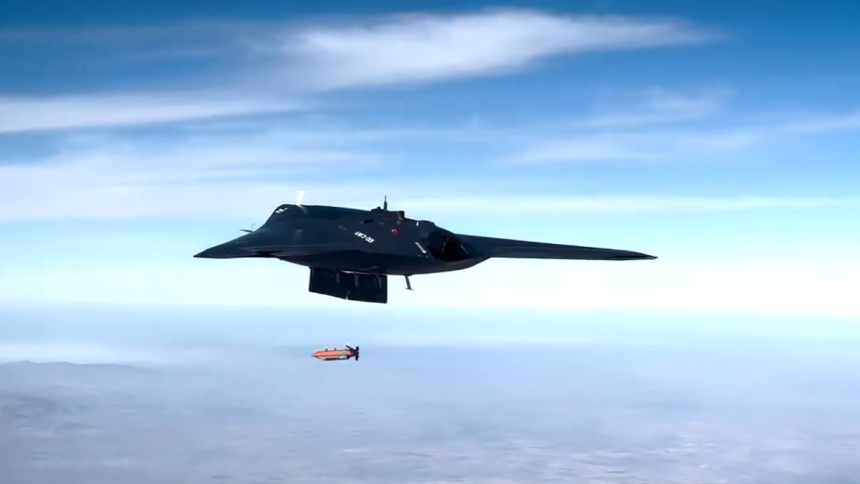
Turkey’s ANKA-III stealth drone has rapidly evolved from a developmental project into a cornerstone of the nation’s ambitious defense strategy, showcasing a transformative vision for modern air power. Developed by Turkish Aerospace Industries (TUSAŞ), this flying-wing unmanned combat aerial vehicle (UCAV) represents a significant leap forward, moving beyond the capabilities of earlier drones like the Bayraktar TB2 to offer a stealthy, high-performance platform for strike and intelligence missions . The ANKA-III, which successfully completed its maiden flight in December 2023, is designed for low radar observability, featuring internal weapons bays and a tailless configuration that allows it to operate effectively in contested airspace . With a length of 7.9 meters, a wingspan of 12.5 meters, and a maximum take-off weight of 6.5 tons, it can carry a payload of up to 1,200 kilograms . Powered by a single turbofan engine, the ANKA-III can reach a top speed of Mach 0.7 (approximately 489 mph) at 30,000 feet and has a service ceiling of 40,000 feet, with an endurance of up to ten hours .
The aircraft’s development has been marked by a rapid and successful testing program that has consistently expanded its operational capabilities. In a landmark achievement for Turkish aviation, the ANKA-III successfully released a TOLUN precision-guided munition from its internal weapons bay in January 2025, demonstrating the full functionality of its stealth-oriented design . This was followed by tests where the drone fired other munitions, such as the LGK-82 guided bomb, proving its potency as a strike platform . Its role is further envisioned as a “loyal wingman,” and in October 2024, it successfully completed a test where it was remotely controlled by a manned aircraft, a crucial step towards integrating it into a manned-unmanned teaming (MUM-T) concept . This concept is central to Turkey’s future air combat doctrine, where the ANKA-III will operate alongside the manned KAAN fighter jet, acting as a forward sensor and weapons carrier under human supervision . The Turkish Air Force’s commitment to this vision is underscored by its plan to acquire an initial batch of over 50 ANKA-III units in 2026, signaling a major shift from development to large-scale production and operational integration .
However, the most groundbreaking development in the ANKA-III’s story is its transformation from a mere strike aircraft into a “flying aircraft carrier” for smaller autonomous drones . In August 2026, TUSAŞ released imagery and video of an ANKA-III flying with two jet-powered SÜPER ŞİMŞEK UAVs mounted under its wings . This demonstration represents a significant evolution from an earlier test in April 2025, where a single SÜPER ŞİMŞEK was successfully released in flight . The new configuration, which TUSAŞ titled “Gizli Güç!” (Secret Power), shows the ANKA-III carrying and preparing to deploy these autonomous wingmen . This capability allows the ANKA-III to carry smaller, expendable systems deep into hostile territory and release them to perform a variety of missions . The SÜPER ŞİMŞEK itself is a highly versatile, multi-role platform. Approximately four meters long with a maximum take-off weight of 200 kilograms, it can carry a 50-kilogram payload, reach speeds of up to Mach 0.85, and has an operational range of 900 kilometers .
The tactical implications of this mothership-wingman dynamic are profound, as it facilitates a layered and networked approach to air combat. The SÜPER ŞİMŞEK can be configured for several roles: it can act as a radar decoy by amplifying its own radar and infrared signatures to mimic a larger, more valuable aircraft like an F-16, thereby drawing enemy fire . It can also be equipped for electronic warfare, jamming enemy signals, or it can serve as a loitering munition to strike high-value targets . In one operational scenario, the ANKA-III could release its SÜPER ŞİMŞEK drones to saturate and confuse enemy air defenses. Once the defenses reveal their positions by engaging the decoys, the ANKA-III, still holding its own internal munitions, can then strike the now-exposed targets . This effectively turns a single stealth platform into a distributed, multi-effect combat network. In a broader sense, this creates a three-tiered system where a human-piloted KAAN commands one or more ANKA-IIIs, which in turn deploy swarms of SÜPER ŞİMŞEK drones, exponentially increasing a single mission’s reach, lethality, and survivability .
Ultimately, the ANKA-III is more than just a new drone; it is a symbol of Turkey’s growing self-reliance and ambition in the defense sector. By developing this advanced platform and its novel “loyal wingman” ecosystem, Turkey is positioning itself as a major player in the global arms market, challenging established producers and offering affordable, high-tech alternatives with fewer export restrictions . The program demonstrates a clear strategic shift from being a traditional arms importer to a key exporter, leveraging its combat-proven drone legacy to build a sophisticated and disruptive air power model centered on networked, autonomous combat . The ANKA-III’s ability to carry and coordinate its own drone swarm represents a paradigm shift in aerial warfare, one that could significantly alter military balances in regions like the Middle East and the Aegean, and offers a compelling glimpse into the future of autonomous combat .