
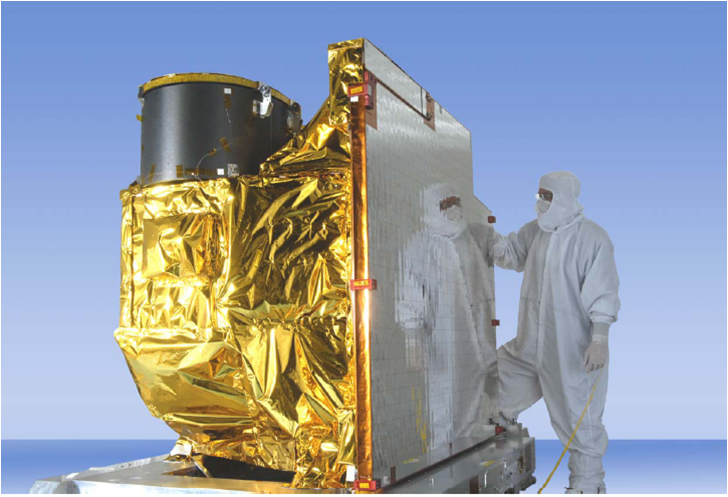
When we gaze upon images of satellites drifting silently against the black velvet of space, or watch footage of astronauts unfolding equipment during a spacewalk, one visual element consistently captures public curiosity: the unmistakable golden or sometimes silver, crinkled foil that seems to wrap these sophisticated machines like a delicate Christmas present. To the untrained eye, this material might appear to be a simple protective cover or perhaps a decorative choice, but in the unforgiving environment of outer space, this “foil” is nothing less than a matter of life and death for the mission. This iconic covering is scientifically known as Multi-Layer Insulation (MLI) , and it represents one of the most critical, yet often misunderstood, engineering achievements in space exploration. Its primary and most vital function is to serve as a sophisticated passive thermal control system, tasked with the monumental challenge of protecting sensitive onboard instruments from the extreme and rapid temperature variations that define the space environment.
In the vacuum of orbit, the absence of air fundamentally changes the rules of thermodynamics; traditional methods of heat transfer like conduction and convection are rendered largely ineffective, making thermal radiation the dominant and almost exclusive mechanism for heat exchange. Without this protective barrier, a satellite in direct, unfiltered sunlight can be heated to over 200°C, while its shadowed side, facing the cold depths of the cosmos, can plummet to below -200°C. This staggering temperature differential, which can exceed 400°C across a single spacecraft, would easily destroy sensitive electronics, warp structural materials, and render the multi-million-dollar mission a catastrophic failure. The MLI acts as a highly efficient thermal blanket, or more accurately, “thermal armor,” maintaining a stable, habitable internal temperature for the spacecraft’s optimal operation.
The visual of a satellite wrapped in “gold foil” is not an accident of manufacturing but an elegant and highly effective solution to a complex physical problem. It is crucial to clarify a common misconception: the “gold” color is not derived from solid gold foil but from the specific materials used in the outer layer of the MLI. This outer layer is frequently made from a polyimide film, most famously known by the trade name Kapton, which is then coated with a microscopically thin layer of metal, typically aluminum or gold. The distinctive golden-yellow hue is the natural color of the Kapton film itself, not the metal coating; in fact, aluminized Kapton is the source of the golden-yellow color we associate with satellites, not a solid gold casing. The structure of MLI is deceptively complex, functioning like a “multi-layer blanket” composed of dozens of alternating layers of this reflective film and a net-like spacer material, such as fiberglass or Dacron mesh.
These layers are carefully stacked, with each layer separated by the spacer to prevent direct physical contact, which would allow heat to conduct between them. The brilliance of this design lies in its physics: the multiple reflective surfaces create a series of radiative barriers. Heat attempting to pass through the blanket must be absorbed and re-radiated by each successive layer, losing energy with each transfer. By carefully designing the MLI, engineers can configure it to either reflect intense solar radiation away from the spacecraft and radiate its own internal heat outward, or to retain heat and prevent it from escaping into the cold of space, depending on the satellite’s specific orbital path and operational requirements. The MLI is so effective that its insulating power in a vacuum is comparable to that of a wall of bricks several meters thick, demonstrating how thin films can achieve extraordinary thermal protection.
Beyond the paramount function of thermal control, the MLI provides several other crucial benefits that contribute to the longevity and success of the mission. The outer layer of the blanket serves as a protective barrier against harmful radiation, including ultraviolet rays from the sun and high-energy cosmic rays, which can damage electronics, degrade materials, and cause single-event upsets in computer systems over time. This shielding is vital for deep-space missions where the craft operates outside the protective magnetosphere of Earth. The material also offers a degree of physical protection from micrometeoroids and tiny orbital debris, which travel at immense speeds—often exceeding 10 kilometers per second—and can puncture thin spacecraft walls or damage critical surfaces.
While the MLI is not designed to stop a large impactor, the multiple layers can dissipate the energy of tiny particles, reducing the risk of catastrophic penetration. Furthermore, the choice of materials like Kapton and its metallic coatings provides exceptional resistance to corrosion and outgassing in the vacuum environment. Outgassing—the release of trapped gases from materials in a vacuum—is a significant concern in space engineering, as these released molecules can condense on sensitive optical surfaces like lenses and solar panels, fogging them and reducing their efficiency. The stable chemical structure of polyimide ensures minimal outgassing, ensuring the longevity and reliability of the spacecraft’s instruments. In some specific advanced applications, the unique properties of gold, such as its ability to reflect infrared radiation more effectively than aluminum or to become stronger under intense laser pulses, are being explored for next-generation protective systems and futuristic propulsion concepts.
The manufacturing and application of MLI is a highly specialized and meticulous process. The production of the blanket requires precision cutting and sealing, as even a microscopic hole in the outer layer can compromise the insulation’s performance. Engineers use specialized techniques to bond the layers together at specific points, known as “quilting,” to prevent the layers from ballooning or shifting during the violent vibrations of launch, while still maintaining the necessary gaps for insulation. The intricate process of creating a custom MLI blanket for each unique spacecraft is a testament to the bespoke nature of space engineering; there is no one-size-fits-all solution.
The blanket must be designed to accommodate sensitive components like thruster nozzles, sensor apertures, and antennae, requiring complex cutouts and seam seals. This versatility is why the “golden foil” is a cornerstone of spacecraft design. It is not a simple “wrap” but a meticulously engineered, multi-functional system that acts as a passive thermal control system, functioning like a built-in air conditioner to safeguard the satellite from the deadly extremes of space while simultaneously offering radiation protection and debris shielding. The shiny, gold appearance is the visible mark of a complex technology that is fundamental to the success of any space mission, from the smallest CubeSat to the largest space telescope.
The historical evolution of MLI is a fascinating journey from early, bulky thermal control methods to the sophisticated, thin-film technology we see today. In the earliest days of space exploration, such as with Sputnik and the first Mercury capsules, engineers relied on more rudimentary methods like polished metal surfaces, paints, and mechanical louvers to manage heat. These systems were heavy, mechanically complex, and prone to failure. The breakthrough came with the development of high-performance polymer films and vacuum-deposition techniques for metal coatings in the 1960s and 1970s. Pioneering work by NASA and aerospace contractors led to the first true MLI blankets, which were used on missions like the Apollo spacecraft and the Viking landers. Over the decades, the technology has been refined, with materials becoming thinner, more durable, and more reflective. Today, the evolution continues with the development of “smart” MLI that can change its emissivity properties on demand, and the integration of flexible solar cells and printed electronics directly onto the blanket’s surface, pushing the boundaries of what this “foil” can achieve.
Looking toward the future, the role of MLI is set to become even more critical and complex. With the advent of commercial space stations, lunar bases, and the ambitious goal of sending humans to Mars, thermal management in space is a primary concern. For these long-duration habitats, MLI will need to provide even greater insulation over much larger structures, potentially requiring kilometers of material. Researchers are currently investigating advanced materials like graphene and carbon nanotubes to create ultra-lightweight, high-strength MLI that offers superior thermal protection and can be deployed autonomously.
There is also significant research into “deployable” MLI, which can be folded up for launch and then expanded in orbit to create large thermal shields, solar shades, or even protective “tents” for lunar and Martian bases. The integration of thermoelectric devices into MLI is another promising avenue, where the temperature difference across the blanket could be harnessed to generate small amounts of electricity to power sensors, reducing reliance on batteries. These innovations will allow spacecraft and surface habitats to venture further into the solar system, where thermal challenges become even more extreme—for instance, on the surface of Venus, where temperatures are hot enough to melt lead, or in the outer reaches of the solar system near Jupiter and Saturn, where sunlight is a mere whisper.
The material choices for MLI are also undergoing a green revolution. Traditional Kapton and its production processes involve complex chemical treatments. The space industry, under increasing pressure to adopt sustainable practices, is exploring bio-based polyimides and recyclable metallic foils that could reduce the environmental footprint of satellite manufacturing. This is crucial as the number of satellites being launched into orbit, driven by the explosive growth of mega-constellations for global internet coverage, increases exponentially, leading to more material production and, eventually, more space debris. Furthermore, the challenge of end-of-life disposal is becoming more pressing. Engineers are researching MLI that can be designed to break down or burn up completely during atmospheric reentry, contributing to the goal of a “zero-debris” space environment. This dual focus on performance and sustainability is shaping the next generation of MLI, ensuring that it remains the material of choice for decades to come.
Another intriguing aspect of MLI is its role in the search for extraterrestrial life. Spacecraft sent to icy moons like Europa or Enceladus, which harbor subsurface oceans, must carry instruments to detect biosignatures. MLI is critical for these missions to maintain the cryogenic temperatures required for these sensitive instruments, while also protecting them from the intense radiation belts of Jupiter. The design of MLI for such missions is particularly challenging because it must balance extreme thermal insulation with the need to shield against radiation without interfering with the scientific instruments. The success of future astrobiology missions hinges on the reliability of MLI; if the thermal blanket fails, the instruments could overheat, and the dream of finding life beyond Earth would be jeopardized. This underscores that MLI is not just a practical solution for heat management, but an enabling technology for humanity’s grandest scientific endeavors.