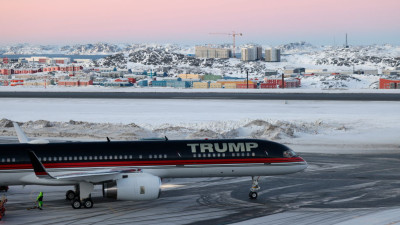
The pursuit of Greenland is a cornerstone of a “New Arctic” doctrine, viewing the territory not as a remote island, but as a geostrategic fortress. The primary motivation is national security, specifically the integration of Greenland into a “Golden Dome” missile defense shield to counter hypersonic threats. Economically, the island is a mineral goldmine, containing the rare earth elements necessary to break China’s global monopoly on high-tech manufacturing. As polar ice melts, the administration seeks to secure Arctic trade routes and naval chokepoints, framing the acquisition as an essential move to ensure American hegemony in a rapidly changing global landscape. The following report outlines the core reasons behind this fixation and the current state of the “Greenland Crisis.”
The Strategic Fortress: Missile Defense and the “Golden Dome”
The primary driver behind the push for control is Greenland’s unique geography. It sits directly on the shortest flight path for ballistic missiles traveling between Russia or China and North America. The U.S. already operates the Pituffik Space Base (formerly Thule Air Base) in the far north, which houses advanced early-warning radar systems. However, the current administration views mere “access” via treaties as insufficient. The goal is to integrate Greenland into the proposed “Golden Dome” missile defense shield, a sophisticated network of space-based interceptors and ground-based sensors. By having full sovereignty, the U.S. could expand military infrastructure without the “bureaucratic friction” of Danish or Greenlandic environmental and political oversight. This is viewed as essential for countering the rapid modernization of Russian and Chinese hypersonic and nuclear arsenals.
The Rare Earth Goldmine: Breaking China’s Monopoly
Greenland holds some of the world’s largest untapped deposits of critical minerals and rare earth elements (REEs). These materials—including neodymium, terbium, and dysprosium—are the lifeblood of modern technology, essential for everything from F-35 fighter jets and cruise missiles to electric vehicle motors and wind turbines. Currently, China controls over 80% of the global supply chain for these minerals. The U.S. identifies this as a “dangerous vulnerability.” The administration views Greenland as a “near-domestic” solution to resource security. In early 2026, the U.S. backed Critical Metals Corp began work on a pilot extraction plant in southern Greenland, signaling a shift toward direct industrial intervention. The logic is simple: whoever controls Greenland’s minerals controls the future of both the green energy transition and advanced military manufacturing.
The “GIUK Gap” and Arctic Hegemony
As climate change accelerates, the Arctic is melting at four times the global average, opening the Northwest Passage and other transpolar shipping routes. These “new arteries of global trade” could significantly shorten the journey between Europe and Asia, bypassing the Suez Canal. Greenland is the anchor of the GIUK Gap (Greenland, Iceland, and the UK), a strategic naval chokepoint. Control over the island allows the U.S. to monitor and restrict Russian submarine activity moving from the Arctic into the North Atlantic. With China declaring itself a “Near-Arctic State” and investing in the “Polar Silk Road,” the U.S. obsession is an attempt to preemptively claim the “high ground” before these waters become fully navigable and contested by rival navies.
Economic Coercion and the “Hard Way” Strategy
The diplomatic situation reached a boiling point in early 2026. After Greenland and Denmark repeatedly stated the island is “not for sale,” the U.S. moved toward coercive diplomacy.
-
Tariff Warfare: In January 2026, the U.S. announced a 10% tariff on Denmark and several other European allies, specifically citing their “unauthorized” military exercises in Greenland as a threat to world security.
-
Societal Influence: Reports surfaced of a “charm offensive” involving U.S. influencers and unofficial envoys (like Jeff Landry) attempting to bypass Copenhagen to deal directly with Greenlandic leadership, promising that U.S. ownership would make Greenlanders “the richest people in the world” through direct cash payments and infrastructure investment.
The Sovereignty Standoff and NATO Stability
The obsession has created a rift within NATO. European leaders, including the UK, France, and Germany, have formed a unified front supporting Danish sovereignty. They argue that Greenland belongs to the Greenlanders and that the U.S. can achieve its security goals through existing cooperation. The administration’s counter-argument is that “Denmark cannot defend Greenland” from the combined interests of Russia and China. This “security-first” framing is also a legal maneuver intended to justify potential annexation or a “forced lease” under emergency powers, bypassing traditional international law that protects territorial integrity.