March 30, 2026
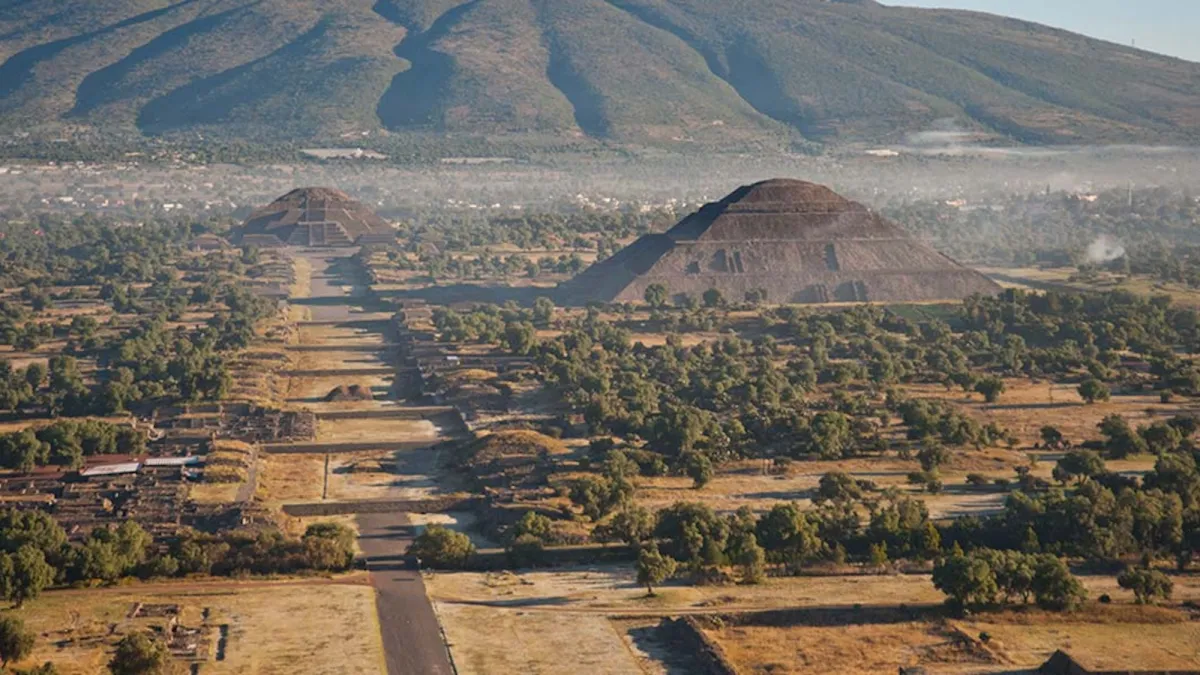
In a revelation being hailed as the single most significant breakthrough in Mesoamerican archaeology in a century, a multidisciplinary team has officially announced that they have cracked the “mysterious code” of Teotihuacan, deciphering the complex system of symbols, murals, and geometric glyphs that have eluded scholars since the ancient metropolis’s abandonment over 1,400 years ago. For generations, the ancient city of Teotihuacan, located in the Basin of Mexico, has stood as a silent enigma; while the Maya left behind a deciphered written language and extensive codices, the builders of the Pyramid of the Sun and the Pyramid of the Moon left no obvious text, forcing experts to speculate about the identity of their rulers, their belief systems, and even the name they called themselves. That silence has now been shattered. By combining high-resolution spectral imaging of fading mural sequences in the residential compounds of the lost city with a revolutionary new AI-driven pattern recognition algorithm designed to map linguistic syntax against visual art, the international team has demonstrated that the city’s art is not merely decorative but constitutes a sophisticated visual-linguistic system—a true “code” blending logograms, syllabic signs, and spatial arrangement that functioned as the empire’s administrative and liturgical language.
The lead epigrapher on the project, Dr. Arisbeth Morales of the National Institute of Anthropology and History (INAH), described the moment of realization during a press conference held this morning at the site museum. “For decades, we treated these symbols as isolated religious motifs. We were looking at the words but not understanding the grammar. When the algorithm began predicting the placement of specific warrior symbols alongside phonetic complements related to ‘speech’ and ‘authority,’ we realized we were looking at proper names—specifically, the names of rulers and perhaps a council of lords,” Dr. Morales stated, her voice carrying the weight of a lifetime of study. The breakthrough centers on what researchers are now calling the “Teotihuacan Syntactic Grid,” a geometric organizational principle where the arrangement of specific motifs—such as the “speech scroll,” the “jaguar,” and the “feathered serpent”—in relation to architectural spaces and cardinal directions creates coherent declarative statements.
The key to the decipherment was a shift in perspective. Previous attempts failed because scholars attempted to read the symbols linearly, as one would read a Maya glyph block or Latin text. However, the new research, published simultaneously in Science and Arqueología Mexicana, reveals that Teotihuacan’s code operates on a spatial-grammatical system, where meaning is derived from the relationship between a symbol, its orientation, its material substrate, and its distance from other symbols within a defined architectural “frame.” The AI model, trained on over 10,000 high-resolution scans of murals from the Tepantitla, Tetitla, and Atetelco complexes, identified recurring triadic structures that appear to function as verbs—specifically denoting acts of “foundation,” “conquest,” and “sacred debt.” By cross-referencing these with stable isotopic data from royal burial chambers discovered in the 2000s beneath the Temple of the Feathered Serpent (also known as the Temple of Quetzalcoatl), the team was able to match specific symbol clusters to specific individuals.
For the first time, archaeologists have tentatively identified the names of Teotihuacan’s rulers, moving beyond the generic “Spearthrower Owl” monikers derived from later Maya texts. Dr. Michael E. Smith, a professor of anthropology at Arizona State University who was not directly involved in the primary research but has reviewed the data, called the findings “a paradigm shift. If the identification of these syntactic rules holds up to further scrutiny, it transforms Teotihuacan from a city known only by its architecture into a city with a voice. We are no longer looking at silent ruins; we are looking at a library written in stone and pigment.”
The implications of the deciphered code are already rewriting the history of the pre-Columbian Americas. One of the first major translations pertains to the city’s own name. For centuries, the Aztec name “Teotihuacan,” meaning “the place where the gods were created,” was used, though it was likely not the original name. Based on the newly translated glyphs found repeated in the central plaza and the Ciudadela, the researchers assert that the inhabitants likely called their metropolis “Tollan-Xicocotitlan” —a name previously associated with the later Toltec capital, suggesting that Teotihuacan’s legacy was so profound that subsequent civilizations effectively “rebranded” their own cities using the sacred name of the ancient giant.
More explosively, the code has shed light on the political structure of the city, which long divided scholars between theories of single-king rule versus collective governance. The deciphered texts describe a system of quadripartite leadership—four lords who governed the four cardinal districts of the city—operating under a singular, semi-divine figure whose title translates to “He Who Speaks for the Hearth.” This title was not hereditary, according to the murals of the Palace of the Sun, but was instead earned through military conquest and ritual performance. Furthermore, the code has confirmed long-held suspicions regarding Teotihuacan’s geopolitical dominance. Murals in the “Avenue of the Dead” complex detail specific conquests against Maya city-states in the 4th century CE, listing rulers by their deciphered Maya names alongside Teotihuacan war symbols.
Dr. David Stuart, the renowned Mayanist epigrapher from the University of Texas at Austin, commented on this aspect, stating: “We’ve always known Teotihuacan was a dominant military power because of Maya texts describing the ‘arrival’ of strangers. Now, for the first time, we are reading the conquerors’ account. It is not just history; it is the victor’s narrative, written in their own hand. It humanizes them in a way we have never been able to achieve before.” As the team prepares to release a full translation lexicon over the coming months, the archaeological community is bracing for a complete reassessment of the Classic period, moving the enigmatic metropolis from the realm of prehistoric mystery into the sharp focus of historical record, where its rulers, wars, and sacred philosophies can finally be articulated not through guesswork, but through the words they left behind on their walls.