
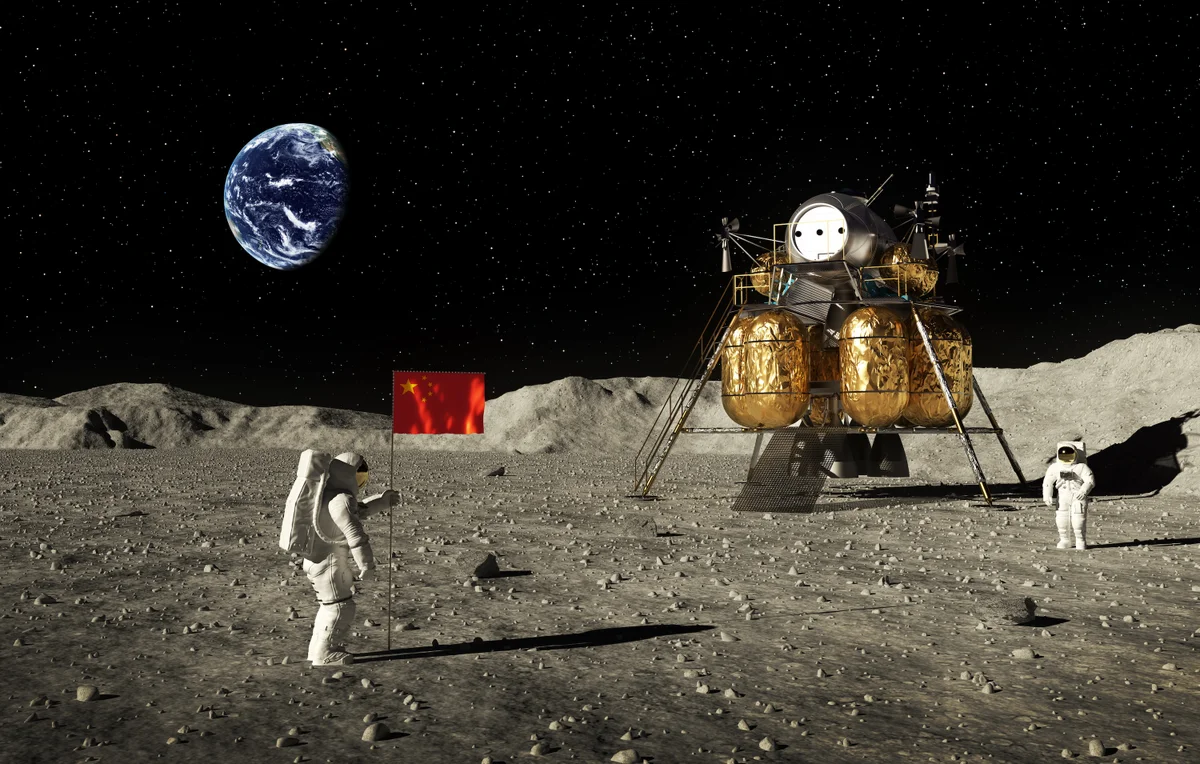
As of this date, China is not only planning a human mission to the Moon but is actively accelerating its hardware production, infrastructure development, and scientific site selection to achieve a historic crewed lunar landing before the end of the decade. Contrary to any speculation that the program might be slowing, official Chinese sources and international scientific analysis confirm that the country is in a full sprint to land its first “taikonauts” on the lunar surface by 2030, with multiple critical milestones achieved in early 2026 that place Beijing in a tight, competitive race with NASA’s Artemis program .
The centerpiece of this ambitious plan involves two massive pieces of hardware: the Long March 10 heavy-lift rocket and the Mengzhou (“Dream Vessel”) crew spacecraft. In a major leap forward, on February 11, 2026, China successfully conducted an integrated test flight at the Wenchang Space Launch Site that combined a low-altitude demonstration of the Long March 10 with a high-stakes maximum dynamic pressure (Max Q) abort test of the Mengzhou capsule . This test was specifically designed to validate the spacecraft’s ability to escape a failing rocket during the most dangerous phase of ascent. “This was a highly significant flight test, especially the retrieval technologies, which are entirely new to us,” stated Zhou Jianping, chief designer of China’s manned space program. “Achieving success on the very first attempt represents a leapfrog development” . The mission also marked China’s first successful sea landing and recovery of a capsule intended for human deep-space travel, a critical capability for returning crews from the Moon .
Beyond the flight hardware, the ground infrastructure is undergoing a massive transformation. Official announcements from the China Manned Space Agency (CMSA) in late February 2026 revealed that the country is “全力推进” (going all out) in building the supporting facilities at Wenchang specifically for the lunar mission . This includes the construction of dedicated vertical assembly buildings to support the two separate launches required for the mission: one rocket will carry the Mengzhou crew ship, while a second will carry the Lanyue (“Embracing the Moon”) lunar lander. The two craft will rendezvous in lunar orbit before descending to the surface . Furthermore, China is pushing the limits of human spaceflight endurance in low Earth orbit as a precursor to deep space travel. The Shenzhou-23 mission, planned for 2026, will include a one-year orbital stay for one of its crew members, doubling the standard six-month rotation to study the long-term effects of microgravity on the human body before committing to a lunar voyage .
One of the most compelling developments in recent weeks has been the narrowing down of the actual landing site. While NASA is fixated on the treacherous, water-ice-rich lunar south pole for its Artemis missions, Chinese scientists have identified a scientifically rich yet geologically safer alternative near the equator. A peer-reviewed study published in Nature Astronomy on March 9, 2026, highlights the Rimae Bode region as a high-priority candidate for China’s first crewed mission . Located on the lunar nearside, this area offers flat terrain, constant sunlight for power, and a direct line of sight for communication with Earth—advantages that reduce risk for a first-time landing. “Think of it as a prime piece of lunar real estate,” explained Jun Huang, a planetary geologist at the China University of Geosciences who led the study. “Its location near the equator provides much flatter, safer terrain for landing, along with constant sunlight for power… and a direct line of sight to Earth for easy communication. Scientifically, it’s like a geological ‘all-you-can-eat buffet’ that the south pole can’t provide” . The study suggests that samples from this volcanic region could unlock secrets of the Moon’s interior evolution.
However, the program is not without its geopolitical overtones and technical hurdles. The United States, under NASA’s Artemis program, is planning its own return to the lunar surface (currently slated for 2028), and there is a distinct possibility that China could land first, a scenario that has sparked debate in Washington . “China’s pretty good at keeping to its timelines,” noted Quentin Parker, director of the Laboratory for Space Research at the University of Hong Kong. “There is a possibility that China will get to the Moon first” . Despite the aggressive timeline, Chinese officials have reiterated their commitment to international cooperation. The CMSA confirmed that training for a Pakistani astronaut is underway, and that the International Lunar Research Station (ILRS)—a planned permanent base built in partnership with Russia—remains the long-term goal for the 2030s, serving as a direct competitor to the US-led Artemis Accords . As of April 4, 2026, the countdown is visibly ticking; while the US is preparing to fly around the Moon, China is validating the engines and landing pads needed to actually touch it.