April 15, 2026
More than half a century after the last attempt, newly declassified documents and interviews with surviving engineers have finally told the full story of the Soviet N1 rocket—the largest, most powerful booster ever built, yet one that never made it to space. Designed to rival America’s Saturn V and win the race to the Moon, the N1 was a colossus of Cold War ambition. Standing 105 meters tall (taller than the Statue of Liberty) and weighing 2,735 tonnes at liftoff, it generated 44 meganewtons of thrust—enough to lift 95 tonnes to low Earth orbit or send 23 tonnes toward the Moon. On paper, it was one of the most advanced launch systems ever conceived. In reality, it became the most spectacular failure in rocketry.
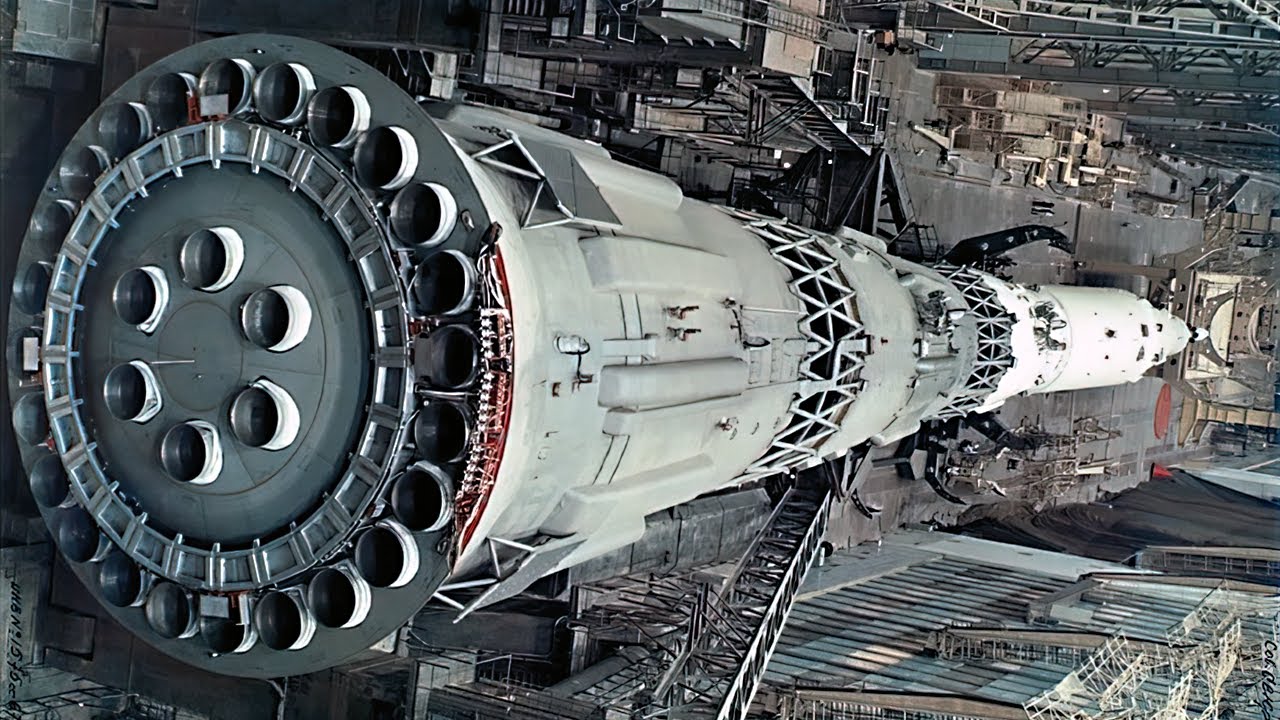
The N1’s fatal flaw was not its power but its propulsion. Unlike the Saturn V’s five massive F-1 engines, the Soviet rocket relied on 30 smaller NK-15 engines arranged in two rings around its first stage. “We had no choice,” recalled Dr. Yuri Petrenko, a former lead propulsion engineer at OKB-1, in a newly released 2025 interview. *“The NK-15 was a masterpiece of closed-cycle combustion—efficient beyond anything in the West. But controlling 30 engines simultaneously was like juggling 30 lit torches in a hurricane.”* Each engine required its own complex plumbing and turbopump; any single failure could cascade into a catastrophe. Worse, the Soviet space program lacked the computing power to run real-time engine diagnostics. Instead, the N1 used a primitive KORD (Control of Rocket Engines) system that could only shut down a malfunctioning engine—and its counterpart on the opposite side of the rocket—attempting to maintain balance through brute-force symmetry.
Between 1969 and 1972, the N1 launched four times. All four ended in explosions. The first flight, on 21 February 1969, lifted off from Site 110 at the Baikonur Cosmodrome but tore apart at 29 kilometers altitude when a gas generator failed and fire consumed the tail. The second, just four months later on 3 July 1969—while Apollo 11 was already preparing for lunar landing—was even more dramatic: seconds after liftoff, a loose bolt was ingested into an oxidizer pump, triggering a massive blast that destroyed the launch pad and sent shockwaves 10 kilometers away. “We stood in the bunker, watching the most beautiful fireball I had ever seen,” Petrenko said, his voice still carrying a mix of awe and grief. “The N1 didn’t just fail. It annihilated itself.”
The third attempt on 27 June 1971 was the most promising: the rocket flew for 50.5 seconds before an uncontrolled roll caused the KORD system to shut down all 30 engines simultaneously—a free fall back to Earth that ended in a 20-kiloton explosion. The fourth and final launch, 23 November 1972, managed 106.9 seconds of flight, but at 40 kilometers altitude, a massive vibration ruptured fuel lines, and the rocket disintegrated. No payload ever reached orbit. By 1974, the Soviet Moon program was dead, though the USSR never officially admitted it. The N1 was quietly canceled, and all remaining hardware was destroyed or scrapped.
What makes the story haunting today, on the 15th of April 2026, is that modern analysis shows the N1’s concept was not fundamentally unsound. *“With today’s engine-out redundancy, real-time telemetry, and AI-controlled stability, the N1 would fly,”* said Dr. Elena Volkov, a rocket historian at the Russian Academy of Sciences. “The tragedy is timing. They built the biggest rocket ever—and it never made it to space because the technology to control it didn’t exist yet.” Indeed, the SpaceX Starship, which first succeeded in 2024, uses 33 Raptor engines on its booster—an almost identical configuration. But unlike the N1, Starship has thousands of sensors and computers that react in milliseconds.
The N1’s legacy remains bittersweet. Three of its four launch pads were buried under concrete at Baikonur. One crater is still visible from satellite images. But the engines—the NK-15s—were secretly stored for decades. In the 1990s, a handful were sold to American companies, and their closed-cycle combustion technology became the basis for the RD-180 engine, which powers United Launch Alliance’s Atlas V rocket to this day. “The N1 died so that modern rocketry could walk,” Volkov concluded. “It was the greatest rocket that never reached the stars—but its heart beats in every booster that does.”