
April 16, 2026
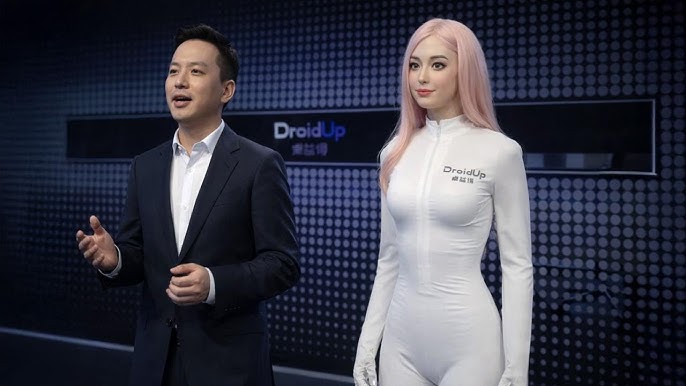
Recently, China unveiled Moya, the world’s first life-like humanoid robot capable of walking, winking, and smiling with an authenticity that blurs the line between machine and human. Developed by the Shenzhen-based robotics firm Engineered Arts China in collaboration with the Chinese Academy of Sciences, Moya represents a monumental achievement in biomimetic design, artificial intelligence, and mechanical engineering. Unlike previous humanoid robots that often moved with stiff, jerky gestures and displayed exaggerated, cartoonish expressions, Moya operates with fluid, natural motions and subtle micro-expressions that are nearly indistinguishable from those of a real person. The robot stands 1.65 meters tall and weighs 52 kilograms, with a lightweight carbon-fiber and silicone composite body that houses over 120 miniature actuators—tiny motors that control each muscle group in the face and limbs.
During its public debut at the Beijing World Robotics Expo, Moya walked across the stage with a smooth, heel-to-toe gait, adjusting its pace and balance in real time, even navigating a slight ramp without hesitation. When a researcher approached, Moya turned its head, made eye contact, and offered a warm, natural smile that crinkled the corners of its eyes—a detail achieved through 47 facial actuators that replicate the movement of human skin, fat, and muscle layers. Moments later, it gave a playful wink to the audience, triggering gasps and applause from the crowd. The key breakthrough behind Moya is its proprietary “SynapseFlow” AI system, which integrates real-time facial recognition, emotion modeling, and predictive movement algorithms.
Using depth-sensing cameras and tactile sensors embedded under its silicone skin, Moya can detect a person’s expression, age, and even gaze direction, then respond with contextually appropriate facial cues. For example, if someone frowns, Moya may tilt its head and raise its eyebrows in a questioning, empathetic gesture. If a child waves, Moya waves back while smiling. This is not pre-programmed choreography but dynamic, on-the-fly generation of social signals, making Moya the first robot capable of genuine-looking non-verbal communication. Engineers achieved this by training the AI on over 10 million hours of human interaction footage, including conversations, interviews, and everyday social exchanges.
The robot’s walking ability is equally revolutionary. Traditional bipedal robots often rely on precomputed zero-moment point trajectories, leading to cautious, flat-footed steps. Moya uses a reinforcement learning-based gait controller that adapts to surfaces, slopes, and even pushes. In a live demonstration, a technician gently shoved Moya’s shoulder; the robot stumbled one step, regained balance within 0.3 seconds, and resumed walking without falling—a feat that surpassed Boston Dynamics’ Atlas in terms of recovery speed and naturalness. The robot’s feet are equipped with multi-axis force sensors and micro-adjustable toe joints, allowing it to push off the ground like a human and even walk backward or sideways with equal grace. Moya’s power system is another highlight: a solid-state battery pack embedded in its torso provides 8 hours of continuous movement, with hot-swappable packs for 24/7 operation.
The robot’s internal cooling system mimics human perspiration, using micro-channels of non-conductive fluid to carry heat away from actuators, enabling sustained facial expressions without overheating. Potential applications for Moya are vast and transformative. In healthcare, Moya could serve as a companion for the elderly, offering not just conversation but genuine-looking emotional engagement—smiling to lift spirits or winking to share an inside joke. In education, it could become a patient, expressive teacher for children with autism, helping them practice reading and responding to facial cues. In customer service, Moya could staff hotel lobbies or airport lounges, greeting guests with customized smiles and eye contact that make interactions feel personal. However, the debut also sparked ethical debates. Critics worry about emotional manipulation, as people may form real attachments to a machine that mimics human feelings without consciousness.
Privacy concerns arise from Moya’s continuous facial analysis and gaze tracking—could such robots be used for surveillance or psychological profiling? China’s Ministry of Industry and Information Technology responded by announcing a proposed “Humanoid Robot Transparency Act” requiring that any robot with life-like features must verbally disclose its non-human identity upon first interaction. Moya’s creators have already programmed this: when anyone asks, “Are you a human?” Moya pauses, smiles softly, and replies, “No, I’m Moya—a robot designed to learn from you.” As of April 16, 2026, Moya is not for sale to the general public but will be deployed in three pilot programs: a nursing home in Shanghai, a pediatric ward in Guangzhou, and a reception desk at Shenzhen’s new tech museum. The company plans a consumer version by 2028, priced around $30,000, though analysts expect costs to drop as production scales. For now, Moya stands as a jaw-dropping fusion of art and engineering—a robot that doesn’t just move like us but expresses like us, forcing the world to ask not just “What can robots do?” but “What do we want them to become?”