April 16, 2026
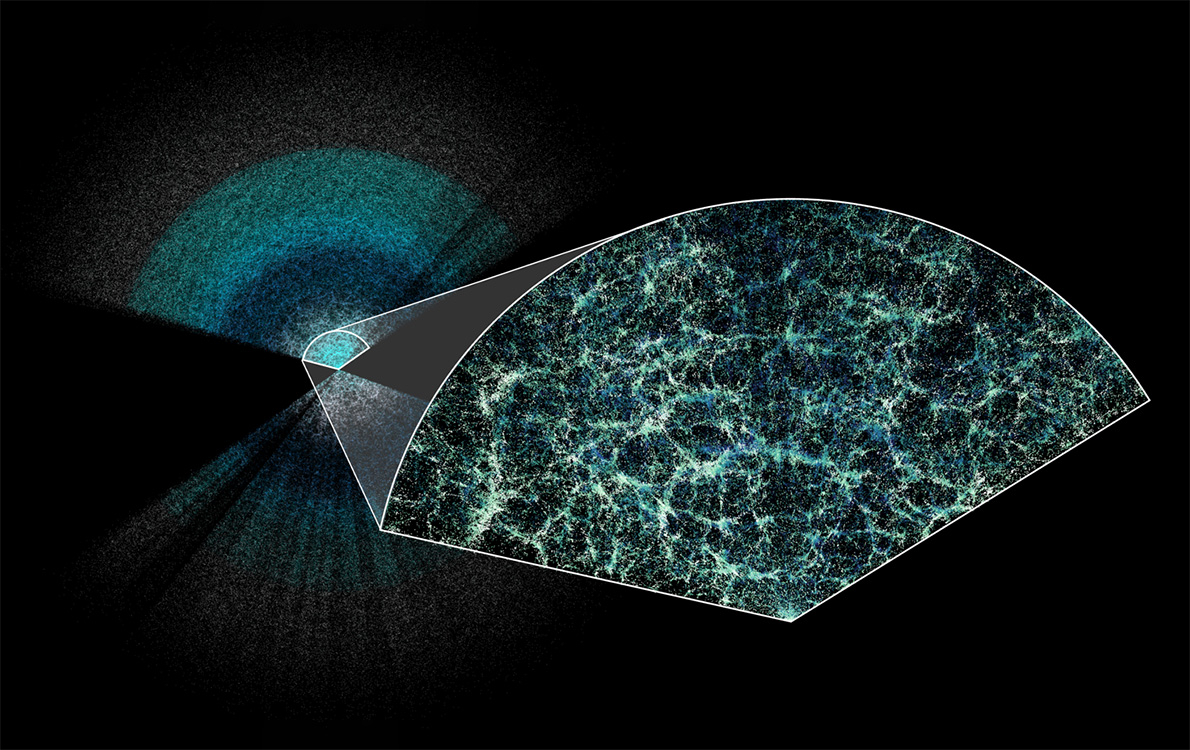
In a monumental achievement for modern cosmology, the Dark Energy Spectroscopic Instrument (DESI) has officially completed its initial five-year mission, producing the most comprehensive 3D map of the universe ever constructed. This massive digital cartography project, announced by the Lawrence Berkeley National Laboratory and the international DESI collaboration, has successfully charted the positions and distances of more than 47 million galaxies and quasars. By peering 11 billion years into the past, the instrument has provided scientists with a high-definition “skeleton” of the cosmic web, offering a unprecedented look at how the universe has grown and shifted since its infancy. The announcement, released late on April 15 and circulating globally today, signals what researchers are calling a fundamental transformation in our grasp of the forces that govern the cosmos.
At the heart of this discovery is the mystery of dark energy, the elusive force that constitutes roughly 70% of the universe and is responsible for its accelerating expansion. For decades, the leading theory—the Lambda Cold Dark Matter (LCDM) model—suggested that dark energy is a “cosmological constant,” meaning its density remains steady throughout time. However, the new data from DESI’s full five-year survey suggests something far more radical: dark energy may be evolving. This hint of dynamic behavior contradicts the standard model and suggests that the strength of this cosmic push might be weakening or fluctuating as the universe ages. If this “evolving dark energy” is confirmed by further analysis, it would mean that our existing textbooks on the physics of the universe are incomplete, necessitating a ground-up redesign of cosmological theory.
The sheer scale of the data is staggering. DESI, which utilizes 5,000 robotic fiber-optic “eyes” mounted on the Nicholas U. Mayall 4-meter Telescope at Kitt Peak National Observatory, exceeded its original targets by nearly 40%. While the mission initially aimed to map 34 million objects, the efficiency of the instrument allowed it to capture nearly 50 million galactic signatures. This density of information allows astronomers to use Baryon Acoustic Oscillations (BAO)—subtle ripples from the early universe—as a “standard ruler” to measure the expansion of space with a precision of better than 1%. This level of detail has allowed scientists to trace the influence of dark energy across a staggering 11 billion years of history, effectively creating a time-lapse of the universe’s expansion.
Nathalie Palanque-Delabrouille, a DESI collaborator and scientist at Berkeley Lab, emphasized the gravity of these findings to the press: “This is a major paradigm shift. All data up to now were compatible with a standard cosmological model where the accelerated expansion of the universe was caused by a cosmological constant. The weakening acceleration observed by DESI can no longer be explained with a cosmological constant. This could be the most interesting discovery in cosmology since that of dark energy itself.” Her sentiment reflects a growing consensus among the 900 researchers involved that we are standing on the threshold of a new era of physics.
The implications for the ultimate fate of the universe are profound. If dark energy is indeed constant, the universe would likely continue to expand forever into a cold, dark “Big Freeze.” However, if dark energy is dynamic and weakening, the trajectory of our cosmos could change entirely, potentially leading to different outcomes that scientists are only now beginning to model. Michael Levi, the DESI Director at Berkeley Lab, expressed his awe at the project’s success: “DESI’s five-year survey has been spectacularly successful. The instrument performed better than anticipated. The results have been incredibly exciting. And the size and scope of the map and how quickly we’ve been able to execute is phenomenal.”
Despite the formal completion of the five-year map, the DESI team is not slowing down. In fact, because the instrument performed so efficiently, the survey has already been extended through 2028. This next phase, known as DESI-II, will focus on even fainter, more distant galaxies and will explore regions closer to the Milky Way’s plane that were previously avoided due to dust and light interference. This extension aims to increase the map’s volume by another 20%, providing the statistical “gold standard” needed to confirm whether the observed evolution of dark energy is a definitive discovery or a statistical fluke.
The international collaboration, spanning over 70 institutions, is now shifting its focus from data collection to rigorous data processing. While the preliminary results have already sent shockwaves through the scientific community, the definitive dark energy results from the full five-year dataset are expected to be published in 2027. In the meantime, the researchers are releasing a “gold mine” of spectroscopic data to the public, which will be used by thousands of astronomers to study everything from the mass of neutrinos to the growth of supermassive black holes at the centers of distant quasars.
Reflecting on the decade of work that led to this moment, Professor Ofer Lahav of University College London noted: “This is a very exciting milestone. The data-gathering phase has far exceeded expectations. DESI observations suggest the intriguing possibility that the density of dark energy may evolve over time. Confirmation of this result would represent a paradigm shift in our understanding of the universe.” This sentiment was echoed by Kathy Turner of the Department of Energy, who remarked: “The Dark Energy Spectroscopic Instrument has truly exceeded all expectations, delivering an unprecedented 3D map of the universe that will revolutionize our understanding of dark energy.”
As of today, April 16, 2026, the global scientific community is beginning to digest the reality that the standard model of the universe may be undergoing its most significant revision in nearly thirty years. The map doesn’t just show us where the galaxies are; it shows us that the very fabric of space is behaving in ways we never predicted. For the first time, we aren’t just looking at the universe; we are watching the very force that drives it change before our eyes. The quest to understand the “dark” side of our cosmos has just moved from the realm of theory into a startlingly clear, three-dimensional reality.