
April 16, 2026
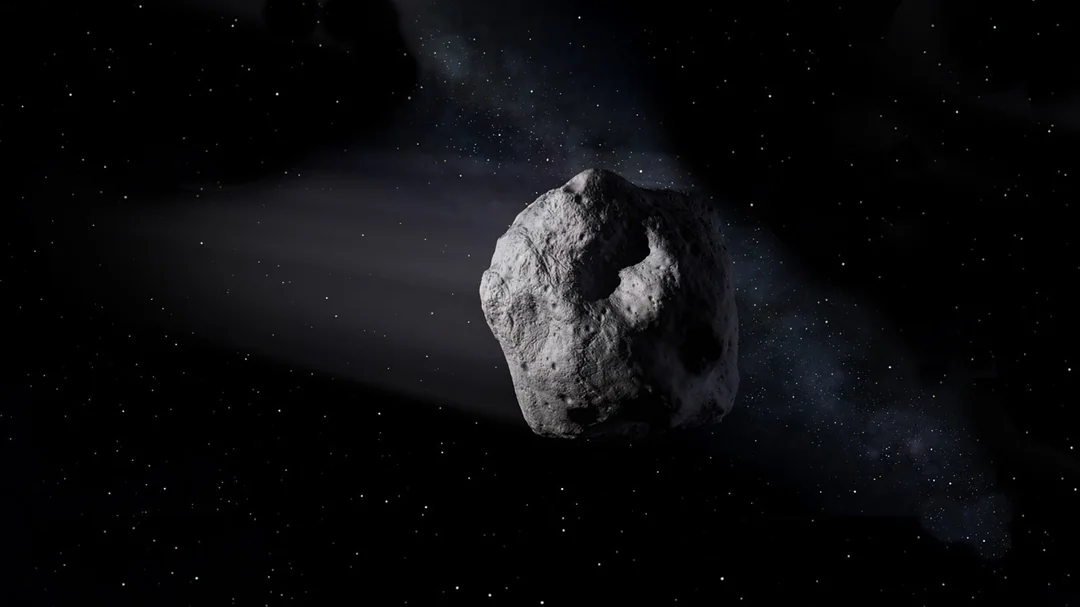
The ‘God of Chaos’ asteroid Apophis will not impact Earth in 2029. Instead, astronomers have confirmed that April 13, 2029 will mark an unprecedented scientific opportunity and a spectacular naked-eye celestial event. Far from a collision, the flyby is expected to bring the asteroid closer than many orbiting satellites, allowing humanity an up-close look at a relic of the early solar system.
The asteroid, officially designated 99942 Apophis, was discovered in 2004 and immediately gained notoriety due to early orbital calculations that suggested a small but significant chance of a catastrophic impact with Earth during its 2029 approach. Named after the ancient Egyptian deity of chaos, darkness, and destruction, it became a symbol of planetary vulnerability in popular culture. However, after nearly two decades of continuous monitoring using optical telescopes and ground-based radar, NASA has completely ruled out any danger. “There is no danger to Earth, to anyone or anything living on it, or to astronauts or satellites in space,” the agency stated in a recent briefing, confirming that the asteroid poses no risk for at least the next 100 years.
The event will occur on Friday, April 13, 2029. At its closest point, scheduled for 5:45 p.m. EDT (2145 GMT), Apophis will pass within approximately 20,000 miles (32,000 kilometers) of the Earth’s surface. To put that distance into perspective, it is 12 times closer than the Moon and actually closer than the geosynchronous communication satellites that orbit the planet at roughly 22,000 miles up. This makes it one of the closest approaches ever recorded for an object of this immense size, which has a mean diameter of about 1,115 feet (340 meters)—roughly the size of three football fields or a cruise ship. For observers on the ground, specifically those in the Eastern Hemisphere (including Europe, Africa, and parts of Asia), the asteroid will be bright enough to see with the naked eye, weather permitting. It will appear as a slow-moving “star” crossing the night sky, a rarity for an object of this magnitude.
While the public will witness a moving point of light, scientists are preparing for a massive physics experiment. Because Apophis will pass so deep within Earth’s gravitational well, our planet’s tidal forces are expected to physically alter the asteroid. “Apophis will come so close that it will feel a strong tidal pull from the Earth. The effects of these tides will include changing the spin rate of Apophis, seismic shaking of its interior, and maybe even landslides on the surface,” explained Nick Moskovitz, a planetary scientist at Lowell Observatory. Researchers from MIT and other institutions are eager to see if this gravitational “stretch and squeeze” rattles the asteroid enough to expose fresh material beneath its surface, which has been weathered by billions of years of cosmic radiation and solar wind. The close encounter will also alter the asteroid’s orbit, shifting its classification from the “Aten” group to the “Apollo” group of Earth-crossing asteroids.
Capitalizing on this once-in-a-thousand-year event, global space agencies are redirecting missions to study the “God of Chaos” up close. NASA has redirected its OSIRIS-APEX spacecraft (formerly OSIRIS-REx, which returned samples from asteroid Bennu) to rendezvous with Apophis in June 2029, just weeks after the flyby, to map the surface changes. Similarly, the European Space Agency (ESA) is planning the Ramses mission to launch in 2028, aiming to arrive at the asteroid before its close approach to watch the gravitational effects in real-time. “Scientists across the globe are excited to use this opportunity to study Apophis in detail,” NASA astronomers noted, highlighting that while the name invokes chaos, the reality offers nothing but invaluable data for planetary defense and understanding the composition of our solar system.