April 19, 2026
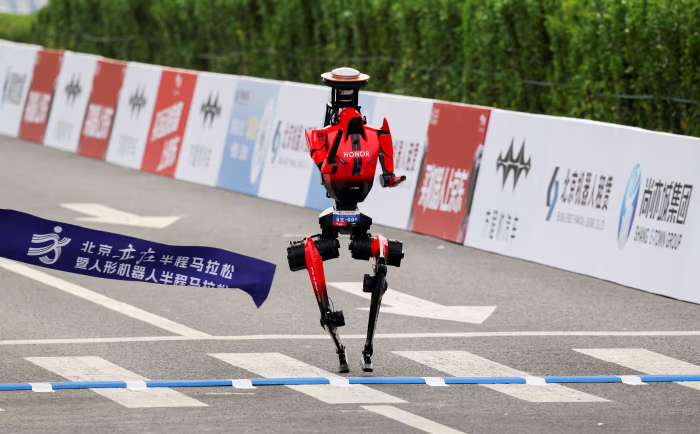
The evolution of robotics took a historic leap on April 19, 2026, when the Beijing E-Town Half Marathon transformed from a traditional athletic competition into a staggering demonstration of mechanical prowess. As of today, April 22, 2026, the global scientific and athletic communities are still reeling from the results of this event, which saw humanoid robots not only competing alongside humans but effectively shattering the human world record for the 21.1-kilometer distance. While the human winner, Zhao Haijie, posted a respectable time of 1:07:47, he was eclipsed by a mechanical runner named “Lightning,” developed by the Chinese technology firm Honor. Lightning crossed the finish line in a mind-bending 50 minutes and 26 seconds, nearly seven minutes faster than the human world record of 57:31 set by Jacob Kiplimo.
The event featured over 100 robotic teams and roughly 12,000 human participants, running on parallel but separate tracks to ensure safety. This second edition of the “Humanoid Robot Half Marathon” provided a stark contrast to the inaugural 2025 race, where the winning robot took over two and a half hours to finish and many others suffered mechanical failures or “stumbled” out of the competition. In 2026, the technology displayed a terrifying level of stability and efficiency. Roughly 40% of the robots this year operated via autonomous navigation, using onboard AI and sensor suites to navigate the course without human intervention, while others were operated via remote control.
The Engineering Behind the Speed
The dominant performance by the Honor team, which swept all three podium spots, was attributed to a radical departure from traditional robotic design. The champion robot, Lightning, was specifically engineered to mimic the biomechanics of elite human long-distance runners. It featured long, slender legs measuring approximately 95 cm, optimizing its stride length and frequency. Perhaps more importantly, the engineers integrated liquid-cooling technology borrowed directly from high-end smartphone hardware. This system allowed the robot’s high-torque motors to maintain peak performance without overheating during the sustained physical exertion of a sub-hour half-marathon.
“The goal wasn’t just to cross the finish line, but to test key technologies through the rigors of a long-distance run, then improve technological breakthroughs, and finally, lay the groundwork for robots to enter our daily lives,” stated Xiong Youjun, CEO of the Beijing Humanoid Robot Innovation Center. He emphasized that the race served as a high-stress laboratory for testing compact, heat-resistant joints and precise motion control algorithms.
A Milestone for Autonomous Intelligence
The 2026 race was characterized by the widespread adoption of autonomous navigation. Unlike last year, where robots often required tethered operators or constant manual correction, the current generation of machines utilized advanced computer vision and LiDAR to adjust to the asphalt terrain, slopes, and turns of the Beijing Economic-Technological Development Area. Liang Liang, deputy secretary-general of the Chinese Institute of Electronics, explained the scoring incentive for this shift: “The setting of a coefficient aims to guide and encourage the research and development of autonomous navigation, which represents a technological foundation for humanoid robots to be applied in more scenarios in our daily life towards the future.”
Despite the success, the race was not without its “robotic” moments. Spectators noted that while the lead robots were incredibly fast, some struggled with balance at high speeds, exhibiting a “swaying” gait that occasionally led to collisions with track barriers. One robot famously “fell flat” at the start line, requiring a quick manual reset by its team before it could begin its pursuit of the pack. These mishaps, however, were viewed by experts as minor hurdles in an otherwise exponential growth curve.
Global Strategic Implications
The race results have reignited discussions about the global race for robotics supremacy. Elon Musk, who has previously identified China as Tesla’s most formidable competitor in the humanoid space, saw his predictions validated as Chinese startups like Unitree, Galbot, and Noetix showcased machines capable of not just walking, but sprinting with professional-grade stamina. The event aligns with China’s broader national strategy to achieve mass production of humanoid robots by 2027.
“Looking ahead, some of these technologies might be transferred to other areas. For example, structural reliability and liquid-cooling technology could be applied in future industrial scenarios,” noted Du Xiaodi, an engineer on the winning Honor team. This sentiment was echoed by government officials who view these “mechanical athletes” as precursors to a workforce capable of handling dangerous manufacturing tasks, smart logistics, and disaster relief.
Public Reaction and the Future of Sport
For the thousands of spectators lined up along the Beijing E-Town route, the sight was surreal. Seeing a headless, armless (optimized for weight) torso on two legs whiz past human elites at an average pace of 3:50 minutes per mile prompted both awe and a touch of existential dread. The event also included a martial arts demonstration where Unitree humanoids performed complex sequences with swords and poles, further proving that the machines’ dexterity is catching up to their speed.
As we look toward the rest of 2026, the success of this race has already spurred plans for more diverse robotic competitions, including a globally livestreamed humanoid boxing match. While some purists argue that comparing machines to humans is unfair, the 2026 Beijing Half Marathon has made one thing clear: the gap between human biological limits and robotic capability has not just closed—it has been crossed.
“The humanoid robots’ running posture I saw was really quite impressive… the future will definitely be an AI era,” remarked one spectator. As these machines return to their laboratories for further refinement, the world watches to see if the human spirit can find a way to coexist with, or perhaps simply keep pace with, the silicon-powered athletes of tomorrow.