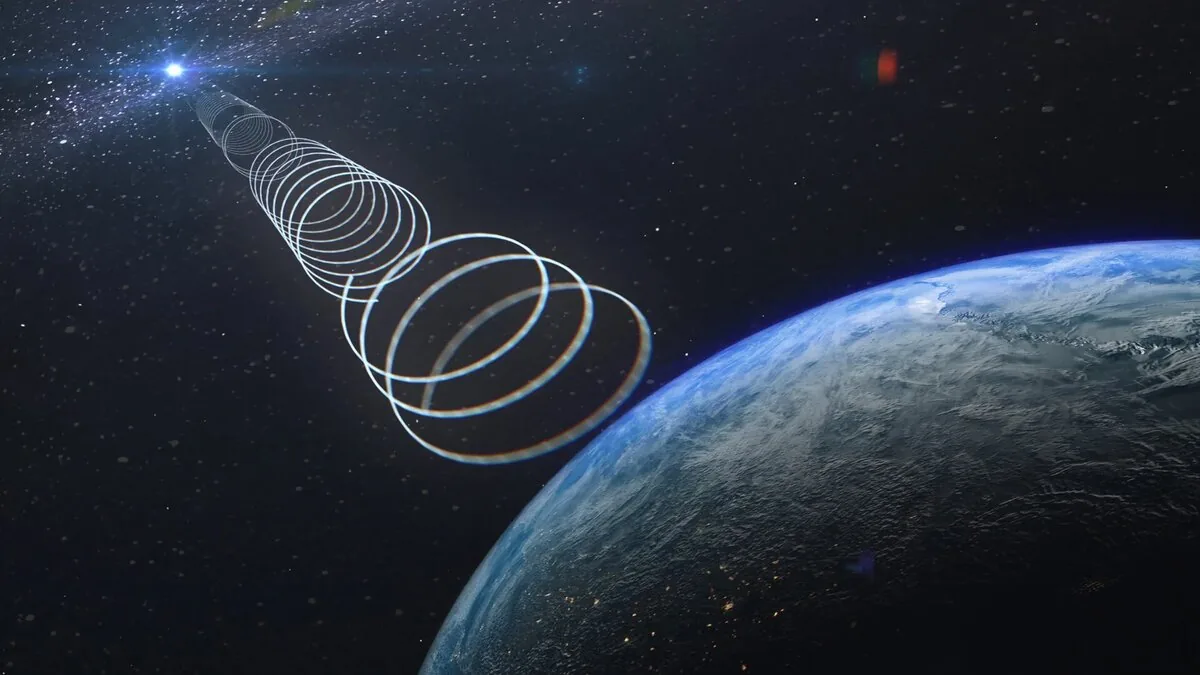
The year 2026 marks a significant milestone in human history, as our “radio bubble” continues its silent, relentless expansion across the Milky Way. For over a century, humanity has been inadvertently—and occasionally intentionally—announcing its presence to the cosmos through electromagnetic radiation. To understand how far these signals have traveled, we must look at the physics of light, the history of our transmissions, and the sobering reality of the inverse-square law, which dictates that while our “bubble” is vast, our “voice” is rapidly becoming a whisper.
The Speed of Light and the Radio Bubble
Because radio waves are a form of electromagnetic radiation, they travel at the universal speed limit: the speed of light, or approximately 299,792 kilometers per second. This means that for every year that passes on Earth, our radio signals advance one light-year further into the void. As of April 20, 2026, the very first high-power radio transmissions have traveled roughly 130 to 140 light-years from Earth. This creates a spherical “radio bubble” with a diameter of nearly 280 light-years. While this sounds immense, it is important to remember that the Milky Way galaxy is roughly 100,000 light-years across; our presence is still a microscopic dot on the galactic map.
The Pioneers of the Airwaves
The edge of this bubble is defined by the earliest successful experiments in wireless telegraphy and radio. While Guglielmo Marconi’s transatlantic signal in 1901 was a landmark, many scientists point to the high-power broadcasts of the early 20th century as the true beginning of our interstellar footprint. “Radio waves have been traveling outward at the speed of light ever since the first intentional radio broadcast on December 24, 1906,” notes science communicator Kelly Kizer Whitt. This 1906 broadcast, conducted by Reginald Fessenden, consisted of him playing “O Holy Night” on the violin. In 2026, those specific violin notes are currently washing over star systems approximately 119 light-years away.
Intentional vs. Unintentional Signals
Most of our radio footprint consists of “leakage”—television signals, FM radio, and military radar that were never meant for an alien audience. These signals are chaotic and relatively weak. In contrast, humanity has sent a few “shouts” into the dark. The most famous is the Arecibo Message of 1974. Aimed at the M13 star cluster, this high-power beam has currently traveled roughly 51.4 light-years. “The Arecibo message was meant as a demonstration of human technological achievement rather than a real attempt to enter into a conversation,” according to historical archives from the Arecibo Observatory. Because M13 is 25,000 light-years away, our message won’t arrive for another 24,948.6 years.
The Inverse-Square Law
The most critical factor in Earth’s detectability is not distance, but signal degradation. As a radio wave travels, its energy spreads out over the surface of an ever-growing sphere. This is known as the inverse-square law: if you double the distance from the source, the signal strength becomes four times weaker ($1/2^2$). By the time our standard television broadcasts reach a star system like Proxima Centauri (4.2 light-years away), they are so faint that they are indistinguishable from the background “noise” of the universe. “While our music, news, and television signals have passed through their skies, the broadcasts are so faint and scattered that they dissolve into cosmic noise,” scientific consensus suggests. To a distant observer, Earth likely sounds like a faint, static-filled hum rather than a structured broadcast.
What Stars Have We Reached?
Within our 130-light-year bubble, there are thousands of star systems. Proxima Centauri, our closest neighbor, was breached by our signals in the early 1910s. Other notable stars like Sirius (8.6 light-years) and Vega (25 light-years) have already “received” decades of Earth’s history, from the first world wars to the invention of the internet. However, detection requires a receiver far more sensitive than anything humans currently possess. SETI (Search for Extraterrestrial Intelligence) researchers argue that while we are “visible,” we are not necessarily “detectable.” Some studies suggest that with modern technology, our most powerful planetary radars might be visible up to 12,000 light-years away, but only if an observer knew exactly where to point their telescope.
The Digital Silence
Interestingly, as we become more technologically advanced, we are actually becoming quieter to the rest of the galaxy. In the mid-20th century, we used massive high-power broadcast towers. Today, we rely on fiber optics, low-power satellites, and focused digital transmissions. These technologies leak much less radiation into space. “Our evolving technology is becoming harder to detect,” space analysts observe, “because digital transmissions leak far less radio energy into space than the analog waves of the past.” If an alien civilization were watching us, they might see a “bright” radio period from 1950 to 2010, followed by a mysterious fading as we moved our data underground and into narrow-beam lasers.
In conclusion, Earth’s radio signals have claimed a territory roughly 140 light-years in radius. We have touched thousands of worlds, yet we remain unheard. The “radio bubble” is a testament to our ingenuity, but also a reminder of our isolation. As the signals of the 21st century grow quieter and more focused, our early 20th-century “shouts” continue to lead the way, traveling deeper into the Milky Way at the speed of light, carrying the ghostly echoes of a violin and the first flickering images of a young civilization. Whether anyone is listening, or if they can even hear us above the roar of the stars, remains the greatest mystery of the modern age.