9 May 2026
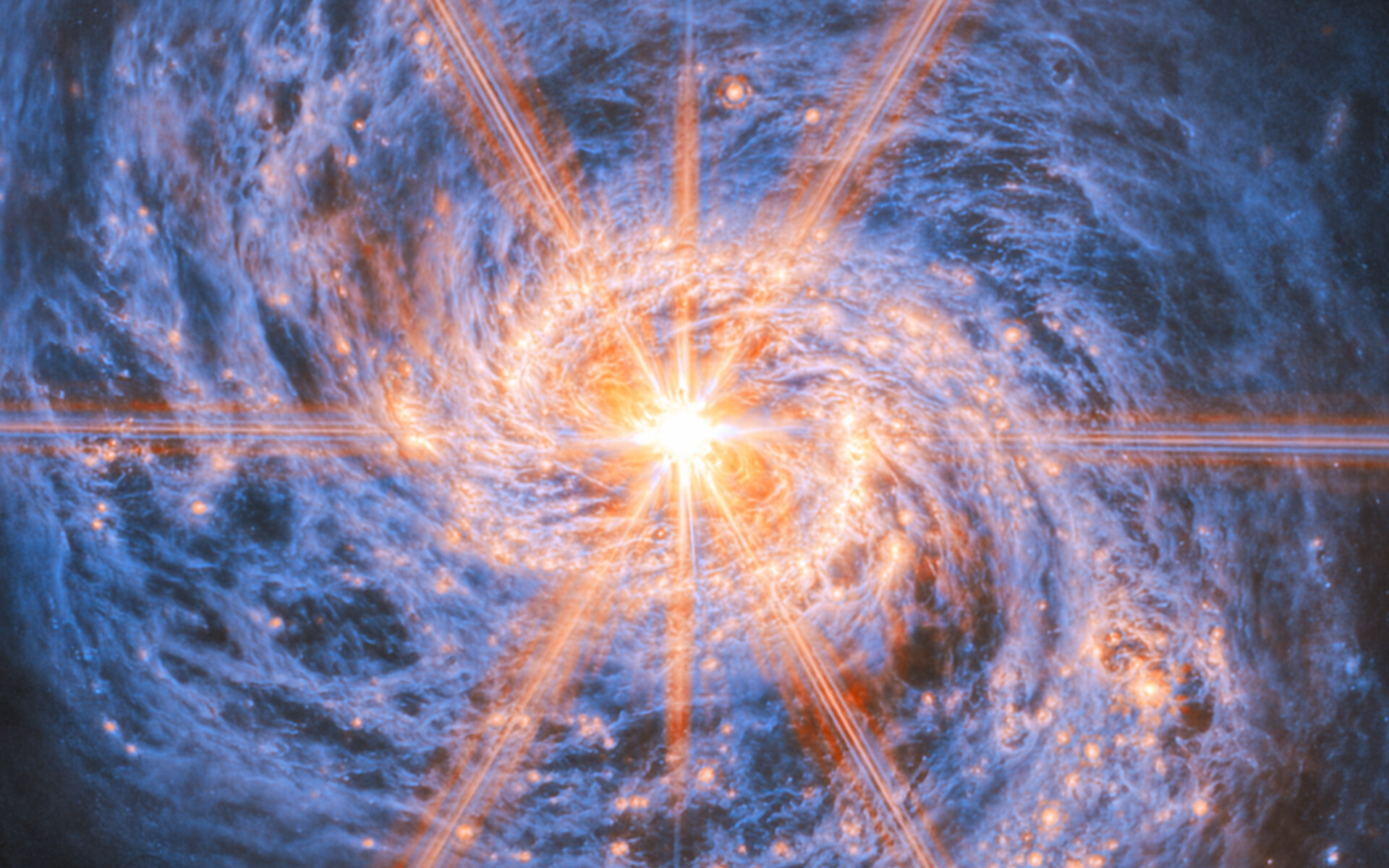
NASA’s James Webb Space Telescope unveiled a breathtaking new image of Messier 77 (M77), one of the most famous and well-studied galaxies in the night sky, located approximately 47 million light-years away in the constellation Cetus. This new observation, captured using Webb’s Near-Infrared Camera (NIRCam) and Mid-Infrared Instrument (MIRI), has revealed unprecedented detail about the galaxy’s turbulent core, its intricate spiral arms, and the hidden nurseries of newborn stars that were previously obscured by dense gas and dust. Messier 77, also known as NGC 1068, is a barred spiral galaxy and one of the brightest Seyfert galaxies—a class of active galaxies with supermassive black holes at their centers.
The Webb image, which took over 18 hours of exposure time, marks a significant leap forward from previous observations by the Hubble Space Telescope and ground-based observatories, offering scientists a clearer view of the dynamic processes feeding the galaxy’s central black hole. Dr. Elena Vasquez, lead researcher on the Webb observation team at the Space Telescope Science Institute in Baltimore, stated: “What we see in this image is nothing short of transformative. The level of detail in M77’s infrared glow allows us to trace warm gas and dust spiraling into the nucleus with precision we’ve never achieved before. It’s like putting on a pair of glasses for the first time.”
The most striking feature of the new image is the galaxy’s active galactic nucleus (AGN), which shines with extraordinary brightness in infrared light. Unlike visible-light images that show M77 as a predominantly smooth, glowing core with tightly wound arms, Webb’s infrared vision penetrates the thick veil of dust surrounding the black hole, revealing a chaotic, heated ring of material—often called the torus—that feeds the supermassive black hole. Scientists estimate the black hole’s mass at roughly 10 million times that of our Sun, and the accretion disk around it emits intense radiation across the electromagnetic spectrum. Webb’s spectroscopic data, gathered simultaneously with the image, detected highly ionized iron and neon lines, confirming that powerful outflows of gas are being driven outward from the core at speeds exceeding 1,000 kilometers per second.
Professor Hiroshi Tanaka, an astrophysicist at Kyoto University and co-investigator of the study, explained: “The AGN in M77 is like a violent engine. Webb shows us not just the bright center, but the feedback loops—how energy and matter from the black hole influence star formation in the rest of the galaxy. This is crucial for understanding galaxy evolution.” In addition to the nucleus, Webb’s image highlights the galaxy’s starburst regions—areas of intense star formation that wrap around the inner part of the galaxy like a ring of fire. These regions, hidden in optical wavelengths, now appear as brilliant knots of infrared emission, each containing clusters of young, massive stars less than a few million years old.
Further enhancing the scientific value of the image are the delicate, filamentary structures within M77’s spiral arms. In previous Hubble images, the arms appeared as graceful, dusty lanes punctuated by bright star clusters. Webb’s infrared view, however, resolves these lanes into complex networks of gas and organic molecules called polycyclic aromatic hydrocarbons (PAHs)—carbon-based compounds that glow in mid-infrared light. These PAH emissions trace the boundaries of dense molecular clouds where new stars are condensing.
Dr. Maria Fontanella, a postdoctoral fellow at the European Space Agency’s ESTEC, commented: “Seeing the PAH emission so clearly across the entire galactic disk is a gift. These molecules are like tracers of the raw material for star formation. In M77, we see that the spiral arms are not simply smooth curves but are broken into a froth of bubbles, shells, and filaments—some likely carved out by supernova explosions from earlier generations of stars.” The image also reveals a population of previously unknown infrared sources—likely background galaxies, globular clusters, or even young stellar clusters embedded in the galaxy’s outskirts. One particularly intriguing feature is a narrow, straight dust lane that cuts across the northern spiral arm, possibly the remnant of a minor merger or a tidal disruption event. Early analysis of Webb’s near-infrared spectra suggests that this lane contains silicate grains with crystalline structures, indicating a relatively recent collision with a smaller dwarf galaxy that pulled out a stream of gas and dust.
The implications of Webb’s M77 image extend beyond the galaxy itself. Messier 77 is often used as a local benchmark for understanding active galaxies since it is relatively nearby and oriented nearly face-on, giving astronomers a clear view of its structure. By comparing Webb’s infrared data with existing radio, X-ray, and optical observations, researchers hope to build a unified model of AGN tori—the doughnut-shaped clouds of dust and gas that surround supermassive black holes and regulate their growth.
Dr. Vasquez added: “Different active galaxies look different depending on our viewing angle. M77’s orientation allows us to test predictions about how the torus obscures or reveals the black hole’s immediate environment. Webb’s image supports the idea that the torus is not a simple smooth ring but is clumpy, warped, and dynamic.” The new data have already been made publicly available through the MAST archive, and dozens of follow-up studies are underway, including a deep spectroscopic survey to map the galaxy’s molecular gas content and star formation efficiency. For the public, NASA released a high-resolution composite image combining Webb’s infrared data with Hubble’s optical and Chandra’s X-ray observations, creating a vivid, multicolor portrait that has been widely shared across science media.