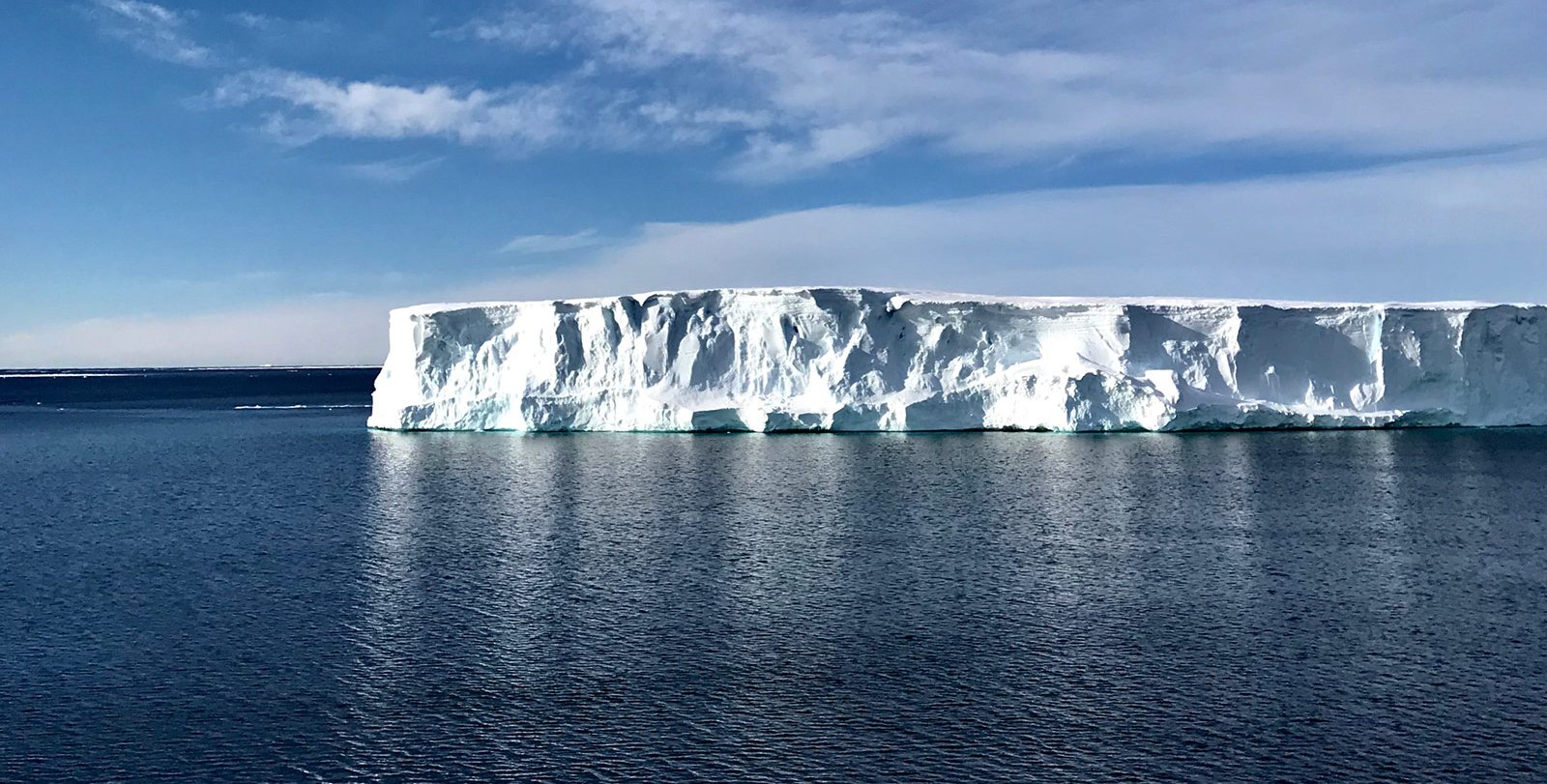
An ice shelf is a thick, floating platform of fresh water ice that forms where a glacier or ice sheet flows down to a coastline and extends out over the ocean. Unlike sea ice, which forms from the freezing of seawater, ice shelves originate from ice that fell as snow on land and subsequently flowed downstream under its own weight. They are primarily found in Antarctica, Greenland, and the Canadian Arctic, with Antarctica hosting the most massive and numerous examples. The largest is the Ross Ice Shelf, roughly the size of France, followed by the Filchner-Ronne Ice Shelf. These structures act as critical buffers, restraining the flow of inland ice toward the sea. To understand an ice shelf, imagine a river of ice meeting the ocean: instead of calving icebergs immediately at the shoreline, the ice continues to float, forming a vast, flat-topped sheet that can be hundreds of meters thick at its grounding line—the point where it last touches bedrock—and thinning toward its seaward edge. The upper surface is exposed to cold air, while the underside melts and refreezes in contact with seawater.
The formation of an ice shelf begins with accumulation of snow in the interior of a continent, which compresses into glacial ice over millennia. As gravity pulls this ice toward the coast, it spreads out laterally. If the bedrock slopes downward below sea level—a common feature in Antarctica—the ice can float once it becomes thick and buoyant enough. The grounding line is a crucial dynamic zone; here, the ice transitions from land-based to floating. Upstream of this line, the ice moves by basal sliding and deformation; downstream, it moves as a floating plate, subject to ocean tides, currents, and winds. Ice shelves grow through continued flow from the interior and also by surface snow accumulation and marine ice accretion—where supercooled seawater freezes onto their undersides. They lose mass primarily through basal melting (melting from below by relatively warm ocean currents) and calving, the process where large chunks break off to form icebergs. A state of equilibrium exists when the inflow and accumulation equal outflow and melting, but this balance is increasingly disrupted by climate change.
The importance of ice shelves is twofold: they are Earth’s “cork in the bottle” for sea level rise, and they are sensitive indicators of climate change. Because ice shelves are already floating, their melting does not directly raise sea level—just as melting ice cubes in a full glass do not cause overflow. However, they buttress (hold back) the grounded ice behind them. Without an ice shelf, the inland glacier would accelerate dramatically, sliding directly into the ocean. For example, the Larsen B Ice Shelf on the Antarctic Peninsula collapsed rapidly in 2002 after a period of surface melting and fracturing. Following its collapse, the glaciers that once fed it sped up by up to eight times, contributing significantly to sea level rise. Thus, ice shelves act as structural reinforcements; once lost, the sea level contribution from the newly exposed ice sheet can be enormous. Antarctica holds enough ice to raise global sea levels by over 60 meters (nearly 200 feet), and ice shelves are the only barriers keeping much of that ice on land.
Ice shelves are also vulnerable to several feedback mechanisms driven by warming. Surface meltwater is particularly dangerous: when the sun melts snow on top of an ice shelf, the water pools into melt ponds. These ponds can seep into cracks, and because water is denser than ice, it forces the cracks deeper—a process called hydrofracturing. This can disintegrate an ice shelf in a matter of weeks, as observed with Larsen B. Ocean-driven basal melting is another threat, especially in West Antarctica, where warm, salty Circumpolar Deep Water intrudes beneath ice shelves, thinning them from below. Thinning reduces the “pinning points” where an ice shelf scrapes against underwater rises or islands, which are essential for providing friction and slowing ice flow. A thinner ice shelf is more flexible and prone to rifting. Moreover, atmospheric warming reduces the protective firn layer (compacted snow) on top, allowing further meltwater infiltration. These processes are interconnected: basal thinning reduces the ice shelf’s strength, surface melting hydrofractures it, and both accelerate with rising temperatures.
Scientifically, ice shelves are studied using satellite altimetry (to measure thickness and elevation changes), radar and seismic sounding (to map the grounding line and bed topography), and ice-penetrating radar (to detect internal layers and cracks). Oceanographic instruments deployed through boreholes measure the temperature and salinity of water beneath them. Observations show that many Antarctic ice shelves are thinning, particularly along the Amundsen Sea coast, where the Thwaites Glacier—nicknamed the “Doomsday Glacier”—is losing its buttressing ice shelf. Should the Thwaites Ice Shelf collapse, it could trigger a marine ice sheet instability, where the retreating grounding line encounters a retrograde (inward-sloping) bedrock, leading to runaway ice loss. This scenario underscores why ice shelves are frontline features of climate research. In summary, an ice shelf is not merely a static slab of ice; it is a dynamic, floating extension of the land ice, a vital buffer against sea level rise, and a sentinel of climate change. Its health—determined by the balance between snowfall, melting, calving, and ocean heat—directly influences the stability of the world’s great ice sheets and, consequently, the future of coastal communities globally.