June 23, 2026
The world reflects on one of the most extraordinary and improbable space stories in history, which concluded just over a year prior. This is the tale of Kosmos 482, a Soviet spacecraft that was designed to land on Venus in 1972 but, after a catastrophic failure, spent 53 years orbiting Earth before finally making an unexpected and dramatic return. Its re-entry on May 10, 2025, was not just the end of a failed mission, but the closing chapter of a journey that outlasted the Cold War, the Soviet Union itself, and all expectations of what a derelict piece of space hardware could endure . The story of Kosmos 482 is a testament to the remarkable engineering of the Soviet space program, a ghost from a bygone era that returned to Earth more than half a century later, not as a cloud of incinerated debris, but potentially as an intact relic from the height of the space race.
The saga began on March 31, 1972, during the peak of the Cold War, when the Soviet Union launched the spacecraft from the Baikonur Cosmodrome in Kazakhstan . It was the twin of Venera 8, which had launched just four days earlier and would go on to successfully land on Venus, becoming the second spacecraft to do so . The probe was part of the ambitious Venera program, through which the Soviets launched nearly 30 missions towards Earth’s “sister planet” in a bid to unlock its secrets and demonstrate technological superiority . The plan was for the probe to travel to Venus, enter its thick, crushing atmosphere, and transmit data from its hellish surface, where temperatures reach around 470 degrees Celsius and pressures are nearly 90 times greater than on Earth .
However, moments after reaching a parking orbit around Earth, the spacecraft’s Blok L upper stage engine shut down prematurely, most likely due to a timer malfunction . Lacking the velocity needed to escape Earth’s gravity, the mission was doomed from that instant . In keeping with Soviet practice, the failed planetary probe was quietly reclassified as “Kosmos 482” , a generic name for Earth-orbiting satellites, effectively hiding the failure from the public for many years .
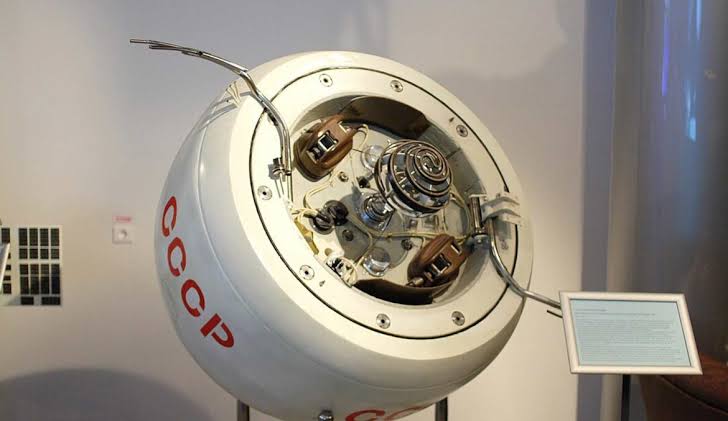
What makes Kosmos 482’s story so remarkable is what happened next. While most of the spacecraft and its rocket stage re-entered the atmosphere and burned up within a decade, the descent capsule remained in a highly elliptical orbit . This capsule was no ordinary satellite; it was a one-metre-wide titanium sphere weighing about 495 kilograms (half a ton), specifically engineered to survive the infernal conditions of Venus . This rugged construction, including a robust heat shield, proved to be its key to longevity. For over five decades, this Cold War relic completed a loop around the Earth every hour or so, plunging from an apogee as high as 9,000 kilometres down to a perigee near the outer edge of the atmosphere .
Each pass through the upper atmosphere created a tiny amount of drag, which slowly, almost imperceptibly, bled off its orbital energy and lowered its altitude over the course of 53 years . During this time, the spacecraft became a silent witness to history, orbiting long after the Soviet Union dissolved in 1991 and outliving the space race that had created it . The capsule’s existence was not entirely forgotten; by the 2020s, satellite observers such as Dutch astronomer Marco Langbroek were tracking the aging relic and suggesting that its Venus-grade construction might allow it to survive re-entry into Earth’s atmosphere .
The engineering that was meant to allow it to land on Venus was the very reason it posed a unique hazard upon its return to Earth. On May 10, 2025, after more than half a century in space, Kosmos 482’s long orbit finally decayed, and it entered Earth’s atmosphere . As it plunged through the sky, its thick titanium shell, built to withstand pressures of up to 100 atmospheres and accelerations of 300 G, did its job, allowing the capsule to remain largely intact when most spacecraft would have disintegrated .
The European Space Agency and other tracking groups confirmed the re-entry, with Russia’s space agency Roscosmos later stating that the capsule most likely fell into the eastern Indian Ocean . Travelling at an estimated 240 kilometres per hour without a functional parachute, the spacecraft probably struck the ocean with tremendous force . In a macabre twist, the very feature designed to help it gently land on Venus—its parachute—was likely a victim of decades of space exposure, meaning it would have fallen like a meteorite rather than a controlled descent . While no debris has been recovered, the extraordinary event marks the first time a Venus lander has returned to Earth after such an extended period in space.
The return of Kosmos 482 is more than just a story about space debris; it is a poignant and dramatic epilogue to one of the most ambitious chapters in space exploration history . The spacecraft was a product of the Cold War, its launch motivated as much by political rivalry as by scientific curiosity . It outlived not only the Soviet Union but also the very ambitions of the program it was a part of, becoming the final surviving relic of the legendary Venera program .
While Kosmos 482 never reached its intended destination of Venus and never sent back a single scientific reading from the planet’s surface, it demonstrated the extraordinary engineering of its creators in the most unexpected way . Built to withstand the harshest world in the Solar System, it instead survived a half-century in the cold vacuum of space and a fiery re-entry to close a 53-year-long orbit around the planet it never truly left. In a strange twist of history, the spacecraft succeeded in the one challenge few thought possible, turning a failed mission from the height of the space race into one of the most remarkable stories in the history of space exploration .