
June 22, 2026
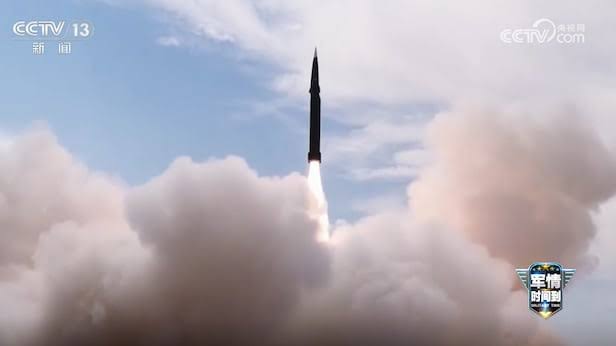
The global security landscape was jolted by a decisive move from Beijing as Chinese state broadcaster CCTV aired the first-ever public footage of a live-fire launch of the Dongfeng-17 (DF-17) hypersonic missile. The broadcast, which occurred on the military program “Military Affairs Time Has Come,” was not merely a routine display of military hardware but a carefully calibrated strategic signal to the United States and its allies, underscoring Beijing’s growing confidence in its ability to challenge the existing military balance in the Indo-Pacific . The footage, captured at a Rocket Force training area in the Gobi Desert, showcased a road-mobile DF-17 launcher deploying and executing a vertical launch, while simultaneous scenes depicted multi-service drills designed to test the PLA’s operational readiness under extreme conditions, including severe electromagnetic interference and precision counterstrikes .
The DF-17, which made its public debut in the 2019 National Day military parade, is not a conventional ballistic missile but a formidable system designed to deliver a hypersonic glide vehicle (HGV) at speeds exceeding Mach 5, with estimates often citing speeds of over Mach 10 (ten times the speed of sound) . This extraordinary speed, combined with its ability to maneuver unpredictably in the upper atmosphere, makes it “almost impossible” to intercept with current missile defense systems, posing a direct challenge to the United States’ strategic and tactical military doctrine .
With an estimated operational range of 1,800 to 2,500 kilometers, the DF-17 is capable of covering the entirety of the strategically vital first island chain—the arc of islands from Japan through the Philippines that the US has long relied upon as a defensive barrier to contain Chinese naval power—and can also reach parts of the second island chain, including US bases in Guam . Military analysts were quick to highlight that the broadcast was a clear demonstration of Beijing’s capability to target US bases in Japan’s Okinawa, across the Taiwan Strait, and even US Navy aircraft carriers in the Pacific, reinforcing its sophisticated Anti-Access/Area Denial (A2/AD) strategy .
The timing of the footage release was as significant as its content, coming just days before the commencement of the U.S.-led Rim of the Pacific (RIMPAC) exercise on June 24, the world’s largest international maritime warfare exercise, and ahead of the 60th anniversary of the PLA Rocket Force on July 1 . This temporal coincidence was widely interpreted in international media as a direct message to Washington and its regional allies, particularly Japan, which was concurrently conducting joint drills with the US . By displaying the DF-17’s road-mobile capabilities, Beijing emphasized its ability to conceal and deploy its most advanced weaponry from anywhere, complicating any preemptive strike plans and showcasing a high level of combat readiness that the Chinese military asserts is now the norm for its Rocket Force units .
The broadcast also prominently featured the DF-26 intermediate-range ballistic missile, nicknamed the “Guam killer,” which boasts a range of approximately 4,000 kilometers and can strike US military installations in the Western Pacific . Military experts, including retired senior colonel Du Wenlong, noted that the footage showed advanced capabilities, such as simultaneous multiple launches and “cold launch” techniques—where the missile’s main engine ignites only after it is ejected from the launch tube—which extend the lifespan of the vehicles and allow for heavier payloads . The overarching signal from these coordinated displays is that China has moved beyond a purely defensive posture; the PLA Rocket Force has integrated a wide array of new systems, including DF-26D, DF-31, and DF-61 missiles, into its arsenal, and is conducting high-intensity, multi-service training to prepare for a complex conflict that would involve navigating through electronic warfare and precision counterstrikes .
Ultimately, the unprecedented public release of the DF-17 launch footage signaled a significant shift in China’s strategic communication, moving from ambiguity to overt deterrence. While analysts suggest that the move could be interpreted as a “stabilizing display of credible deterrence” aimed at preventing US intervention in a potential Taiwan contingency, others view it as a “provocative escalation of the region’s missile balance” . By showcasing a weapon system that neutralizes the technological edge of US missile defense, Beijing is forcing a reckoning in Washington and capitals across the Indo-Pacific, compelling policymakers to reassess the survivability of their forward-deployed forces in the face of a peer competitor capable of delivering a near-unstoppable strike .