
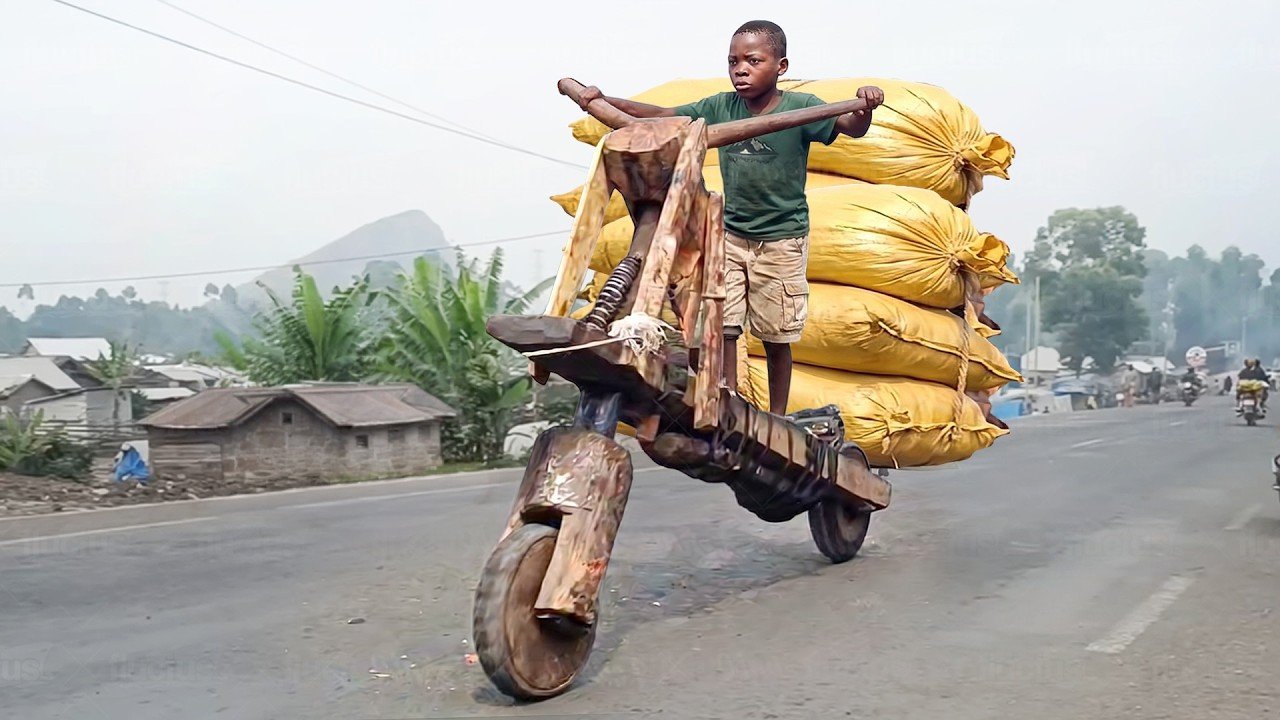
In the rugged, volcanic landscape of eastern Democratic Republic of the Congo, an unassuming vehicle rules the roads. Known locally as the chukudu, this giant, handcrafted wooden scooter serves as the ultimate workhorse of the city of Goma and the surrounding North Kivu province. Built entirely out of natural timber, scrap rubber, and basic hardware, the chukudu costs a fraction of any motorized vehicle, yet it regularly carries heavier loads than most commercial pickup trucks. The story behind this invention is a fascinating tale of human ingenuity, born from necessity during times of extreme economic hardship and conflict.
The history of the chukudu dates back to the 1970s, during the dictatorial reign of Mobutu Sese Seko, when the Congolese economy collapsed and local infrastructure disintegrated. Farmers living in the fertile highlands around Mount Nyiragongo desperately needed a way to bring hundreds of pounds of agricultural produce downhill to the markets of Goma. With fuel prices soaring, trucks virtually nonexistent, and roads destroyed by volcanic rock, locals turned to local woodcraft. They engineered a heavy-duty, two-wheeled scooter made almost completely out of mumba and eucalyptus hard wood, capable of navigating treacherous terrain without relying on a single drop of gasoline.
At first glance, a chukudu looks like a oversized toy scooter, but it is actually a masterful piece of practical engineering. Measuring around 6.5 feet long, the chassis features a wide central wooden deck, broad handlebars, and a padded knee-rest for the driver. Local carpenters hand-carve the wooden wheels, which are then wrapped tightly in recycled strips of discarded rubber tires to act as long-lasting treads. To handle Goma’s notoriously rough, lava-paved roads, craftsmen fit the front handlebars with heavy metal springs or tensioned rubber bands that function as makeshift suspension systems.
Despite its rustic materials, the load-bearing capacity of a chukudu is astonishing. A standard wooden scooter can carry up to 1,000 pounds (450 kg), while customized extra-large models are capable of hauling an incredible 1,800 pounds (800 kg). Operators, known as chukudeurs, use them to transport massive bags of potatoes, charcoal, timber, building materials, and fuel cans across the province. On flat terrain or mild inclines, drivers rest one knee on the padded deck and push off the ground with their other leg; on steep downhill descents, they stand fully on the frame and use a foot-operated rubber pad pressed against the rear tire as a manual brake.
The economic impact of these handmade machines is life-changing for the local population. In a region where a vast majority of the population lives on less than two dollars a day, constructing a brand-new chukudu costs roughly $50 to $150 in raw materials and takes about three days of labor. A dedicated chukudeur can earn anywhere from $10 to $20 per day hauling cargo. This means an operator can pay off the initial investment within a few months, turning the low-cost wooden scooter into one of the most reliable pathways out of extreme poverty.
Beyond its economic value, the chukudu has evolved into a deeply cherished symbol of pride, self-reliance, and cultural identity for the people of eastern Congo. Unlike imported trucks or expensive motorbikes, the chukudu is built entirely by local hands using local resources. Its central role in daily life is celebrated throughout the region—Goma even features a monumental golden statue of a chukudu in the middle of a major city roundabout, honoring the humble wooden scooter as the true backbone of the regional economy.