June 21, 2026,
The global scientific community celebrates a landmark achievement in space exploration, as new research confirms that Japan’s ball-shaped lunar rover, SORA-Q, successfully completed the world’s first fully autonomous exploration of the Moon’s surface . This palm-sized marvel, officially designated as the Lunar Excursion Vehicle 2 (LEV-2), was deployed from the Smart Lander for Investigating Moon (SLIM) in January 2024. Its success, published in the journal Science Robotics, has not only rewritten the rulebook for space robotics but has also proven that even the smallest machines can accomplish the most monumental tasks .
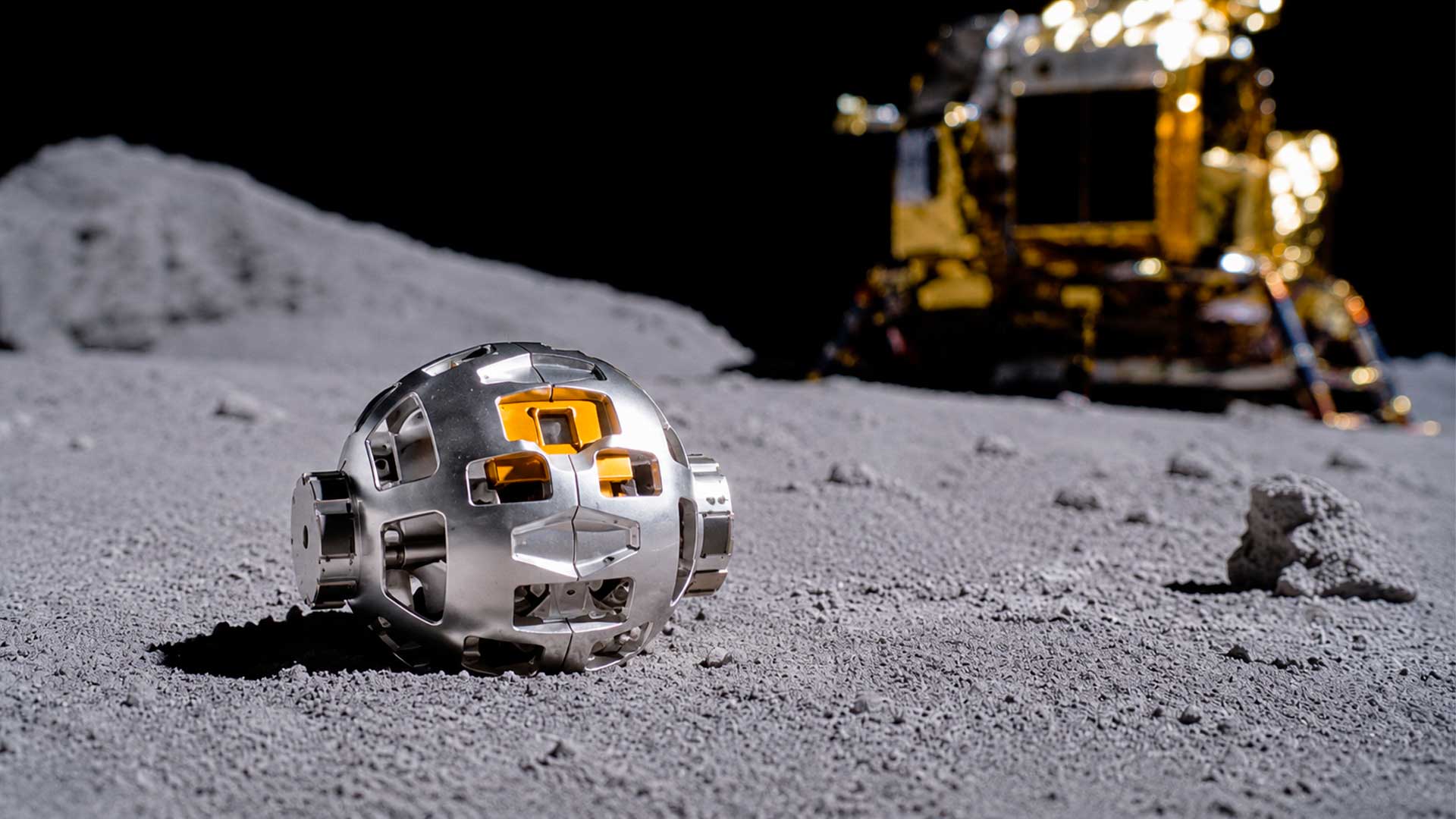
The story of SORA-Q is one of ingenious engineering, where inspiration came from an unlikely source: children’s toys. The Japan Aerospace Exploration Agency (JAXA) co-developed this tiny explorer alongside TOMY Company, the creators of the Transformers franchise, as well as Sony Group and Doshisha University . Weighing a mere 250 grams and measuring just 8 centimeters in diameter, the rover was designed to be a sphere for its journey to the Moon, ensuring it survived the violent vibrations of launch . Upon reaching the lunar surface, it performed a spectacular transformation.
The metallic ball cracked down the middle, its two halves extending outward to become eccentric wheels, while a small tail deployed from the rear to stabilize its movements and a camera popped up from its core . This mechanized “birth” allowed the robot to waddle, roll, and “butterfly” across the harsh, dusty regolith, showcasing a unique mobility system that allowed it to navigate slopes up to 15 degrees .
The mission’s primary objective was to demonstrate that ultra-small, low-cost robots could function as autonomous explorers, and SORA-Q exceeded all expectations . After being released from the lander, the rover did not rely on commands from Earth. Instead, it utilized a fully autonomous control system to activate itself, stabilize its posture, and begin its mission . It then made history by navigating away from the lander, capturing images, and wirelessly transmitting the most valuable data via a local mesh network to its companion rover, LEV-1, which acted as a telecommunications relay to Earth .
Telemetry data confirmed that SORA-Q operated for at least 108 minutes on the lunar surface, during which it performed onboard image processing 240 times . Even more remarkably, when the rover detected attitude anomalies during its traverse, it autonomously executed recovery sequences without any intervention from ground control, proving its resilience in the face of the unknown .
This extraordinary feat of autonomy was crucial not just as a test, but as a mission-saver for the entire SLIM project. The primary lander, nicknamed the “Moon Sniper” for its precision landing technology, had suffered an engine failure during its descent and ended up flipped upside down on the lunar surface, with its solar panels facing away from the sun . Its fate hung in the balance. However, SORA-Q was able to roll to a vantage point and capture the first definitive photographic proof of SLIM’s orientation . Daichi Hirano, a JAXA scientist who designed the rover and led the study, stated, “The palm-sized rover accomplished autonomous lunar exploration by navigating around the SLIM lander, capturing images of both the SLIM lander and its environment and transmitting selected images through wireless communication on the lunar surface,” .
This image was the key that allowed engineers to calculate when the sun’s angle would hit the inverted solar cells, ultimately enabling them to revive the lander and salvage the mission. Hirano and his team further emphasized the broader potential, writing, “Although the capabilities of an individual small rover are inherently limited, the results highlight the potential of such platforms … as independent explorers, capable of accessing environments beyond the reach of a primary large spacecraft,” .
The analysis of the two images captured by SORA-Q provides tangible evidence of its capabilities. The first image, taken by the front camera, clearly shows the lander and its surroundings, while a newly released second image, captured by the rear camera, provides further critical context. By comparing these images, researchers determined that the rover moved approximately 0.13 meters and rotated about 180 degrees between the two shots, confirming that the innovative transforming and eccentric wheel mechanisms effectively allowed it to traverse the soft lunar soil . The research team noted that the rover’s success provides “practical guidance for the design and operation of next-generation distributed space robotic systems,” and added that “in the long term, this approach may enable more flexible, robust, and cost-effective planetary exploration missions,” .
The success of SORA-Q heralds a new era of space exploration where small, intelligent robots are the vanguard. The mission demonstrated that low-cost, rapidly developed micro-robots can perform reconnaissance, scout ahead of larger rovers, and access hazardous areas like craters and caves that would be too dangerous for larger systems . Looking to the future, JAXA envisions deploying swarms of these small robots to explore wide areas efficiently, combining them with larger rovers for flexible exploration architectures . Commenting on the potential of such robotic systems, planetary scientist Roger Wiens, who was not involved in the project, noted, “There are not expensive devices. You can have several of them. And if one or two fails, then you still have others,” and speculated that in the future, “we’ll have transformers on various planets and asteroids,” . As the world looks toward establishing a permanent presence on the Moon and venturing further to Mars, the little ball that could has lit the way, proving that great things truly come in small packages .