
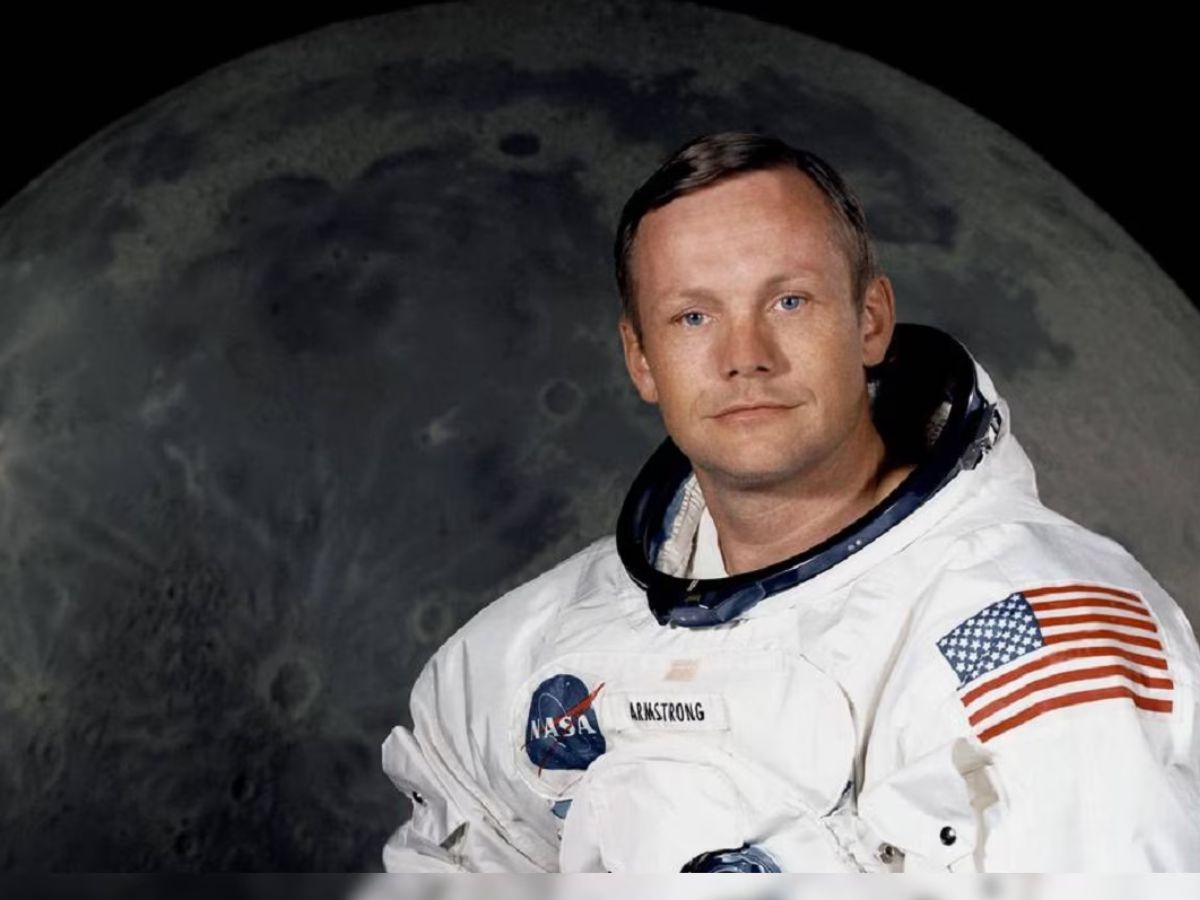
On July 20, 1969, Neil Armstrong descended from the Eagle lunar module and fulfilled humanity’s age-old dream, becoming the first man to set foot on the Moon. However, the path to this historic achievement was not a smooth, triumphant march but a narrow, perilous journey through a gauntlet of mechanical failures and violent conflict, a path on which Armstrong, with legendary coolness, repeatedly cheated death. His life story is a testament to the idea that a man who survives the impossible may very well be destined for the extraordinary.
Before he was an icon of human achievement, Neil Armstrong was a 21-year-old Navy fighter pilot flying missions in the Korean War. In September 1951, during a “bridge-busting” mission over North Korea, his Panther jet was engulfed by heavy flak as he made a low strafing run on a truck convoy. The aircraft was shredded; chunks of wing and tail were torn away, and shrapnel cut through the control cables and severed the hydraulic lines. The plane’s control system was completely knocked out; Armstrong could keep it flying, but it was impossible to land. For over 100 miles, he nursed the crippled jet through Chinese-controlled territory using only the throttle.
Just behind US lines, the jet finally gave out, and Armstrong was forced to eject. This was only his first brush with annihilation in a career marked by what fellow pilots called the “Armstrong Jinx”. Just months later, he smashed his Panther through a taut cable strung across a valley by Chinese forces, an ingenious trap designed to down low-flying aircraft. The impact jolted the jet sideways and nearly sent it crashing into the valley wall, but he again managed to pilot his battered plane back to base. By the end of his 78th combat mission, his plane bore 78 bullet holes, a tangible record of the gauntlet he had run.
After the war, Armstrong became a test pilot, a profession where pushing the limits was the job description and death was a constant, silent partner. In 1957, while grieving the death of his two-year-old daughter Karen from a brain tumor, Armstrong was accepted into the US Air Force’s “Man In Space Soonest” program. This blend of profound personal tragedy and immense professional risk would define his path, a life where the heavens were both his workplace and the source of his deepest pain. As a test pilot, he flew the rocket-powered X-15 to the edge of space, an aircraft that was more a missile with a pilot than a conventional plane. He pushed this aircraft to an altitude of 207,000 feet—almost 38 miles above the Earth—but even the X-15 could not compare to the dangers he would face in the space program.
Armstrong’s first mission in space, Gemini 8 in 1966, almost became his last. During the mission, a thruster on the spacecraft became stuck open, sending the tiny capsule into a terrifying, one-revolution-per-second spin. The g-forces were immense, threatening to cause the astronauts to black out and the spacecraft to tear apart. With supreme composure, Armstrong shut down the primary system and used a backup set of thrusters to regain control of the ship, executing an emergency landing in the Pacific Ocean and saving the crew from certain death. This moment of crisis showcased the unflappable demeanor and technical brilliance that would make him the ideal commander for the first lunar landing.
Even his training for the Moon landing was a fight for survival. To prepare for the delicate descent to the lunar surface, he flew the Lunar Landing Research Vehicle (LLRV), a notoriously dangerous machine that was described as a flying bedstead. In 1968, one of these training vehicles rolled out of control. Armstrong was forced to eject from the craft, his parachute opening barely 100 to 200 feet from the ground. Displaying the same matter-of-fact attitude to danger that defined his career, Armstrong reportedly survived the crash, dusted himself off, and went straight back to his office to complete his paperwork.
These frequent brushes with violent death were not a sign of carelessness but rather a prerequisite for the job he had been chosen to do. By June 23, 2026, the date of this account, Armstrong’s story is a near-mythic narrative—a chilling reminder that the greatest triumphs in history are often built on a foundation of incredible risk and personal sacrifice. He was a quiet, self-described “white socks, pocket protector, nerdy engineer” who had not only accepted the mortal dangers of his profession but had conquered them time and again.
On July 16, 1969, Armstrong, along with Buzz Aldrin and Michael Collins, launched on the historic Apollo 11 mission. On July 20, 1969, as the world watched, he descended from the Eagle’s ladder and spoke the words that would echo through eternity: “That’s one small step for [a] man, one giant leap for mankind”. The man who had learned to fly at sixteen, who had been shot at over Korea and spun out of control in Earth’s orbit, had finally, and safely, touched another world. His journey proves that the line between a near-death experience and a date with destiny is often a razor’s edge, one that Neil Armstrong crossed many times before making the greatest leap of all.