June 26, 2026
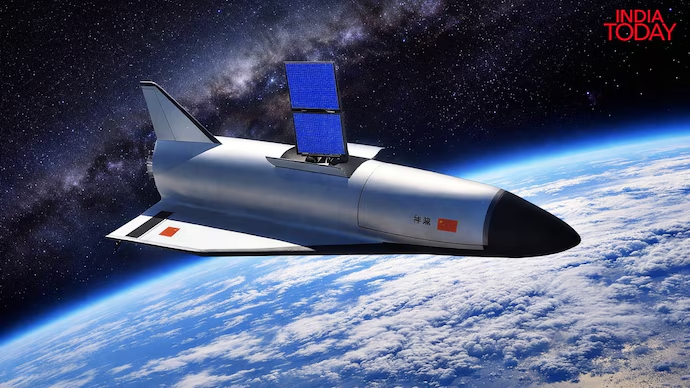
The global space community is focused on a new development in Earth’s orbit involving China’s secretive space plane, Shenlong. Just days prior, on June 22, 2026, the U.S.-based space surveillance firm LeoLabs detected an unidentified object that had been released from the Chinese reusable spacecraft. This event has reignited international speculation and concern regarding the true purpose of the Shenlong program, as experts suggest the newly deployed object could be a spy satellite used for intelligence gathering.
The detection was made public by LeoLabs, which stated that at 02:30 UTC on June 22, 2026, its Kiwi Space Radar in New Zealand first observed an unknown object near the Shenlong spaceplane. Following additional observations and analysis via its global radar network, the company assessed with high confidence that the object had been released from the Chinese spacecraft. The object was subsequently cataloged by the U.S. Space Force, where it is registered as NORAD ID 69673, and has been designated as a “payload” with an estimated mass of 500 kg and a length of two meters. This action is consistent with patterns from Shenlong’s previous orbital missions, where the spaceplane has deployed smaller subsatellites and conducted rendezvous and proximity operations (RPOs) with them.
The ongoing mission, known as CSSHQ4, began on February 6, 2026, with the launch of Shenlong atop a Long March 2F rocket from the Jiuquan Satellite Launch Center in the Gobi Desert. As with all its previous flights, Chinese authorities have not disclosed the specific objectives of this mission, only providing a general statement that it would conduct technological verification for reusable spacecraft to support the peaceful use of space. This lack of transparency, combined with the spacecraft’s capabilities, is what fuels global scrutiny. Shenlong is a product of the China Academy of Launch Vehicle Technology and is widely considered to be a counterpart to the U.S. Space Force’s X-37B spaceplane, a similarly secretive, unmanned, and reusable vehicle. The spacecraft is designed to launch vertically and land horizontally like an airplane, and its exact specifications remain classified.
The release of this mysterious object is alarming to experts for several reasons. First, the Shenlong is known to have conducted RPOs in the past, a capability that has dual-use applications. While such operations can be used for legitimate purposes like satellite repair or refueling, they are also the foundational technology required for inspecting and potentially disabling or interfering with rival nations’ satellites. This is particularly concerning given that China has launched the Shenlong spaceplane and a similar experimental spacecraft within months of each other, demonstrating an accelerated push into advanced space technologies. Observers noted that the Shenlong spaceplane had previously released objects that emitted various signals while in orbit, which could indicate electronic surveillance or communication jamming capabilities.
Second, the release fits a broader pattern of testing and development in China’s space program, which is rapidly advancing its reusable launch technology. While the Shenlong is a state-run program, commercial Chinese space companies are also making significant strides. For instance, LandSpace plans new tests for its reusable Zhuque-3 rocket, and the commercial company CAS Space successfully completed a suborbital test flight for a recoverable spacecraft in January 2026, demonstrating a national push towards cost-effective and rapid space access. The secretive nature of the Shenlong, which is developed by a state-owned manufacturer that produces both civilian and military space launch vehicles, makes it difficult to separate its technological advancements from military applications.