
July 1, 2026
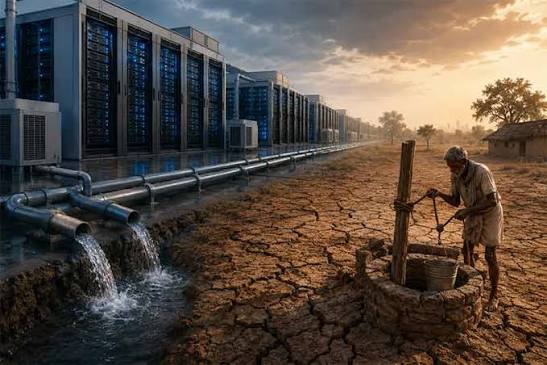
India stands at a critical crossroads, driven by an audacious ambition to become a global AI superpower. This pursuit has triggered an unprecedented digital infrastructure boom, with tech giants and domestic conglomerates pouring billions into establishing the nation as a hub for cloud computing and artificial intelligence. However, beneath the gleaming surface of this technological revolution lies a significant and often overlooked challenge: the immense water cost of powering the future. The central irony of India’s AI dream is that it is being built on the back of a resource the country is rapidly running out of. As data centres multiply to process the enormous computational loads of generative AI, their thirst for water threatens to exacerbate India’s pre-existing water crisis, raising critical questions about sustainability, equity, and the true price of technological leadership .
The scale of AI’s “digital thirst” is staggering. At the heart of this issue are the vast data centres—essentially giant warehouses of servers—that process every AI prompt, from drafting emails to generating images. These facilities generate immense heat and require constant cooling to function, a process that, in India’s warm climate, relies heavily on water-intensive evaporative cooling systems . According to a 2026 report by the Council on Energy, Environment and Water (CEEW), India’s data centres consumed an estimated 150 billion litres of water in 2024-25 . To put this in perspective, a single 100-megawatt (MW) hyperscale data centre can consume around 2 million litres of water per day—equivalent to the daily needs of several thousand households . With the rise of generative AI tripling these requirements, the future projections are alarming: consumption is projected to more than double to a staggering 358 billion litres annually by 2030 . Even a simple interaction with an AI chatbot can carry a hidden water cost, with some estimates suggesting that a 100-word response can require half a litre of water for cooling .
This challenge is compounded by the fact that India’s AI infrastructure is being built in precisely the wrong places. The majority of data centre capacity is concentrated in major urban hubs like Mumbai, Chennai, Hyderabad, Bengaluru, and Noida—regions that are already classified as water-stressed . These are the very cities that have experienced recent, severe water crises, such as Bengaluru’s critical shortage in 2024 and Chennai’s “Day Zero” event in 2019 . An S&P Global study predicts that 60-80% of India’s data centres could face high water stress within this decade . The problem is further intensified by climate change. As a report by the India Meteorological Department (IMD) projects a below-normal monsoon for 2026, the resulting higher temperatures will only increase the cooling demand and water consumption of these already-thirsty facilities . The irony is profound: the AI systems being trained to forecast water scarcity and climate events are themselves consuming vast quantities of the water we are running out of .
The consequences of this imbalance are already being felt on the ground, with experts warning of a political allocation of a scarce common resource that systematically disadvantages the most vulnerable . Rural communities living near data centres are reporting dramatic drops in groundwater levels. In a village in Uttar Pradesh, borewells have had to be deepened by nearly 180 meters to find water . In Hyderabad’s IT hubs, groundwater levels dropped nearly a metre in just three months in early 2026 . A particularly alarming development is the classification of data centres as “essential services” in states like Maharashtra and Telangana. This status grants them uninterrupted access to water and electricity during times of scarcity, meaning that, in a crisis, the cooling of AI servers could be prioritised over the drinking water and sanitation needs of local communities . As one analysis put it, India is using water to build the machines that are warning us that we are running out of it, effectively creating a hierarchy of sacrifice where the burden of AI progress falls on the most water-insecure populations .
Despite these severe warnings, the Indian government and industry are moving forward with aggressive expansion. The country’s data-centre capacity has already quadrupled from 375 MW in 2020 to 1,500 MW in 2025, with industry forecasts predicting it could reach between 8,000 and 10,000 MW by the end of the decade . To fuel this growth, the Union Budget 2026 has extended a tax holiday for foreign companies building data centres in India until 2047 . The AI Impact Summit in February 2026 showcased billions of dollars in new partnerships, including Google’s plans for a major hub near Visakhapatnam and Reliance’s partnership with Meta to build its first AI data centre in the country . This push is despite the fact that India holds 18% of the world’s population but only 4% of its freshwater resources, making it one of the most water-stressed nations on Earth .
However, the problem is not insurmountable. Experts and policymakers are calling for a fundamental shift from unchecked expansion to sustainable development. Proposed solutions include a greater reliance on treated wastewater instead of freshwater, and the adoption of advanced cooling technologies like closed-loop liquid cooling, immersion cooling, and dry-cooling systems which can cut freshwater use by 70% or more . The government is also facing pressure to implement a binding national framework that mandates environmental and hydrological impact assessments before approving large AI projects . The Central government has responded to some concerns by stating that the industry is adopting these advanced solutions, but environmental groups argue this is not enough . A coalition of organizations has appealed to Prime Minister Modi to adopt a “Plan Water First” framework, urging India to lead the world not just in AI capability, but in AI responsibility . For a country already grappling with recurring water shortages, the question is no longer about whether AI will consume water. It is about how much, where, and, most critically, who will bear the ultimate cost of India’s superpower ambitions .