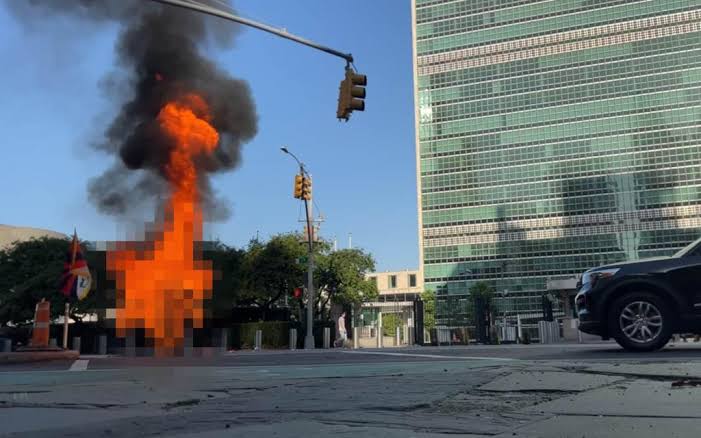
On Thursday evening, July 2, 2026, a tragic and highly symbolic act of protest unfolded directly outside the United Nations headquarters in New York City, drawing immediate international attention to the ongoing geopolitical struggles over Tibet. A 42-year-old Tibetan activist, identified by exile groups and close associates as Lobga Rangzen, set himself on fire at First Avenue and 42nd Street in Manhattan. Carrying a Tibetan flag and leaving behind documentation boldly declaring “CHINA OUT OF TIBET,” Rangzen staged a live appeal for Tibetan independence and unity before succumbing to catastrophic burns at Bellevue Hospital.
An Uber driver who had lived in the United States for approximately two decades, Rangzen was described by fellow activists as a tireless advocate who grew increasingly enraged by Beijing’s tightening grip over his homeland. Because this extreme act occurred on the doorstep of the world’s primary diplomatic body, its international visibility threatens to disrupt China’s foreign policy objectives, intensify scrutiny over its human rights record, and complicate its ongoing efforts to assimilate ethnic minorities.
The timing of Rangzen’s self-immolation is intrinsically linked to a major domestic policy milestone in China: the implementation of Beijing’s controversial “Law on Promoting Ethnic Unity and Progress,” which went into effect this week. This new legislative framework aims to aggressively forge a unified, “shared” Chinese national identity among the country’s 55 recognized ethnic minority groups, including Tibetans and Uyghurs. Human rights organizations, along with the United States and the European Union, have strongly condemned the statute, warning that it essentially provides Beijing with a legal mechanism to eradicate unique cultural, linguistic, and religious identities while punishing dissent even beyond China’s borders. By taking his life in such a public and visceral manner at the UN, Rangzen shattered the carefully constructed narrative of “peaceful liberation” and ethnic harmony that the Chinese Communist Party (CCP) tries to present to the global community.
For China, the primary domestic worry regarding this incident is the potential for internal instability and copycat protests within the Tibet Autonomous Region and surrounding provinces. Historically, self-immolation has been used as a devastating tool of political resistance by Tibetans; since 2009, more than 150 individuals have set themselves on fire inside China to protest against what they view as a repressive Chinese occupation. Beijing maintains a massive, high-tech security apparatus across the Tibetan plateau to suppress any news of these acts and prevent public gatherings. However, when an activist succeeds in making such a profound statement abroad, the news inevitably bypasses Chinese firewalls, filtering back to the mainland. This risks reigniting local unrest, inspiring localized protests, and forcing the Chinese government to expend significant resources on further heavy-handed security crackdowns, digital censorship, and arbitrary detentions to keep the domestic population compliant.
On the geopolitical stage, the incident severely undermines China’s diplomatic soft power and global reputation, particularly at a time when Beijing is trying to position itself as a responsible global leader and mediator. The visual of a man burning himself alive while holding a Tibetan flag outside the UN headquarters serves as an undeniable, shocking reminder of a decades-long conflict that China has desperately tried to sweep under the rug. This highly publicized tragedy forces the international community—specifically Western nations already at odds with China over trade, tech, and security—to push Tibet back onto the active diplomatic agenda. It provides immediate leverage for foreign governments to pressure Beijing during bilateral talks, demand independent access to Tibet for international observers, and potentially introduce fresh targeted sanctions against Chinese officials responsible for enforcing the new ethnic unity laws.
Furthermore, this event is poised to significantly invigorate the global “Free Tibet” movement, which has faced hurdles in maintaining mainstream international media attention in recent years due to other competing global crises. Rangzen’s ultimate sacrifice serves as a rallying cry for the Tibetan diaspora worldwide, bridging generational gaps and mobilizing younger, tech-savvy activists to organize widespread protests outside Chinese embassies and consulates globally. By forcing the UN to confront the issue on its own doorstep, the movement will likely demand formal debates within the UN Human Rights Council. This renewed momentum directly challenges China’s long-term strategy of waiting out the 90-year-old Dalai Lama’s lifetime, exposing the reality that Tibetan resistance is not merely tied to an aging spiritual leader but is deeply embedded in a younger generation of activists willing to take extreme measures to demand sovereignty and human rights.
Ultimately, while Beijing will officially dismiss the incident as an isolated act or attempt to scrub it from domestic internet searches, the ramifications will ripple through China’s statecraft. It directly exposes the volatile friction generated by China’s forced assimilation policies, ensures that the Tibetan issue remains a permanent thorn in Beijing’s international relations, and proves that geographical distance cannot silence the profound desperation of those fighting for their cultural survival.