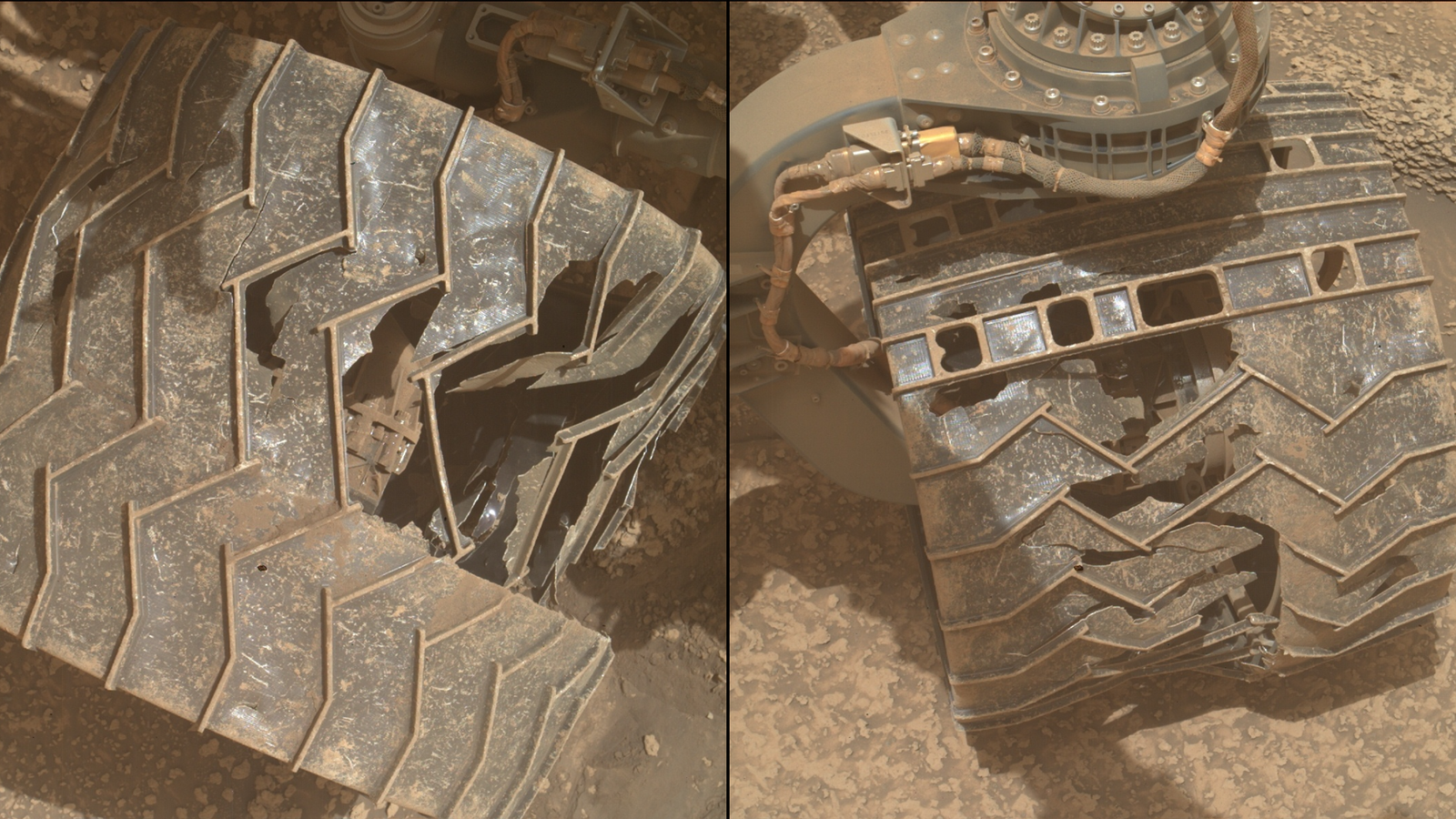
A stark new image beamed back from the surface of Mars has offered a powerful reminder of the extreme conditions faced by humanity’s robotic ambassadors in space. A close-up image captured by NASA’s Curiosity Mars rover has revealed extensive damage to one of its aluminum wheels, showcasing deep cracks and dents that serve as a visual record of the machine’s punishing 14-year journey across the Red Planet’s harsh terrain . The image, taken by the rover’s Mars Hand Lens Imager (MAHLI) camera on July 23, 2026, shows sections of the wheel’s side wall that have been completely breached, highlighting the toll of exploring a landscape filled with sharp rocks and uneven surfaces . This is not a sudden failure but the latest chapter in a long-running story of wear and tear, as the car-sized rover continues to exceed all expectations, having been originally designed for a mission lasting just two years .
The damage to Curiosity’s wheels has been a known concern for NASA engineers for many years. The rover, which landed in Gale Crater on August 5, 2012, weighs over a ton and has traveled more than 20 miles (32 kilometers) across the Martian surface . Its six wheels, made of lightweight aluminum and just 0.75 millimeters thick, feature specially designed treads called grousers for traction but have proved vulnerable to the planet’s sharp, unforgiving rocks . Signs of significant wear and tear were first observed just 14 months into the mission, with sharp rocks puncturing the wheels .
To mitigate further damage, NASA’s Jet Propulsion Laboratory (JPL) engineers have adapted their strategies over the years. These adaptations include altering driving routes to avoid the most damaging terrain and implementing a traction control algorithm that reduces the load on the front wheels by 20% . The rover is also often driven in reverse, a method that puts less stress on the wheels when climbing over rocks . In a 2024 update, NASA noted that the wheels, despite enduring some of the worst abuse on Mars, were “holding up well,” and planetary scientists have even suggested that the rover could continue to drive “perfectly fine” even if the inner portion of a wheel rim were to completely break off .
While the images of the battered wheels are a clear sign of ageing, they are not seen as an immediate threat to the mission’s success. NASA and JPL use the rover’s onboard cameras, including the MAHLI, for regular health checks, and these inspections show that the rover remains scientifically robust, powered by a radioisotope generator system that could sustain it for many more years . The deep cracks and metal fatigue are, in a sense, a testament to the incredible endurance of a machine that was never expected to last this long. Even as Curiosity shows its age, it continues its primary mission: ascending the foothills of Mount Sharp to investigate the geological layers and search for clues about Mars’ ancient history, a mission it has been diligently carrying out for well over a decade .
The recent wheel inspection comes as Curiosity has also been making headline-grabbing scientific discoveries. This year, the rover detected the most complex organic molecules ever found on Mars—long-chain carbon compounds containing up to 12 atoms—in ancient rock samples from the “boxwork” formations . This discovery suggests that Mars preserved more advanced carbon chemistry than previously expected. Furthermore, the rover has been exploring a geological boundary between smooth and rough terrain, using its full suite of instruments to study the planet’s present environment and its deep past .
Despite the visual evidence of wear on its wheels, the Curiosity mission stands as a monumental success of engineering and science, having definitively proven that Gale Crater once contained conditions that could have supported microbial life . As it continues to navigate the rugged Martian landscape with its cracked but resilient wheels, Curiosity is not only providing invaluable data about the Red Planet but is also paving the way for future human exploration, one damaged but determined rotation at a time