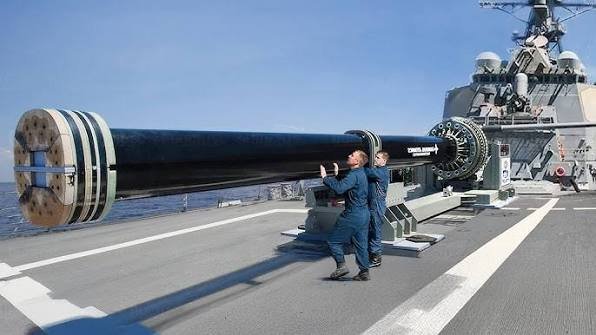
The United States military has reignited its ambitious pursuit of next-generation electromagnetic weaponry, recently conducting a new series of tests on its advanced railgun system. After the program was officially shelved and funding redirected in the 2022 budget, the U.S. Navy signaled a significant shift in strategy by quietly resuming live-fire tests . This renewed activity, confirmed by credible defense sources, indicates that the electromagnetic railgun is no longer viewed as a failed science project but as a potentially pivotal technology in future high-end conflicts.
The tests mark a critical re-evaluation of a weapon that has long been plagued by technical hurdles, refocusing its purpose from a direct-fire naval gun to a testbed for foundational technologies essential to the Pentagon’s wider strategic goals. The experimental firings were conducted at the White Sands Missile Range in New Mexico, under the purview of the Naval Surface Warfare Center and in collaboration with the Joint Hypersonics Transition Office, signaling a deep integration of the railgun’s data with the development of hypersonic weaponry . This effort is not simply about reviving an old prototype; it represents a sophisticated attempt to harness the extreme physics of electromagnetic launch to support the Pentagon’s primary strategic priority—the rapid development of hypersonic strike capabilities .
The core of this technological revival lies in the railgun’s ability to use electromagnetic force—rather than chemical explosives—to launch projectiles at staggering velocities. This is a fundamental shift from traditional artillery, which relies on gunpowder. By generating a massive electromagnetic field, the railgun can propel a non-explosive projectile at speeds reaching Mach 7, or approximately 3,500 meters per second . This extreme velocity translates to immense kinetic energy upon impact, offering a way to destroy targets through sheer force rather than the explosive warheads of conventional missiles. This capability is crucial in a modern combat environment where adversaries field vast swarms of cheap drones and supersonic anti-ship cruise missiles.
The railgun provides a solution to a critical economic equation; while a single intercepting missile can cost millions of dollars, an electromagnetic railgun round is significantly cheaper, potentially costing just thousands of dollars, allowing navies to defeat expensive threats without depleting their limited and costly missile magazines . The recent tests at White Sands were specifically designed to collect data on “hypervelocity projectile dynamics,” focusing on the immense acceleration forces and the thermal and structural stress inflicted on the rails during the launch process . The data gathered is essential for overcoming the primary engineering obstacles that have historically grounded the program: the rapid erosion of the rails, the immense power demands, and the massive thermal management required to sustain a firing rate . For the weapon to be viable, it must achieve “shot-to-shot stability” and prove it can be maintained on a moving warship over extended deployments, not just in a lab .
The path to a deployable weapon system, however, is still fraught with complex integration issues that the new tests aim to resolve. For a railgun to function, it requires a surge of energy that is currently beyond the capacity of most existing U.S. Navy ships, with the possible exception of the futuristic Zumwalt-class destroyers, which were designed with an Integrated Power System . The challenge is not just generating the power, but ensuring the ship’s power architecture can feed the gun without crippling other vital systems like radar, propulsion, and combat management computers .
This has led to a more pragmatic shift in the program’s direction. Instead of solely aiming for a stand-alone naval cannon, the current testing phase emphasizes the railgun as a “modality” of energy, exploring how its underlying power-pulsing and switching technologies can be integrated into a broader “kill web” that includes lasers, electronic warfare, and traditional missiles . This renewed research is also driven by international competition, as other nations, including Japan and China, continue to advance their own electromagnetic weapon programs. Specifically, the emergence of Japanese railgun prototypes undergoing sea trials is a powerful incentive for the U.S. to maintain a technological edge in electromagnetic launch technologies . The U.S. Navy’s recent test cycle is thus a critical step to ensure they do not fall behind, providing real-world data to evaluate if the technological readiness justifies a future path to at-sea deployment .