
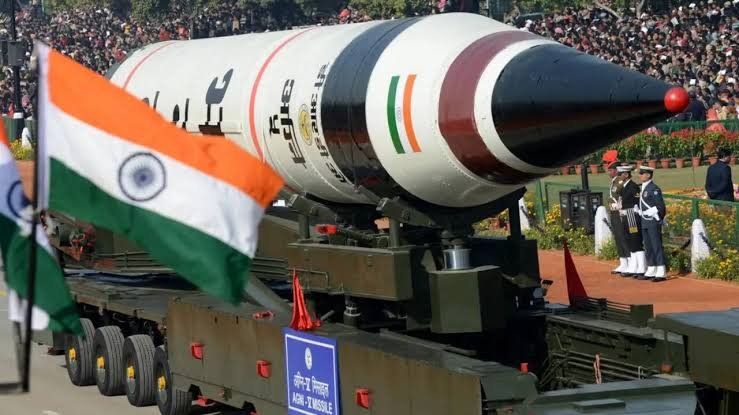
Agni: The Vanguard of Indian Sovereignty
In the landscape of international geopolitics and strategic posture, the Agni missile family represents the bedrock of India’s nuclear deterrence and strategic sovereignty. Named after the sacred elemental god of fire in Hindu mythology, the Agni series consists of surface-to-surface, solid-fueled ballistic missiles developed by the Defence Research and Development Organisation (DRDO). Over four decades, this indigenous missile architecture has evolved from a single technology demonstrator into a sophisticated lineup ranging from short-range tactical vectors to intercontinental ballistic missiles (ICBMs) capable of hitting targets over 5,500 to 7,000 kilometers away.
The strategic necessity of the Agni family stems directly from India’s geopolitical reality. Positioned between two nuclear-armed neighbors—Pakistan to the west and China to the north—India has maintained a strictly declared doctrine of “No First Use” (NFU) paired with a “Credible Minimum Deterrence” policy. To render such a doctrine effective, the nation required a land-based deterrent capable of surviving an initial enemy attack and delivering a devastating second strike. The Agni family has fulfilled this exact operational role, continuously integrating cutting-edge composite materials, advanced inertial navigation, canisterized quick-launch mechanisms, and Multiple Independently Targetable Re-entry Vehicle (MIRV) technology.
Genesis: The IGMDP and the Vision of Dr. A.P.J. Abdul Kalam
The roots of the Agni project trace back to July 1983, when the Government of India sanctioned the landmark Integrated Guided Missile Development Programme (IGMDP) under the visionary leadership of Dr. A.P.J. Abdul Kalam. At the time, India faced severe foreign technological denials, sanctions, and stringent export control regimes such as the Missile Technology Control Regime (MTCR). The goal of the IGMDP was ambitious: achieve complete self-reliance in guided missile technology across five major projects—Prithvi, Trishul, Akash, Nag, and Agni.
Initially designated as a Technology Demonstrator project, the original Agni test vehicle was built to prove crucial concepts in multi-stage solid-and-liquid propulsion systems, atmospheric re-entry heat shields, and closed-loop guidance systems. On May 22, 1989, the first Agni technology demonstrator was successfully test-fired from the Interim Test Range at Chandipur, Odisha. The missile utilized a solid-fuel first stage derived from India’s SLV-3 space launcher combined with a liquid-fuel second stage from the Prithvi missile. The successful launch marked India’s entry into an elite group of nations possessing long-range ballistic missile design capabilities. Realizing the immense strategic implications of the platform, the Indian government subsequently separated the Agni program from the general IGMDP, designating it as a special, fully funded strategic defense initiative.
Evolutionary Spectrum: From Agni-I to Agni-IV
As operational requirements shifted from technology demonstration to deployed combat capability, DRDO systematically designed a tiered family of missiles tailored for specific regional threat profiles.
1. Agni-I: Addressing the Immediate Frontier
Following the 1998 Pokhran-II nuclear tests, India needed a quick-reacting, highly mobile ballistic missile tailored for medium ranges. Developed in record time and first tested in January 2002, Agni-I is a single-stage, solid-fuel road/rail-mobile missile with an operational range of 700 to 1,200 kilometers. Designed primarily for tactical and regional coverage, its lighter mass (12 tonnes) and high mobility allowed rapid deployment via specialized rail launchers.
2. Agni-II: Deep Operational Reach
To project power across deeper operational theaters, DRDO fielded Agni-II, a two-stage, solid-propellant missile with a range of 2,000 to 3,500 kilometers. First tested in April 1999, Agni-II integrated advanced Ring Laser Gyroscope (RLG) navigation systems and high-precision terminal guidance, allowing the Strategic Forces Command (SFC) to maintain a standing deterrent across broader geographical spans.
3. Agni-III and Agni-IV: High Payload and Composite Breakthroughs
With Agni-III (tested in 2006) and Agni-IV (tested in 2011), Indian missile architecture underwent a fundamental technological leap.
-
Agni-III featured a shorter, wider fuselage optimized for underwater/sub-surface derivative designs and multi-stage solid propulsion, boasting a range of 3,000 to 5,000 kilometers with a 1.5-tonne payload capacity.
-
Agni-IV introduced lightweight composite rocket motor casings, micro-inertial navigation systems (MINGS), and digital flight control computers capable of enduring extreme atmospheric temperatures exceeding 3,000°C during re-entry. With an operational range of 3,500 to 4,000 kilometers, Agni-IV significantly enhanced the survivability and accuracy of India’s medium-to-long-range deterrent matrix.
| Missile Variant | Stage Configuration | Propellant Type | Operational Range | Key Technological Feature |
| Agni-I | Single-stage | Solid fuel | 700 – 1,200 km | Rail/Road mobility for regional deterrence |
| Agni-II | Two-stage | Solid fuel | 2,000 – 3,500 km | Ring Laser Gyroscope (RLG) navigation |
| Agni-III | Two-stage | Solid fuel | 3,000 – 5,000 km | High payload capacity & wide body design |
| Agni-IV | Two-stage | Solid fuel | 3,500 – 4,000 km | Composite casings & micro-navigation systems |
| Agni-P (Prime) | Two-stage | Solid fuel | 1,000 – 2,000 km | Next-gen canisterized launch & high maneuverability |
| Agni-V | Three-stage | Solid fuel | 5,500 – 8,000 km | Intercontinental reach & MIRV capability |
The Intercontinental Leap: Agni-V and Canisterization
The operational debut of Agni-V in April 2012 represented a monumental shift in Asia’s strategic balance. Weighing 50 tonnes and standing 17.5 meters tall, Agni-V is a three-stage, solid-fueled missile capable of hitting targets at distances exceeding 5,500 to 8,000 kilometers, placing the entire expanse of Asia, parts of Europe, and critical adversary infrastructure within striking distance. Flight tests verified terminal re-entry speeds exceeding Mach 24 (~29,400 km/h), making interception virtually impossible for contemporary ballistic missile defense (BMD) systems.
Beyond pure range, the defining breakthrough of Agni-V is its hermetically sealed canister launch system mounted on heavy multi-axle Transporter Erector Launchers (TELs). Canisterization provides three major strategic benefits:
-
Long-Term Storage and Reliability: The missile remains housed inside a climate-controlled, protective composite tube, safeguarding the solid propellant and sensitive electronics from environmental degradation over years of storage.
-
Reduced Launch Reaction Time: Pre-loaded inside a canister, the missile can be moved, raised, and fired within minutes of receiving authorization, radically shortening reaction windows during crisis scenarios.
-
Enhanced Mobility and Stealth: Canisterized units can navigate national highways and off-road terrain undetected, complicating enemy satellite tracking and counter-battery targeting.
Modern Frontier: Agni-Prime and Mission Divyastra (MIRV Technology)
In recent years, DRDO has focused on two transformative pillars: modernized propulsion/guidance for short-to-medium systems, and Multiple Independently Targetable Re-entry Vehicles (MIRVs) for intercontinental platforms.
Agni-P (Prime): The Next-Gen Medium-Range Vector
First tested in June 2021, Agni-P is a modern two-stage solid-fuel missile designed to replace legacy Agni-I and Agni-II systems. Incorporating composite motor casings, advanced maneuvering thrusters, and canisterized road mobility, Agni-P weighs half as much as older models while delivering significantly higher accuracy and dynamic evasion capabilities against enemy air defenses.
Mission Divyastra: Crossing the MIRV Threshold
On March 11, 2024, India conducted the landmark maiden flight test of the Agni-V equipped with MIRV technology under “Mission Divyastra”. In this mission, a single Agni-V missile deployed multiple independently targetable reentry vehicles, each loaded with dummy warheads, releasing them at precise velocities and vectors to hit geographically separated targets hundreds of kilometers apart.
By successfully mastering MIRV technology, India joined a select group of global powers—the United States, Russia, China, France, and the United Kingdom—possessing operational MIRV capability. MIRVs multiply deterrence efficiency by ensuring that a single launch vector can neutralize multiple target nodes while swamping enemy missile defense systems with a combination of active warheads and electronic decoys.
Strategic Impact: Securing the Second-Strike Triad
The maturation of the Agni missile family completes the land-based leg of India’s strategic nuclear triad, complementing air-delivered gravity bombs and sea-based Submarine-Launched Ballistic Missiles (SLBMs like the K-series).
In accordance with India’s nuclear doctrine, the Agni force structure is managed by the Strategic Forces Command (SFC). The high survivability, rapid mobility, extended range, and precision targeting of the Agni platform ensure that any potential adversary attempting a preemptive nuclear strike would face guaranteed, catastrophic retaliation. From Dr. Kalam’s early experiments in Chandipur to the multi-warhead capabilities of Mission Divyastra, the Agni story remains one of India’s definitive technological triumphs—a testament to domestic scientific capability that underpins national defense autonomy.