
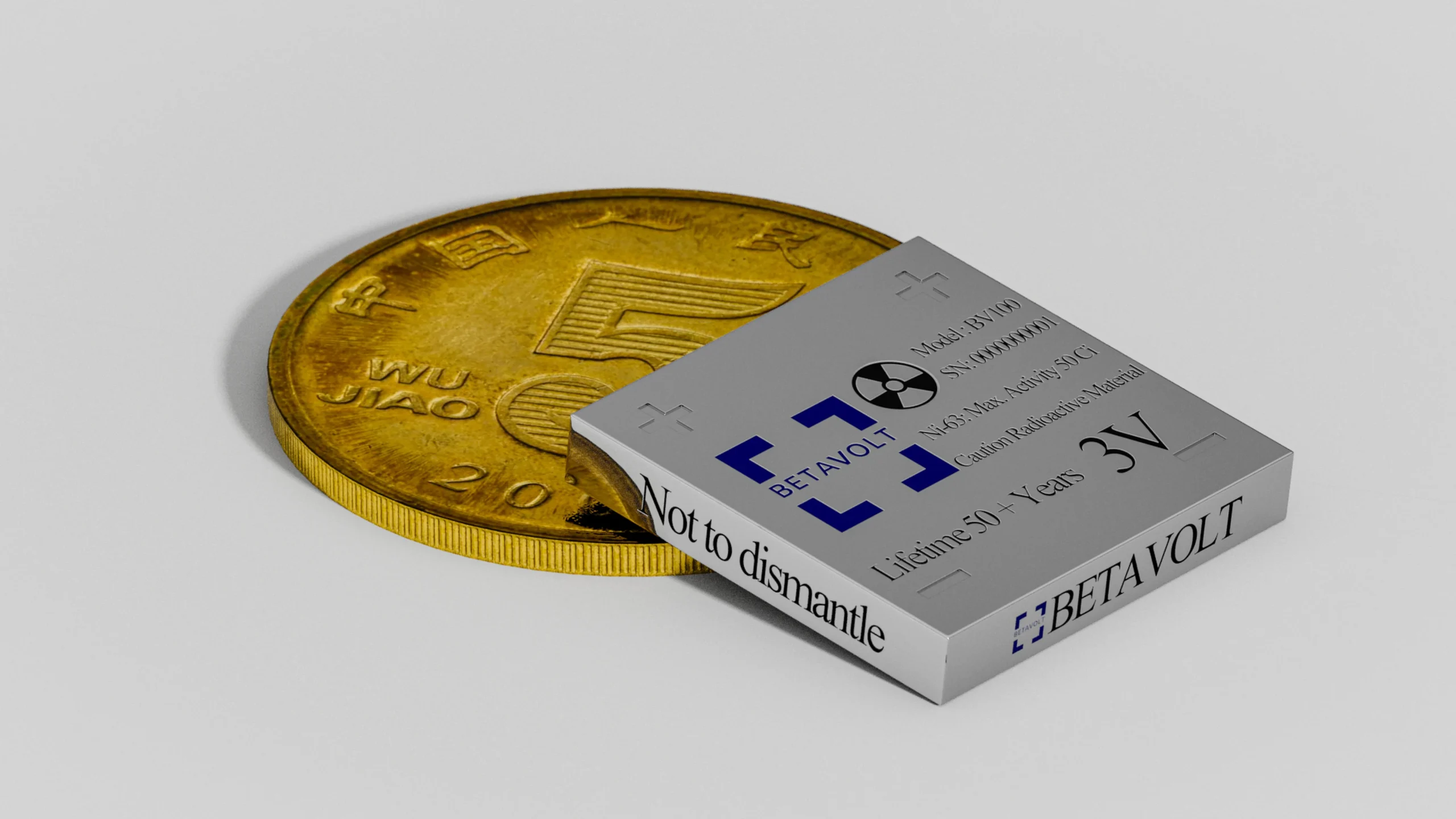
In a development that sounds like it is pulled from the pages of science fiction, China has achieved a remarkable breakthrough in energy technology by building a nuclear battery smaller than a coin that can run for decades without ever needing a charge. The device, known as the BV100, is the creation of Beijing-based company Betavolt New Energy Technology and marks a significant step in the miniaturization and commercialization of atomic energy . This technological leap forward, which has garnered global attention, signals the beginning of a new energy race and could revolutionize a host of industries by providing a power source that outlasts the devices it powers .
The secret behind this groundbreaking battery lies in its innovative use of betavoltaic technology. Unlike traditional chemical batteries that store energy and degrade over time, the BV100 generates electricity by harnessing the energy released from the radioactive decay of a nickel-63 isotope. This isotope decays into a stable, non-radioactive form of copper, which minimizes environmental impact and reduces the need for costly recycling processes . The BV100’s design is a marvel of engineering, featuring a two-micron-thick sheet of nickel-63 sandwiched between two ultra-thin diamond semiconductor converters, which serve as the energy conversion layer . As the nickel-63 decays, it releases beta particles (fast-moving electrons). These electrons interact with the diamond semiconductor, creating an electrical current in a process analogous to how a solar panel converts light into electricity . The entire battery measures just 15 x 15 x 5 millimeters, making it smaller than a typical coin, yet it represents the culmination of research into nuclear batteries that began as far back as the 1950s .
The BV100 is designed to be exceptionally durable and safe. It boasts an energy density more than 10 times that of ternary lithium batteries and can operate reliably in extreme temperatures, ranging from -60°C to 120°C . Furthermore, the company states that the battery is safe from the risk of fire or explosion, even if punctured, and produces no external radiation, making it suitable for use in close proximity to humans . However, the current prototype, the BV100, generates a power output of just 100 microwatts at 3 volts, a tiny amount insufficient for power-hungry devices like smartphones or laptops . For context, this is far less than the several watts required to charge a typical mobile phone. Betavolt has acknowledged this limitation and is already working on a more powerful 1-watt version, with plans for future higher-powered models using different isotopes .
Despite its current power constraints, the implications of a 50-year, maintenance-free power source are profound. Its most immediate and practical applications are in specialized fields where longevity and reliability are far more critical than raw power. This includes medical implants like pacemakers, which could last a patient’s lifetime without the need for risky replacement surgeries, and aerospace equipment and satellites, where replacing a battery is often impossible . Other potential uses include environmental sensors in remote locations, deep-sea monitoring devices, micro-robots, and AI hardware, all of which stand to benefit from a power source that can operate for decades without human intervention . The battery’s modular design, which allows multiple units to be connected in series or parallel to scale up power, opens up a wide array of future possibilities .
The development of the BV100 places China at the forefront of a global race to commercialize nuclear battery technology . While the fundamental concept is not new, China’s ability to produce the necessary materials, particularly carbon-14 for related projects, and to scale manufacturing gives it a significant advantage . However, competition is fierce, with researchers in the United Kingdom developing a carbon-14 diamond battery that could theoretically last for millennia, and the U.S. company City Labs working on its own betavoltaic batteries for pacemakers . While the dream of a smartphone that never needs charging remains on the horizon, China’s miniature nuclear battery is a concrete and powerful step toward a future where the need to recharge or replace a power source becomes a thing of the past for many of the technologies that underpin modern life .