
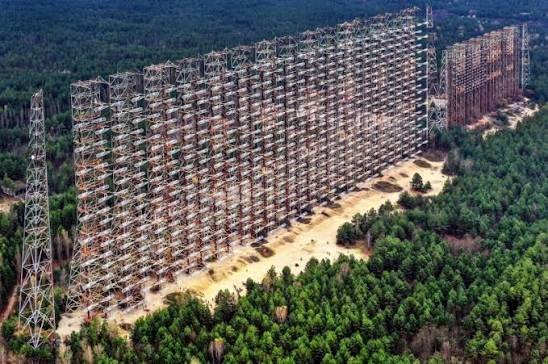
Deep within the radioactive heart of the Chernobyl Exclusion Zone, shrouded by the encroaching Polissya forest, lies a colossal metal behemoth—a ghost of the Cold War known as the Duga radar. This is not merely an abandoned structure; it is a monument to a technological arms race, an enigmatic source of global disruption, and a silent witness to one of history’s worst nuclear disasters. For a brief but impactful period from 1976 to 1989, this system was one of the most powerful and mysterious military installations on Earth, its signal reaching around the world and earning it the chilling nickname, the “Russian Woodpecker” .
The Duga radar was the Soviet Union’s ambitious answer to the threat of intercontinental ballistic missiles (ICBMs) during the Cold War. In the 1960s, Soviet early warning systems relied on line-of-sight radars that were insufficient for providing the critical early warning needed to intercept an incoming attack . To counter this, Soviet scientists began developing an over-the-horizon (OTH) radar, a system that could detect missile launches from thousands of kilometers away. An OTH radar works by bouncing high-frequency radio waves off the ionosphere, allowing it to see far beyond the curvature of the Earth . Two primary Duga systems were built: a prototype near Mykolaiv in Ukraine and, most famously, the massive operational array near Chernobyl, with its transmitter and receiver stations located approximately 60 kilometers apart .
What made the Duga radar truly legendary was its sheer, almost incomprehensible scale and power. The main antenna array is a monstrous steel structure stretching nearly half a kilometer (about 460-500 meters) long and standing around 150 meters tall—taller than the Great Pyramid of Giza . Its construction consumed an estimated 100,000 tons of metal and cement, and its operational cost is rumored to have rivaled that of the entire Chernobyl nuclear power plant itself . The system was so powerful that its peak output was estimated at a staggering 10 megawatts, requiring its own dedicated power station to operate . To protect this technological marvel, the Soviet military maintained a cloak of absolute secrecy, erasing the town from maps under the ambiguous code name “Chernobyl-2” and deploying thousands of soldiers to guard its perimeter .
While its physical presence was a secret, its signal was anything but. On July 4, 1976, a strange, new signal began appearing on shortwave radio bands across the globe . It was a sharp, repetitive tapping sound at a frequency of about 10 Hz, which led amateur radio operators to dub it the “Russian Woodpecker” . This signal was incredibly disruptive, randomly hopping frequencies and effectively jamming civilian radio, aeronautical, and maritime communications worldwide, sparking thousands of complaints . Its true nature became a global mystery, sparking wild theories that ranged from Soviet mind-control and weather-altering experiments to a secret submarine communication system . For years, the Soviet Union refused to acknowledge the signal’s existence, while NATO intelligence, having photographed the facility, gave it the reporting name “STEEL WORK” or “STEEL YARD” . It wasn’t until after the fall of the Soviet Union that the Duga’s true purpose as an OTH radar was publicly confirmed . Despite the mystery, the signal eventually ceased in 1989, as technological advancements, particularly in satellite early-warning systems, made the energy-guzzling Duga obsolete .
The story of the Duga radar is tragically and inextricably linked to the Chernobyl nuclear disaster of 1986. When Reactor 4 exploded, the Duga-1 installation, located within the exclusion zone, was directly impacted. Despite the disaster, it is believed that the radar continued to operate for a short period, drawing power from the still-functioning reactors at the plant—a decision that would have required personnel to work in a highly radioactive environment . Ultimately, the combination of the nuclear fallout, which made dismantling the structure a monumental and hazardous task, and the end of the Cold War led to its decommissioning. The massive steel skeleton was simply left to rust where it stood, too costly and dangerous to remove .
Today, the Duga radar is a haunting relic. Its rusting, skeletal frame stands as a silent sentinel in the irradiated forest, a powerful symbol of the immense cost and inherent risks of the Cold War’s technological ambitions. It has since become a site of dark tourism, an eerie destination for explorers and a stark, unforgettable backdrop in popular culture, notably in the video game franchise S.T.A.L.K.E.R. . The story of the Duga radar is more than just a tale of Cold War engineering; it is a narrative of global disruption, shrouded secrecy, and the catastrophic intersection of military might and environmental disaster, leaving behind a colossal ghost in the woods of Chernobyl.