
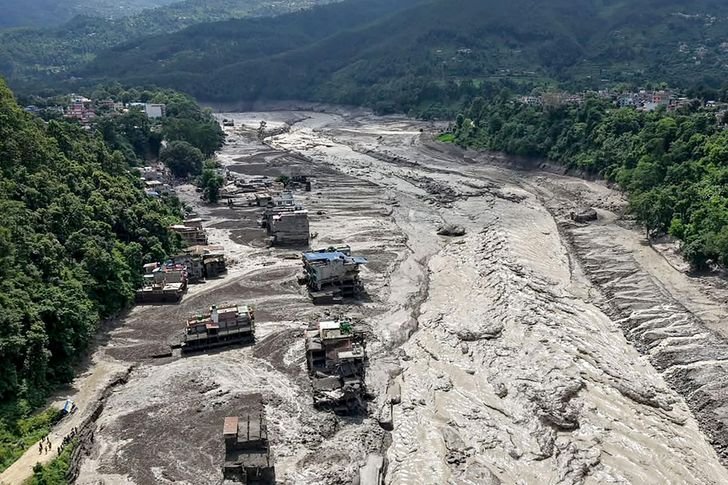
As of August 29, 2026, the catastrophic flash floods and landslides that have devastated the Nepal-China border region represent one of the most severe humanitarian crises in Nepal’s recent history. The death toll has tragically climbed to at least 584, with a staggering 2,482 people still reported missing across both sides of the border . Nepal’s disaster authorities have confirmed 579 fatalities within its borders, while China has reported seven deaths in the Tibet Autonomous Region . The number of missing in Nepal nearly doubled to 1,924, and 558 remain unaccounted for in Tibet’s Gyirong County, figures that are expected to rise as rescue teams access more remote and devastated areas .
The primary trigger for this disaster was a massive glacial collapse in the Himalayas on August 26, which unleashed a torrent of water, ice, rock, and debris through the mountain river systems . The US Geological Survey confirmed that this event was not an earthquake, but a sudden glacial break that picked up speed and destructive force as it cascaded down steep slopes, already saturated by the ongoing monsoon season . The wall of water and debris ravaged communities along the Bhotekoshi and Trishuli rivers, obliterating everything in its path . Surveillance footage from the worst-hit Gyirong border crossing complex showed the immense flood engulfing buildings and people, and when Chinese rescue teams finally reached the site on Friday, they found “nothing but ruins” .
Rescue and recovery operations are being conducted under extreme duress, hampered by the widespread destruction of critical infrastructure. The Prithvi Highway, which links Kathmandu to much of the country, as well as countless local roads and bridges, have been swept away or buried under debris . The Rasuwa district, one of the worst-affected areas, has been described as “physically totally disconnected” by Nepal’s information minister, with access only possible by helicopter . Despite these logistical nightmares, rescue teams have managed to save nearly 4,500 people, with Nepal’s Prime Minister confirming over 4,500 rescues . Helicopters have been crucial in these efforts, airlifting stranded survivors and dropping emergency supplies to communities cut off from the outside world . However, many of the missing, including more than 540 foreign nationals, remain unaccounted for, with a large number being Hindu pilgrims from India .
The scale of the disaster extends far beyond the immediate casualties. The International Red Cross estimates that around 93,000 people may have been affected by the floods, as assessments continue in areas that are still hard to reach . Countless homes have been swept away, and survivors are left with nothing. Rescue efforts have been further complicated by the formation of unstable barrier lakes upstream. Officials in Nepal have been monitoring two such lakes, and on Friday, one of them began to overflow, sparking panic and forcing a temporary suspension of rescue operations on both sides of the border . The newly formed lake, holding an estimated three million cubic meters of water and debris, posed a secondary flood threat that authorities warned could be catastrophic . While operations have since resumed after the immediate threat subsided, Chinese government experts have warned that over 100 glacial lakes in the region may be unstable, and Nepal has stated that the flood risk will persist until all the lakes are fully drained .
This ongoing danger of a secondary disaster and the level of destruction has prompted international responses and warnings. South Korea, for example, issued a special travel advisory for the four provinces of Bagmati, Gandaki, Koshi, and Lumbini, advising its citizens to cancel or postpone travel and to move to safer areas . In a move of solidarity, Nepal’s cabinet ministers agreed to contribute one month’s salary to the Prime Minister’s Disaster Relief Fund . The Nepali government has also begun assessing the damage and preparing a rehabilitation package for the affected people and businesses . The tragedy has also highlighted the human cost of these floods; amidst the despair, a mother was reunited with her eight-year-old son who survived by running into a forest and climbing trees as the flood swept through his school .
The full extent of the devastation is still unfolding as authorities work tirelessly to reconcile casualty figures and reach the most isolated communities. The situation remains precarious, with the threat of more floods looming large, underscoring the immense challenges ahead in rescue, recovery, and rebuilding after this monumental disaster.