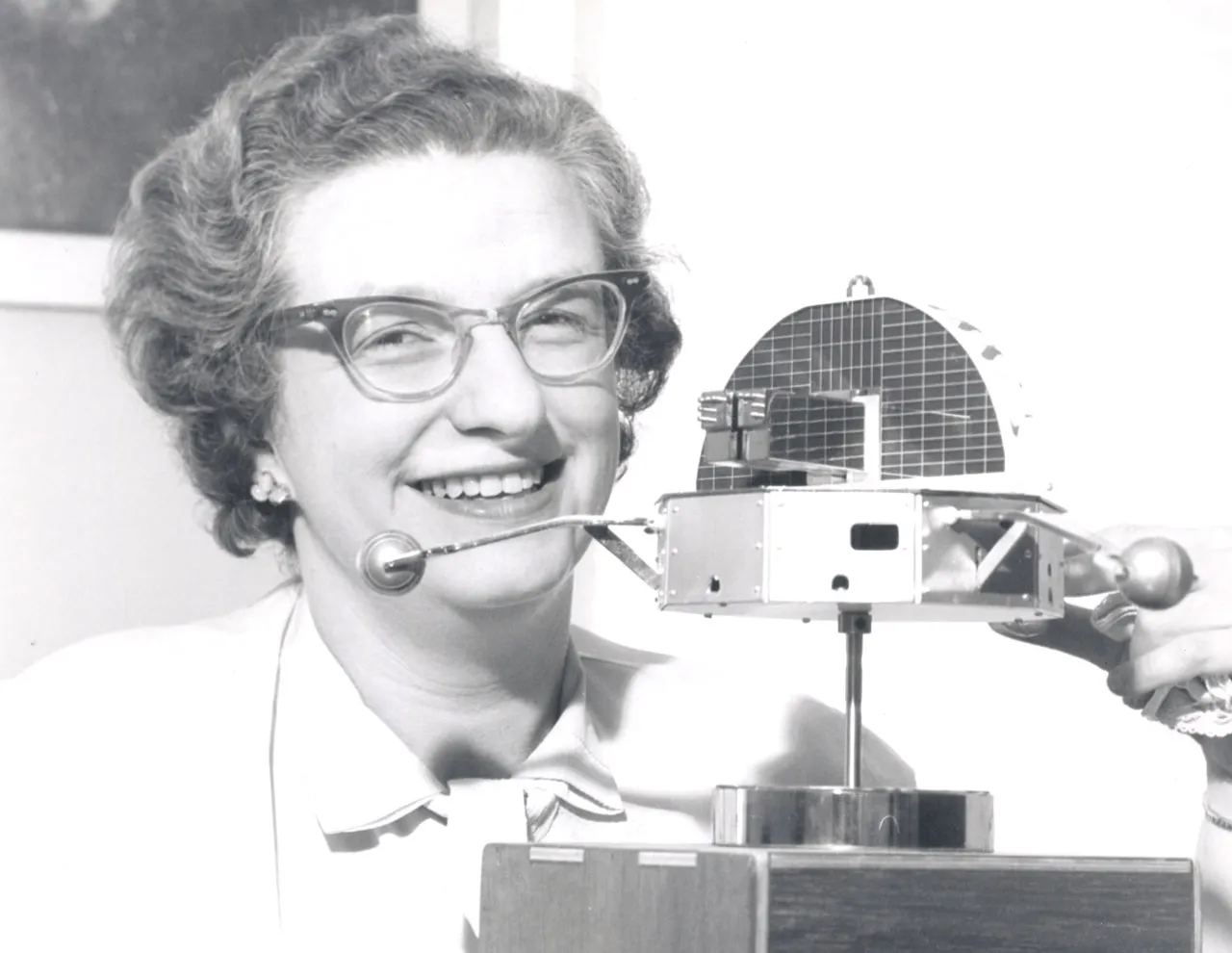
Born on May 16, 1925, in Nashville, Tennessee, Nancy Grace Roman’s journey to the stars began in childhood. By the age of eleven, she had already organized an astronomy club with friends in Reno, Nevada, where the family briefly lived, to learn about constellations from a book. Her mother, Georgia, nurtured this early curiosity by taking her on nature walks, but it was the constellations and the aurora borealis that captivated her most. By seventh grade, she had firmly decided to become an astronomer, a dream she would pursue against nearly all advice. Her high school guidance counselor once asked her, “What lady would take mathematics instead of Latin?” when she requested a second year of algebra. She took the math anyway. This early determination defined her life, as she later joked, “If I hadn’t been stubborn, I would’ve been talked out of it years earlier”.
Roman’s academic journey took her to Swarthmore College, where she earned her bachelor’s degree in astronomy in 1946, followed by a Ph.D. in astronomy from the University of Chicago in 1949. She remained at the University of Chicago for six years, working at the prestigious Yerkes Observatory and observing stars. She made a name for herself with a landmark 1955 paper demonstrating a correlation between a star’s motion through the Milky Way and its chemical composition, providing important evidence for how galaxies evolve. Despite these successes, she recognized that as a woman in academia, she faced an insurmountable ceiling on promotion and tenure. At that time, there was only one tenured female astronomer in the country, and it became evident that her career would be stifled. This realization prompted her to leave for the Naval Research Laboratory in 1955, where she entered the new field of radio astronomy and adapted to an engineering environment, a skill that would prove essential for her future career. During her time there, she became the head of the microwave spectroscopy section.
In 1959, just six months after NASA was formed, Roman was recruited to create the agency’s space-based astronomy program from scratch. She answered the call herself, taking on a responsibility that meant she could no longer do research but would “influence astronomy for decades to come”. She became NASA’s first Chief of Astronomy and its first female executive, later serving as Chief of Astronomy and Solar Physics. In this role, she built the program of astronomical research in space, working to secure budgets, convene experts, set research priorities, and oversee the creation of dozens of science missions. Her role was essentially to serve as the crucial link between scientists, engineers, and the government, managing a significant program of grants to support the astronomical community and planning programs that used satellites, rockets, balloons, and airplanes for research.
Roman’s most enduring legacy, however, is her championing of the Hubble Space Telescope. Over two decades, she devoted herself to securing congressional approval and funding for what was then called the Large Space Telescope. She brought together scientists and engineers, briefed executive branch officials, and lobbied NASA to approve the ambitious project. In her congressional testimony, she famously argued that “for the price of one night at the movies each year, each American would receive 15 years of exciting discoveries” — and she undersold it, as Hubble has now provided over 30 years of discoveries. Her technical acumen and political capability allowed her to detail compelling arguments to both her peers and stakeholders. One of her most significant technical contributions was insisting on installing charge-coupled devices (CCDs) as image sensors, a risky choice at the time that would become the new gold standard for astronomical imaging. For her foundational role in making Hubble a reality, she was given the nickname “Mother of the Hubble” by her successor, Edward J. Weiler. When asked what she thought was Hubble’s most interesting discovery, her reply was “dark energy,” the very mystery that the telescope bearing her name is designed to investigate.
Roman retired from NASA in 1979 but lived to see Hubble’s launch and its many successes. She passed away on December 25, 2018, at the age of 93. In May 2020, NASA announced that its next-generation flagship observatory, previously known as WFIRST, would be named the Nancy Grace Roman Space Telescope in her honor. On August 30, 2026, this observatory is set to launch, continuing her legacy of pushing the boundaries of space-based astronomy and exploring the universe’s deepest secrets.