
Pascal’s Law, also known as the Principle of Transmission of Fluid Pressure, is one of the most fundamental concepts in fluid mechanics and hydrostatics. Formulated by the French mathematician, physicist, and philosopher Blaise Pascal in the 17th century (1647–1648), this law explains how pressure applied to a confined fluid is transmitted uniformly in all directions. Its discovery laid the foundation for modern hydraulics, influencing countless technologies we rely on today, from car brakes to industrial machinery. This article explores Pascal’s Law in depth, covering its statement, derivation, mathematical expression, applications, limitations, and significance in science and engineering.
Pascal’s Law states that when pressure is applied to any part of a confined, incompressible fluid at rest, the pressure change is transmitted undiminished and equally in all directions throughout the fluid, such that the same pressure is exerted on every point of the container’s walls. In simpler terms, a change in pressure at any point in an enclosed incompressible fluid is transmitted equally to all other points in the fluid. For example, if you squeeze a sealed plastic bottle filled with water, the pressure increase is felt everywhere inside the bottle, not just at the point of squeezing. This occurs because fluids are incompressible and cannot be compressed into a smaller volume, so the applied force is distributed evenly.
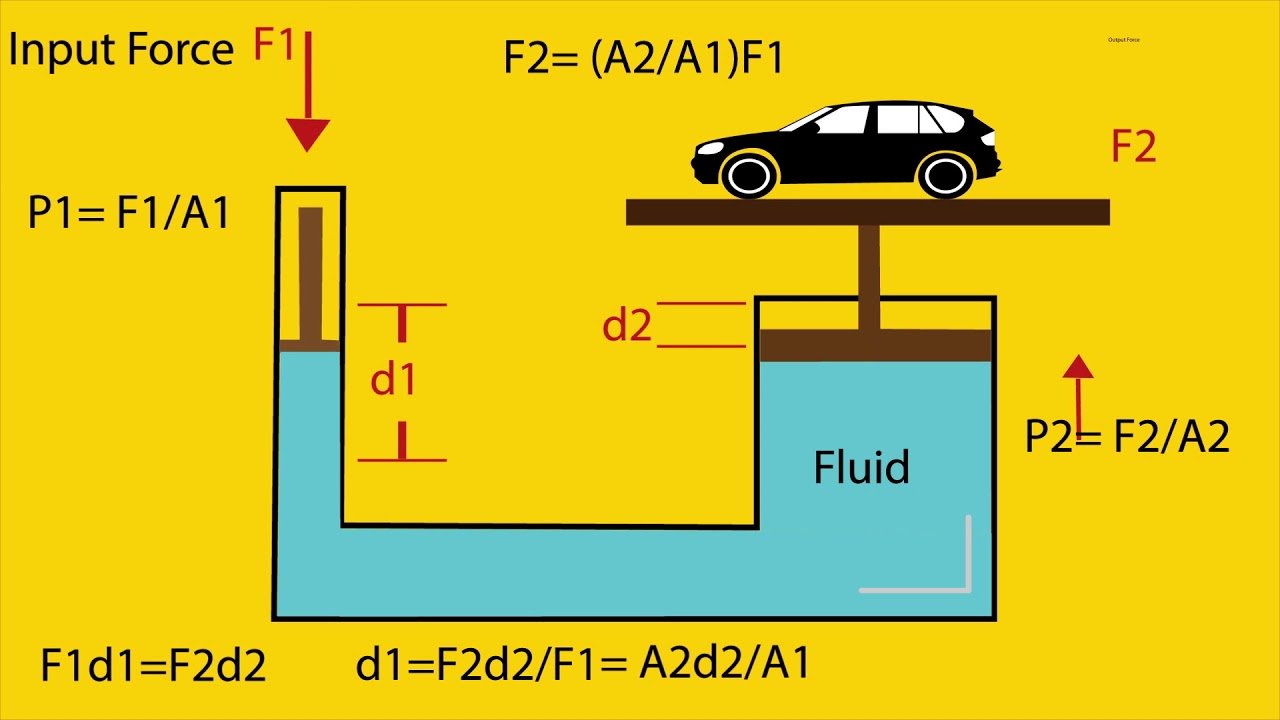
The mathematical expression of Pascal’s Law is straightforward: P = F / A, where P is pressure, F is the applied force, and A is the area over which the force acts. The law also implies that pressure is a scalar quantity, meaning it has magnitude but no direction. Importantly, Pascal’s Law applies only to fluids at rest (static fluids) and incompressible fluids, such as water or hydraulic oil. Gases are generally excluded because they are compressible, though the law can be approximated in some low-pressure scenarios.
To understand Pascal’s Law more clearly, consider a classic example: a container filled with liquid and fitted with two pistons of different sizes. If a small force is applied to the smaller piston, it creates a pressure increase in the fluid. According to Pascal’s Law, this same pressure is transmitted to the larger piston, which then produces a much larger force because force equals pressure multiplied by area (F = P × A). This principle is known as mechanical advantage and is the basis of the hydraulic press, hydraulic jack, and hydraulic lift.
The derivation of Pascal’s Law can be understood through Newton’s laws of motion and the equilibrium of fluid particles. In a confined fluid at rest, the net force on any fluid element must be zero. If pressure were not transmitted equally, a fluid particle would experience an unbalanced force and start moving, violating the condition of static equilibrium. Therefore, pressure must be the same in all directions at a given point in a static fluid, and any external pressure applied is distributed uniformly. This reasoning confirms that Pascal’s Law is a direct consequence of fluid equilibrium.
Key applications of Pascal’s Law are found in numerous everyday and industrial systems. The hydraulic braking system in automobiles is one of the most common examples: when the driver presses the brake pedal, pressure is transmitted through brake fluid to all four wheels, causing the brake pads to clamp down simultaneously. Another major application is the hydraulic jack, used to lift heavy vehicles or machinery with minimal effort. Hydraulic presses used in manufacturing, hydraulic lifts in garages, dentist chairs, excavators, and aircraft landing gear systems all rely on Pascal’s Law. Even water supply systems and firefighting equipment use this principle to transmit pressure efficiently.
However, Pascal’s Law has certain limitations and conditions. It is valid only when: (1) the fluid is incompressible, (2) the fluid is at rest, (3) the container is completely enclosed, and (4) the fluid is homogeneous and continuous. Temperature changes, leakage, air bubbles, and compressibility of gases can affect the accuracy of the law. In real-world hydraulic systems, factors like friction, viscosity, and pressure losses must also be considered, which is why engineers design systems with safety margins and pressure regulation.
The historical significance of Pascal’s Law is immense. Blaise Pascal conducted experiments with barometers and syringes, demonstrating that pressure in fluids behaves uniformly. His work was published in “Treatise on the Equilibrium of Liquids” and laid the groundwork for hydrostatics and fluid dynamics. Later scientists and engineers, including Daniel Bernoulli and Joseph Bramah, expanded on Pascal’s ideas, leading to the Industrial Revolution’s hydraulic innovations. The Bramah Press (1795) was one of the first practical applications of Pascal’s Law, revolutionizing manufacturing and lifting technology.
In modern science and engineering, Pascal’s Law remains a cornerstone of fluid mechanics, mechanical engineering, civil engineering, and biomedical engineering. It is essential in designing hydraulic systems, pneumatic systems, dams, pipelines, and even medical devices like blood pressure monitors and IV drips. Robotics and automation heavily depend on hydraulic and pneumatic actuators based on this principle. Moreover, Pascal’s Law helps explain atmospheric pressure, buoyancy, and pressure distribution in the human body, such as in blood circulation.
In conclusion, Pascal’s Law is a fundamental principle of fluid mechanics that explains how pressure applied to a confined incompressible fluid is transmitted equally in all directions. Its mathematical simplicity (P = F/A) and practical applications make it invaluable in engineering, technology, and daily life. From car brakes to hydraulic jacks, from industrial presses to medical equipment, Pascal’s Law powers countless innovations. Despite its limitations with compressible fluids, it remains a pillar of hydrostatics and a testament to Blaise Pascal’s genius. Understanding this law not only illuminates the behavior of fluids but also highlights how a simple scientific principle can transform technology and society.